EN


Home > > Check Weigher

Precision Weighing: Guarantees product weight accuracy for quality and compliance.
High-Speed Operation: Boosts productivity on fast-moving lines.
Easy to Use & Integrate: Simple setup and intuitive controls minimize downtime.
Durable & Reliable: Built for 24/7 performance in tough environments.
Clear Data & Reports: Provides actionable insights for process improvement.
Energy Efficient: Reduces operating costs.
Bottom Line: Ensures quality, maximizes output, and simplifies control.
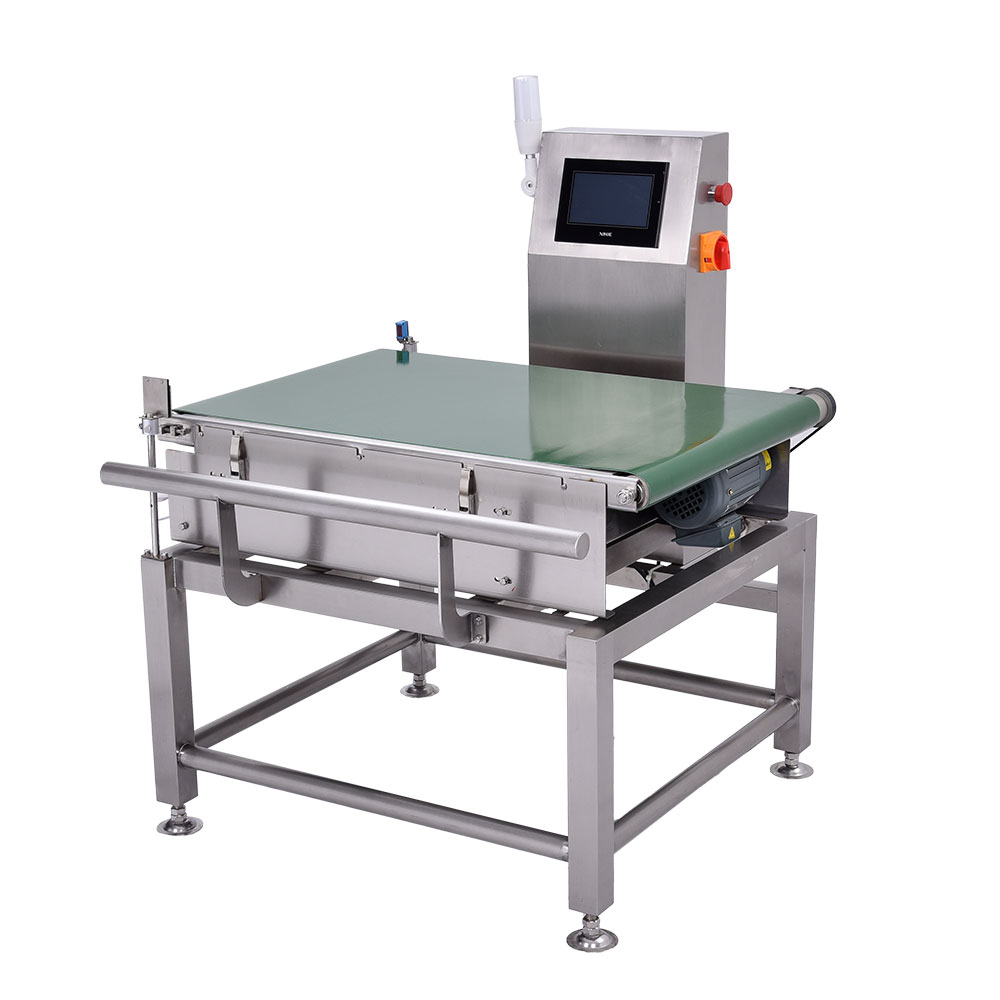
A 15 kg range with a 1 g scale, on a belt 620 mm long and 400 mm wide running at 10 to 60 m/min. One frame covers both ends of a mixed line: a small boxed item in the morning and a 10 kg sack in the afternoon, without changing machines and without the scale losing the resolution it needs for the light one. That is what the range is for — the pack that fails is usually the one nobody expected.
A mixed line is the hard case for a check weigher. Run a light pack over a heavy-duty cell and the resolution disappears; run a heavy pack over a fine cell and you damage it. This frame sits in the middle: a 15 kg range that takes a sack or a case, and a 1 g scale that still reports a small shortfall on a light box, at ± 1 to ± 5 g.
Switching between two packs is a stored programme, not a rebuild. Up to 100 of them are held on the machine, each with its own target and tolerance, recalled from the 7-inch colour touch screen; a learning function will take a target from a run of good packs instead of from the keypad. Zero tracking runs continuously, following the drift as the belt turns.
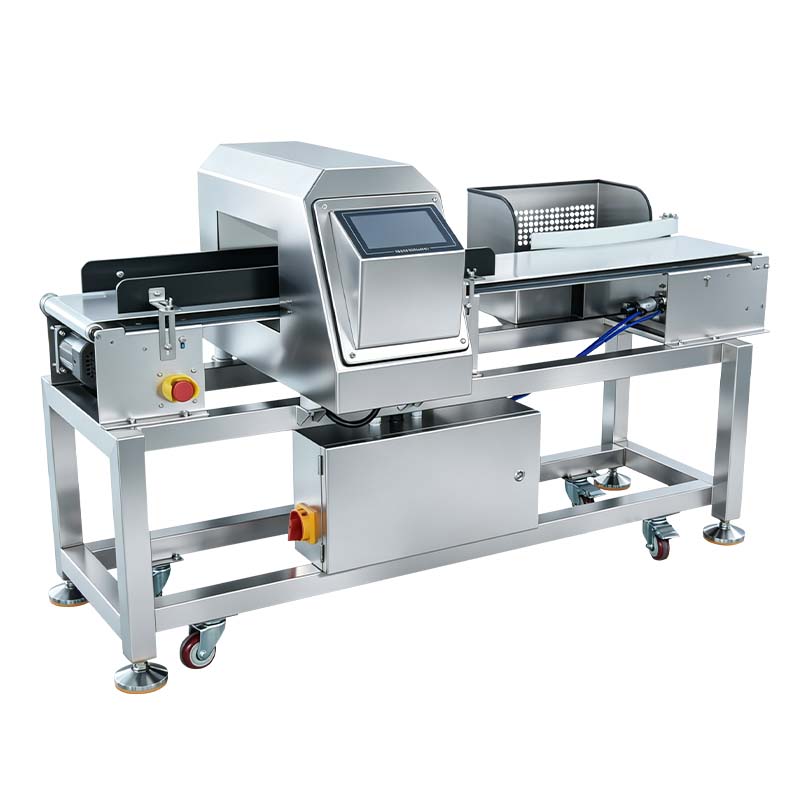
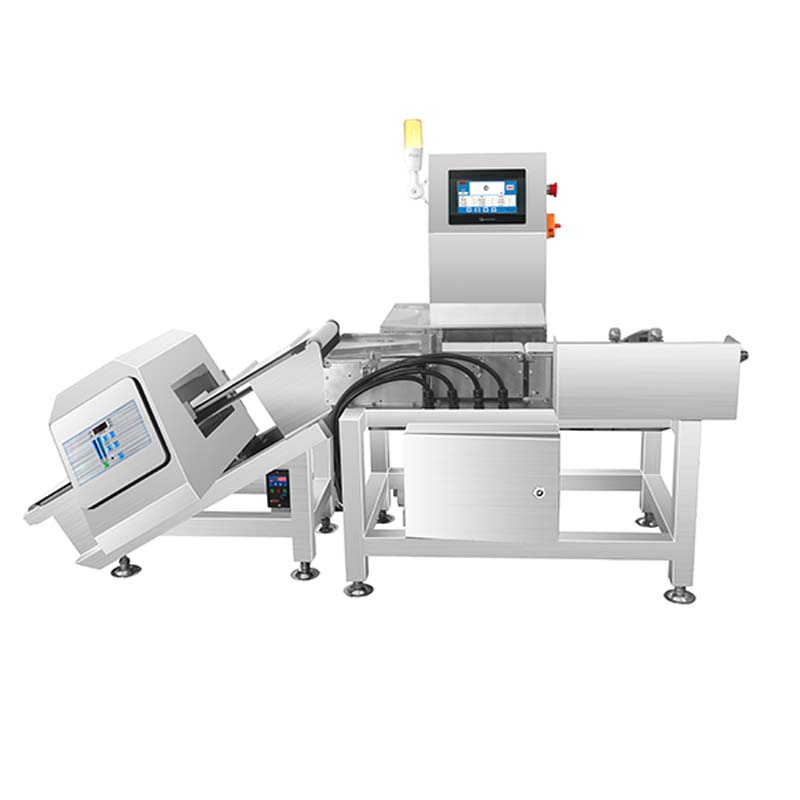
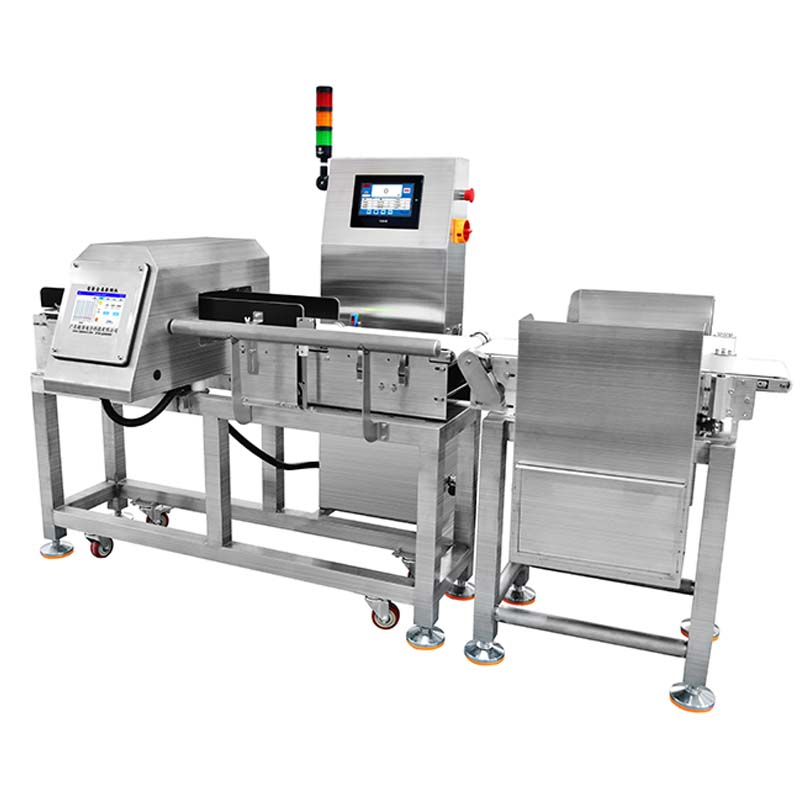
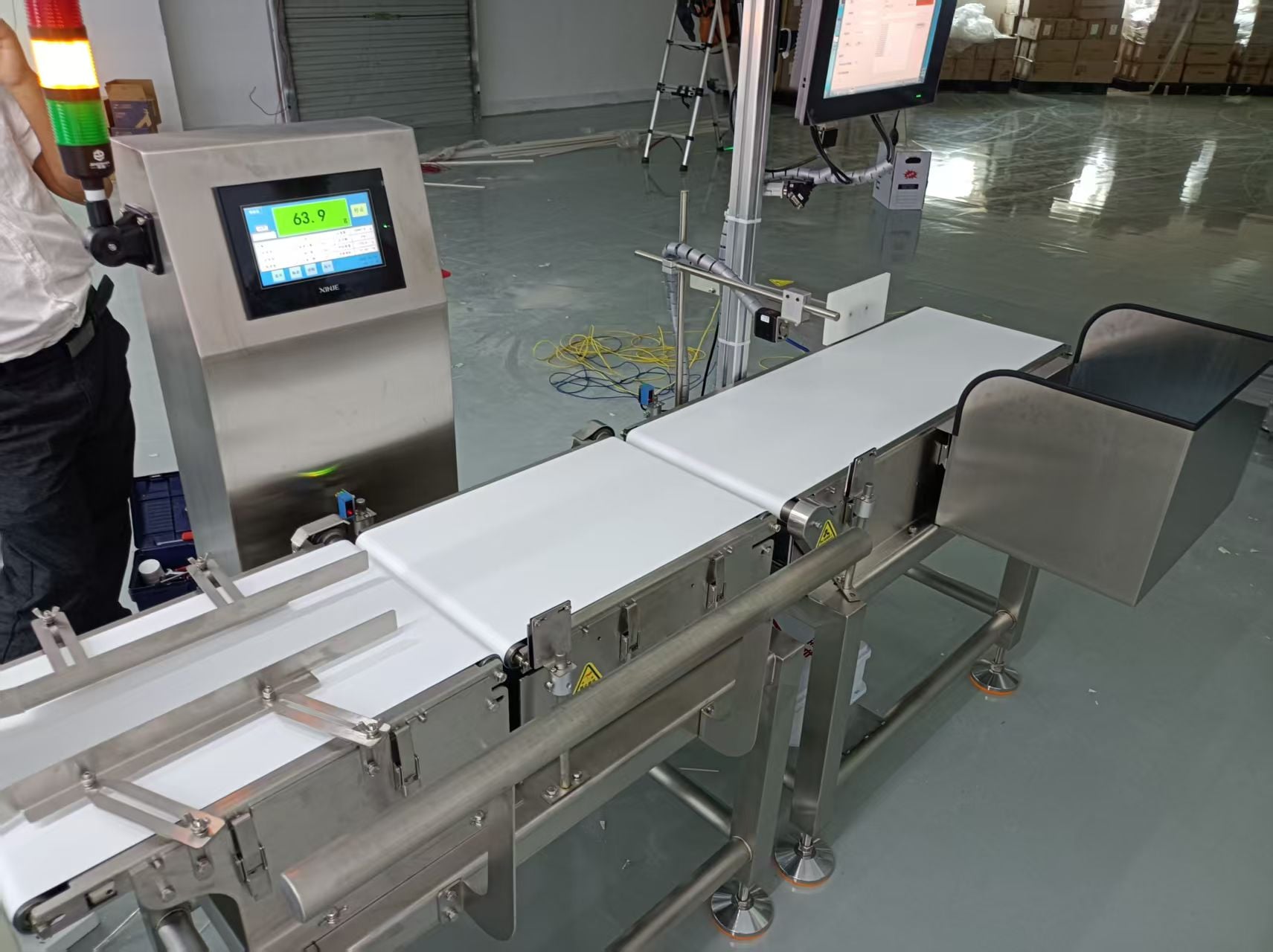
The machine is two stainless frames bolted in line, carrying three belt sections: infeed, weighing, and the short reject section at the outfeed end. Putting the reject section on its own frame keeps the weighing section from feeling the cylinder fire, and on a 15 kg pack that thump is not small. The two frames also split for shipping and rejoin on site.

Four removal devices are offered on this frame: a pusher travelling across the belt, a flap, an air blow, or a swing arm. At this weight the pusher is the usual answer — it takes the pack off squarely rather than tipping it, and it does not care whether the pack is a box, a bag or a bundle. All four are pneumatic, and the machine carries its own filter and regulator.


| Feature | Technical Details / Performance |
| Model | CQ-YWXP400 |
| Weighing range | ≤ 15 kg per item |
| Minimum scale | 1 g |
| Weighing accuracy | ± 1 g to ± 5 g On a pack crossing the weighing section at a steady speed |
| Belt speed | 10–60 m/min, adjustable |
| Throughput | Up to 60 pcs/min |
| Weighing conveyor belt | 620 mm (L) × 400 mm (W) |
| Maximum product size | ≤ 450 mm (L) × 390 mm (W) |
| Rejection method | Pusher · flap · air blow · swing arm Matched to the pack and the line |
| Stored product programmes | 100, with automatic learning storage |
| Load cell and control | ZEMIC L6D16 load cell High-speed A/D sampling controller |
| Body material | SUS 304 stainless steel |
| Conveyor belt material | Food grade PVC |
| Control and data | 7-inch colour touch screen USB · RS232 · RS485 |
| Power supply | AC 220 V ± 10 %, 50 Hz, 400 W |
| External air supply | 0.6–1 MPa For the pneumatic rejection device |
| Dimensions (L × W × H) | 2146 × 1110 × 1231 mm |
| Working environment | 0–40 °C, 30–95 % RH |
The electricals sit in a tall lockable cabinet on the rear of the weighing frame rather than being spread along it, with the warning labels and the earth stud outside where an engineer expects them. The air filter and regulator hang on the reject frame within reach, so the drop that feeds the pusher can be set without opening anything. Every leg ends in a threaded foot on a pad, which is what lets a machine this long be levelled on a floor that is not.

The 15 kg range on a 620 × 400 mm belt is for packs up to 450 × 390 mm, at up to about 60 packs a minute. It suits a packing hall running more than one pack size: paper reams, boxed goods, sacks, bagged components, where the check has to keep up with the line and no one wants a second machine for the lighter half of the range.
It is not the frame for sachets, stick packs or anything weighed in hundredths of a gram; those want a narrower belt and a finer cell. Nor is it intended for pallet loads. Send the pack sizes you run and the weight of each and we will say whether one frame covers them or whether the line needs two.
Yes, within the ranges quoted: up to 15 kg per pack with a 1 g scale and ± 1 to ± 5 g. Tell us the lightest and the heaviest piece you run and we will say whether they belong on one frame.
Packs up to 450 mm long, 390 mm wide and 15 kg each, crossing at a steady speed.
A pusher across the belt, a flap, an air blow or a swing arm — chosen against the pack. All four are pneumatic and the machine carries its own regulator.
100 stored programmes, each with its own target and tolerance, recalled from the 7-inch colour touch screen or learned from a run of good packs.
AC 220 V, 50 Hz, 400 W, compressed air for the reject device, and a level floor to stand it on.
The two frames split and travel in export crates on pallets, by sea, air or international express. Whole machine one year, with parts replaced free inside it.
Pack sizes, weights and line speed is enough for us to come back on fit, accuracy and how a failed pack should leave your line.

 ONLINE