 EN
EN



Aluminum Foil Metal Detector: Why Standard Units Fail
A foil-laminated pouch leaves the filler, passes the aluminum foil metal detector head, and nothing happens — even with a 1.0 mm iron fragment sitting inside the seal. This is the complaint we hear most often from snack, coffee and confectionery packers, and it is almost never a setting problem. Here is why foil defeats an ordinary metal detector, what a ferrous-specific machine does and does not see, and how to specify one so the numbers in your audit file hold up.
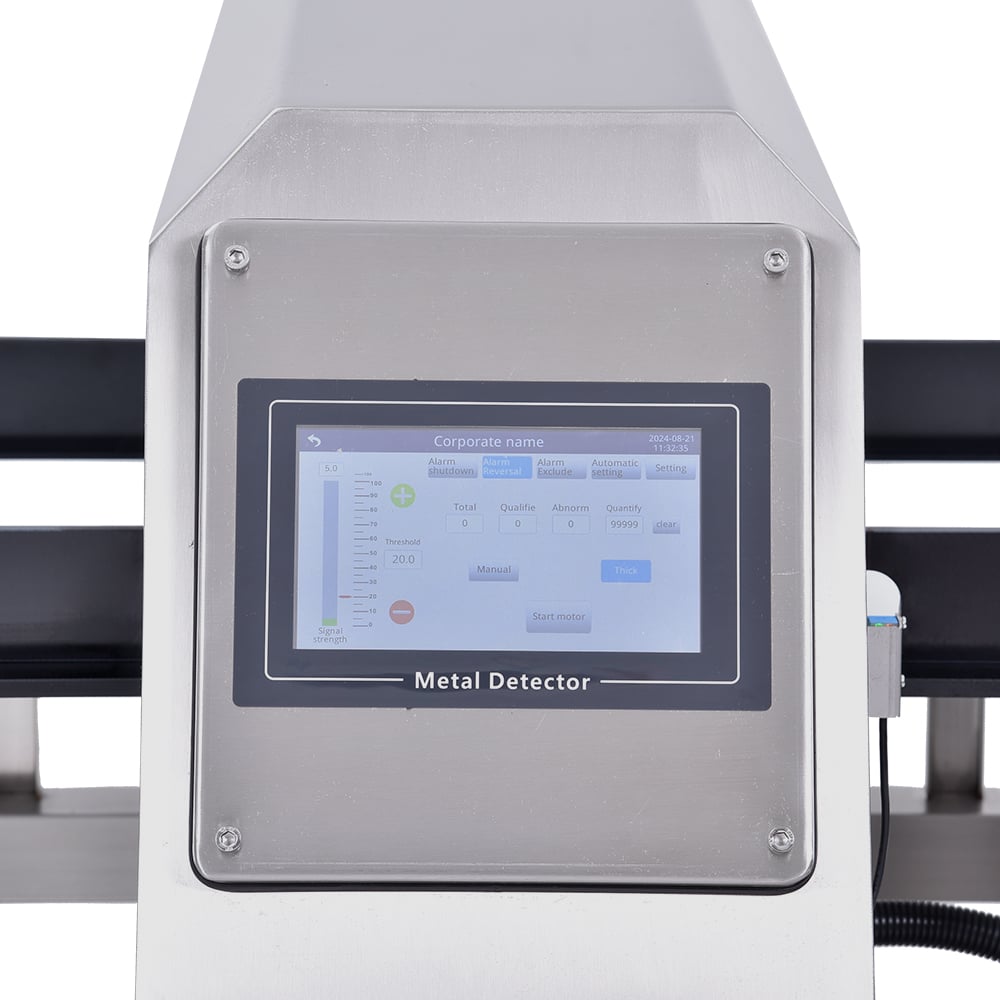
Why Aluminum Foil Breaks a Normal Metal Detector
Most conveyor detectors are balanced-coil instruments. They work on eddy currents: a coil field is disturbed by any conductive object that passes through it, and the machine reports the disturbance. A foil pouch is a large, continuous conductive sheet. The signal it produces is enormous next to a 1 mm particle, and both signals arrive at the same moment, on the same channel.
Operators normally solve this with product-effect learning. The machine is taught the pouch's signature, then ignores anything that matches it. That works while the pack is perfectly repeatable. The moment the fill weight shifts, the pack sits at a different angle, or the foil is a different laminate, the learned signature no longer matches, and you have two bad options: widen the tolerance and lose the small particles you were hired to catch, or tighten it and reject good packs every few minutes.
What an Aluminum Foil Metal Detector Looks For — and the Three Things It Cannot See
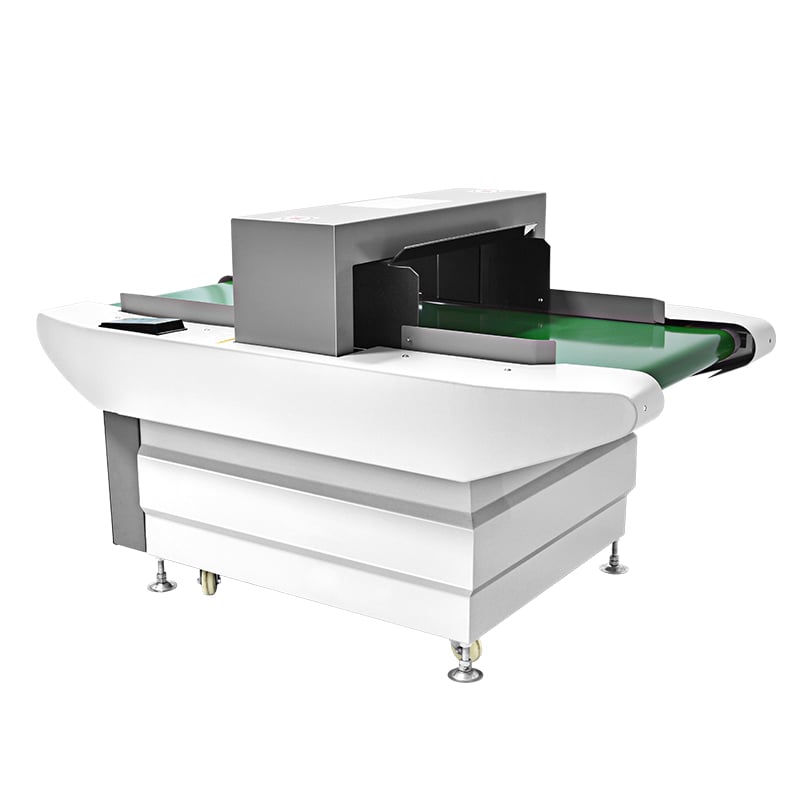
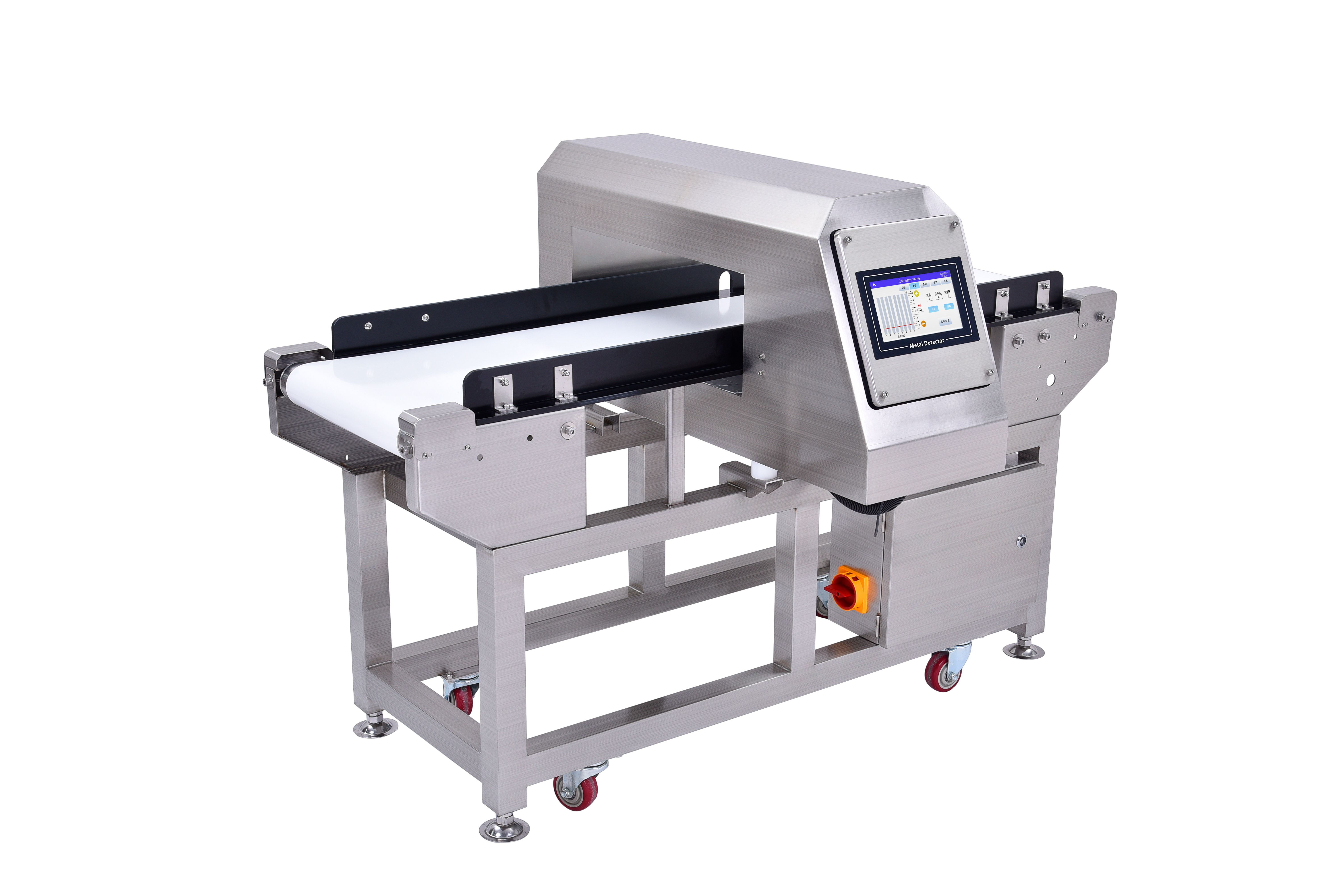
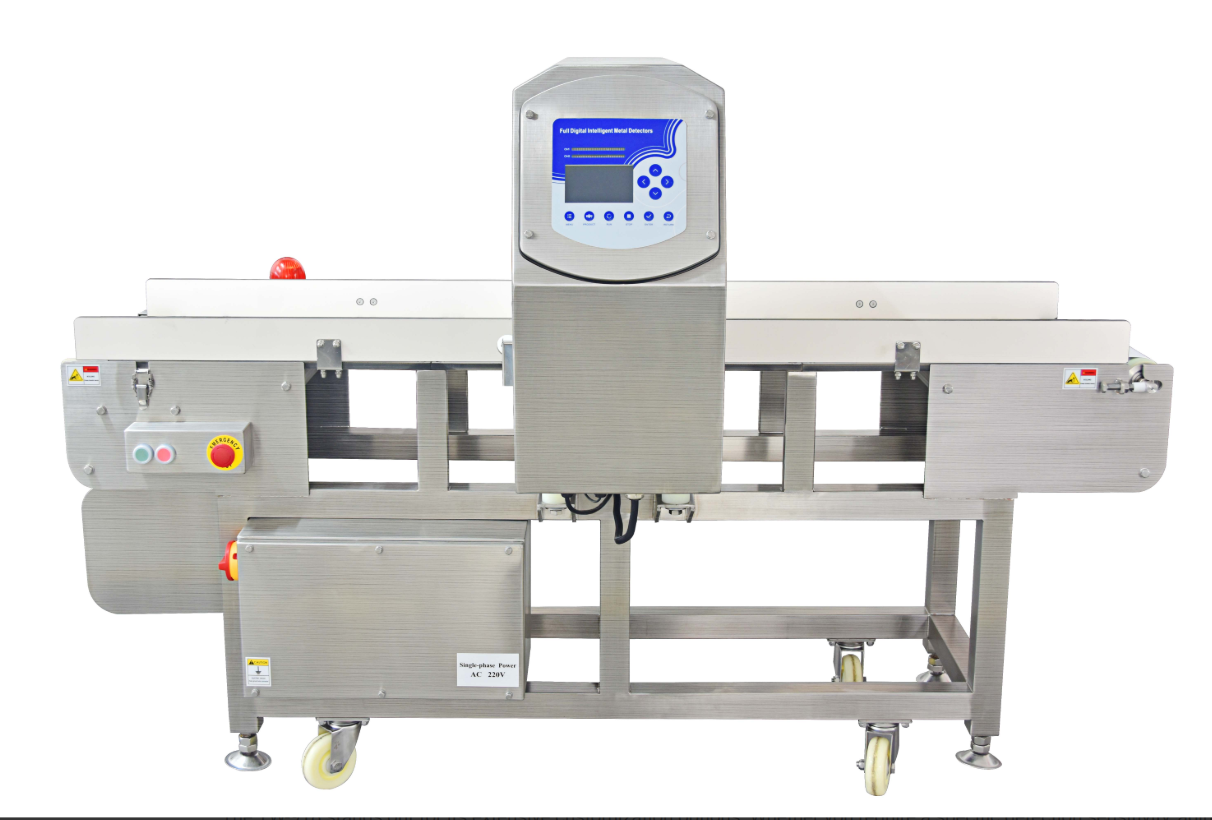
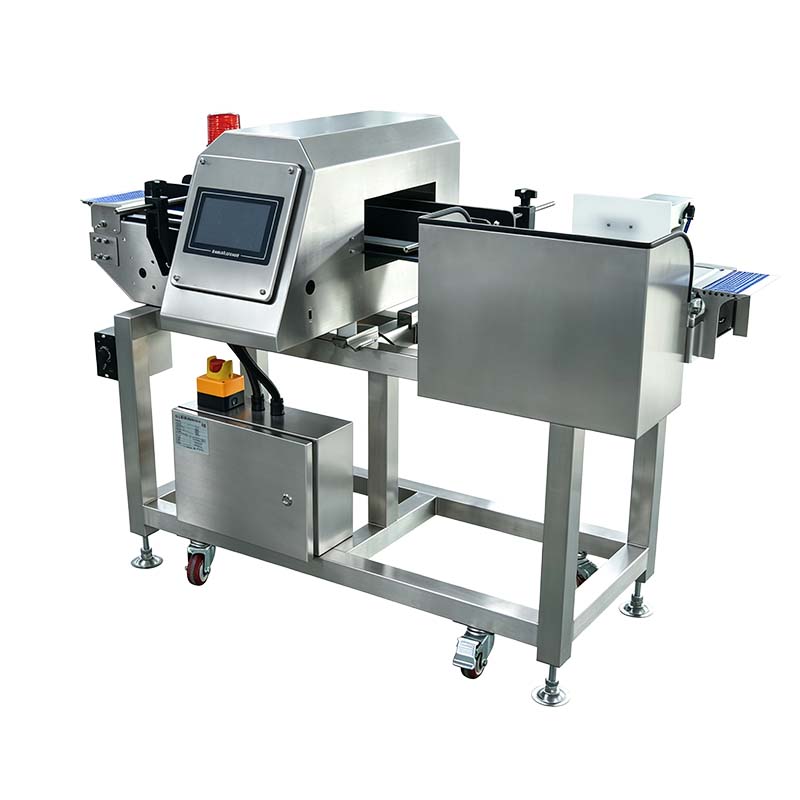
The CQ-YW806 and CQ-YW807, the two aluminum foil metal detectors we build, belong to that family. Instead of eddy-current balance, they use magnetic induction with permanent-magnet signal processing and upper and lower dual induction coils, tuned to the ferromagnetic response of the contaminant. In practical terms: the machine keys on magnetic permeability, not on conductivity. Aluminum foil has almost no magnetic response, so the packaging largely drops out of the measurement, and the detection field stays available for iron.
What it catches: iron filings and wear particles from cutting, grinding, sieving and mixing; broken needles and pins; staples and clips; wire fragments; and ferritic — that is, magnetic — stainless grades.
What it does not catch, and this is the part that decides whether one machine is enough:
Austenitic stainless steels. The 304 and 316 grades that most food-contact parts, blades, screens and fasteners are made of are effectively non-magnetic. A ferrous-only instrument will not see a 304 fragment, however large.
Non-ferrous metals. Aluminum, copper, brass and their alloys produce no useful magnetic response either.
Non-metals. Glass, stone, bone, hard plastic, rubber and wood — no magnetic response at all.
Specifying an Aluminum Foil Metal Detector: Window Size vs Sensitivity
Every aluminum foil metal detector is sold with a table, and the table — not the headline sensitivity — is what your auditor will read. Here is the CQ-YW806 table as published:
Model: 4010 / 4012 / 4015 / 4020 / 4025 / 4030 / 4035
Detection channel height: 100 / 120 / 150 / 200 / 250 / 300 / 350 mm
Fe sensitivity (sphere diameter): 0.8 / 1.0 / 1.2 / 1.5 / 2.0 / 2.5 / 3.0 mm
Detection channel width: 400 mm as standard, customizable 200–2000 mm
Read it as a trade-off curve. The smallest aperture, 400 × 100 mm, gives 0.8 mm iron. Stretch the height to 350 mm and the guaranteed figure drifts to 3.0 mm.
So specify in this order:
Start from the test piece your hazard analysis requires, in millimetres of iron.
Measure the tallest product that will ever run on the line, including the pack standing proud on the belt.
Choose the smallest channel height that clears it with a little margin.
Then confirm belt width and line speed: 400 mm is standard, and this machine runs at 25–30 m/min.
Around the Aluminum Foil Metal Detector: Housing, Belt and Rejection
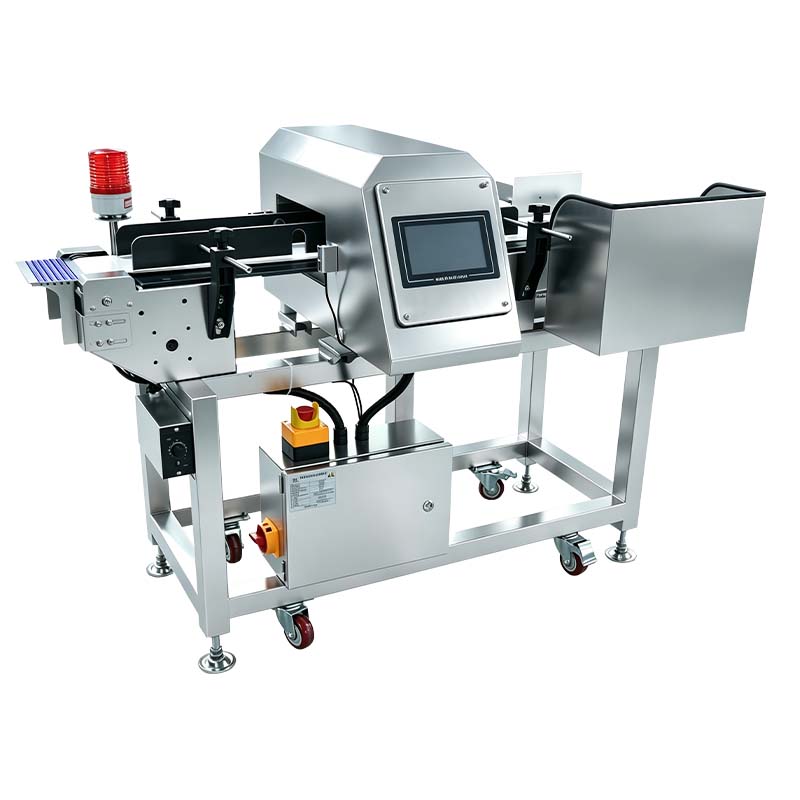
Both aluminum foil metal detectors use 3 mm mirror stainless steel for the housing, with the whole machine built in 304 stainless steel. That thickness is not decoration. It holds the coil geometry steady against vibration and belt tension — the most common cause of a machine that passes its test in the workshop and drifts in the plant — and the polished surface gives product nowhere to accumulate.
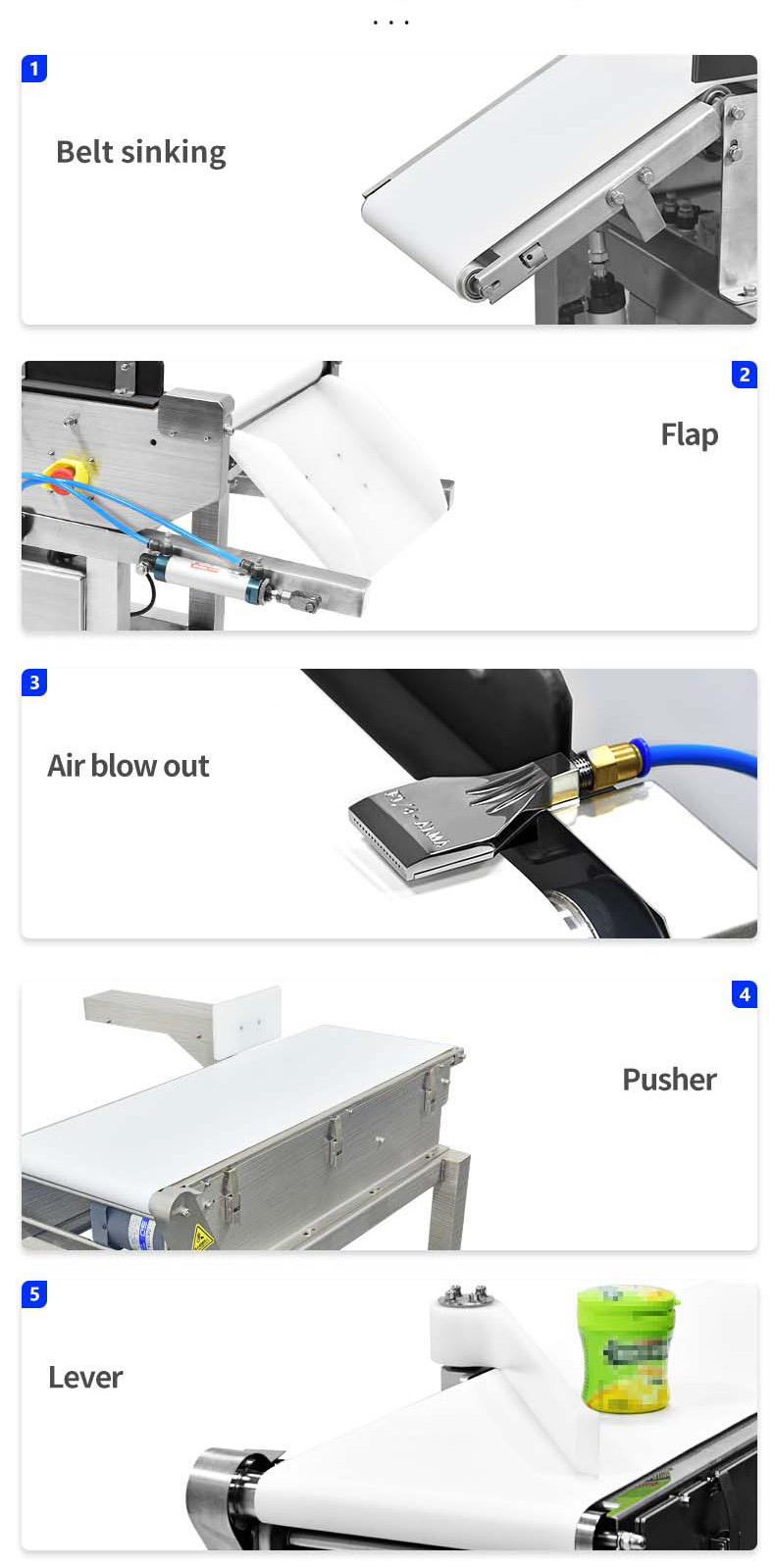
Rejection is where the foil pack itself matters, because a foil pouch is light, flat and easily damaged. The available methods are:
Belt sinking — a section of belt drops away and the pack falls into a bin. Gentle, good for flat pouches and for products that should not be handled hard.
Flap — a hinged plate sweeps the pack off the belt. Simple and reliable at moderate speeds.
Air blow out — a timed air jet pushes the pack sideways. Best for small, light packs at speed, and the choice when you do not want anything touching the product.
Pusher — a pneumatic ram pushes the pack off the belt. Suits heavier or boxed items, and higher throughput.
Aluminum Foil Metal Detector: Frequently Asked Questions
Can a metal detector detect metal through aluminum foil?
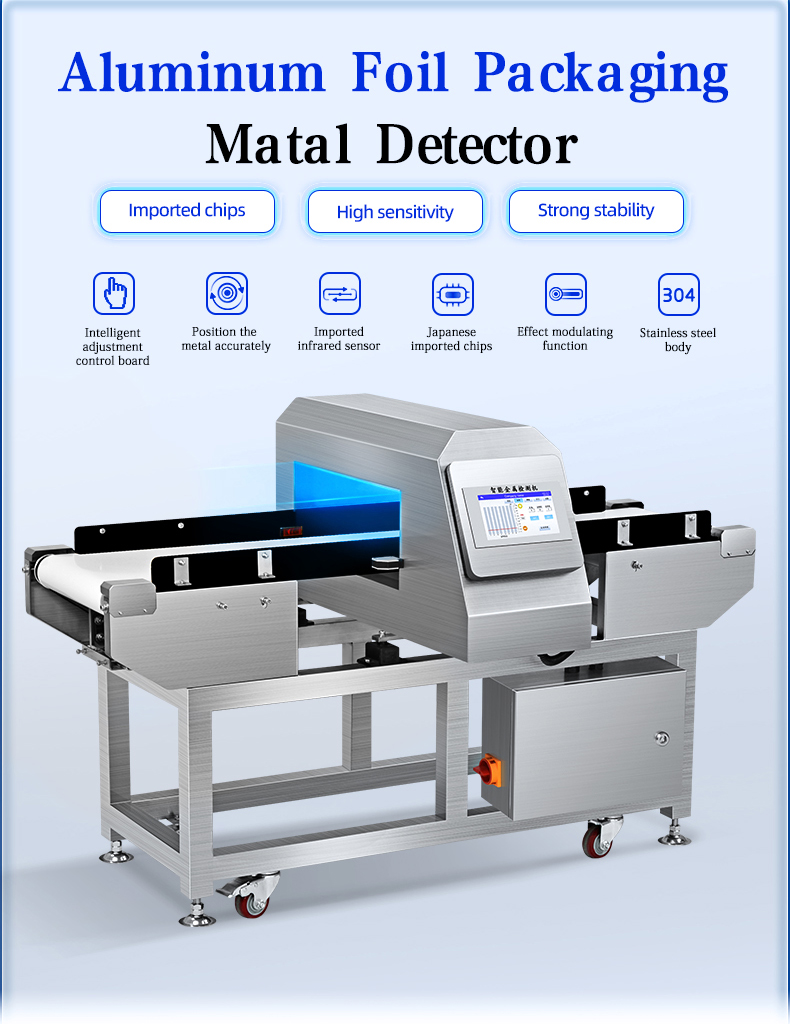
Not a standard balanced-coil unit — the foil's conductive signal swamps a small particle, which is why an aluminum foil metal detector uses a different principle. A ferrous-specific machine such as the CQ-YW806 or 807 can detect iron and steel inside a foil pouch, because it responds to magnetic permeability rather than conductivity. It will not detect the aluminum foil itself, and it will not detect austenitic stainless steel 304 or 316.
Do the CQ-YW806 and CQ-YW807 detect stainless steel?
No. They are ferrous detectors: iron, steel and nickel. Austenitic stainless grades such as 304 and 316 are effectively non-magnetic and are outside their scope. If your specification includes stainless steel or non-ferrous metals in foil packaging, X-ray inspection is the appropriate technology, because it discriminates by density.
What sensitivity can I expect on a 400 mm wide machine?
The published table gives iron sensitivity of 0.8 mm at a 100 mm channel height, 1.0 mm at 120 mm, 1.2 mm at 150 mm, 1.5 mm at 200 mm, 2.0 mm at 250 mm, 2.5 mm at 300 mm and 3.0 mm at 350 mm, all measured on a 400 mm channel width. Quote the figure for the window you actually buy, and put that number into the specification.
Which rejection method suits foil pouches?
For light, flat pouches, belt sinking or a flap is gentle and effective. For small light packs at speed, air blow is the usual choice. A pusher suits heavier or boxed items and higher throughput. If nothing may leave the station without a decision, use alarm-and-stop with the 12 V buzzer and inspect the pack by hand.
What do you need from me before quoting or testing?
Pack dimensions and fill weight, the tallest pack that will run on the line, line speed and belt width, your required test piece (material and size in millimetres), and whether the foil is laminated to a plastic film. For a test report, send three filled samples — we will run them and tell you the smallest iron test piece the machine stops.
Foil packaging does not have to be a blind spot in your quality system — but it needs an aluminum foil metal detector built on the right principle, a window size chosen from your test piece rather than from the price list, and a rejection method that suits a light, flat pouch.
Send us your pack details, or three filled samples, and we will run them on the CQ-YW806 and report the smallest iron test piece the machine stops. If your specification also covers stainless steel, glass or stone, ask about X-ray inspection on the same line — we build both, and we will tell you which one you actually need.



 Hot News

 ONLINE