EN


Home > > Check Weigher

Precision Weighing: Guarantees every product meets exact weight requirements for quality and compliance.
Maximum Speed: Built for high-speed lines to boost your productivity without slowing you down.
Plug-and-Play: Easy to integrate and operate, getting you up and running quickly.
Smart Data: Real-time monitoring and reports help you optimize your process effortlessly.
Built Tough: Reliable performance designed for 24/7 operation in demanding environments.
Bottom Line: Ensure accuracy, maximize output, and simplify quality control.
This is the frame we build for cartons already sealed and moving: up to 60 kg each, on a 900 × 600 mm belt running at 10 to 30 metres a minute. It weighs every carton that crosses the weighing section, compares it with the target held for that item, and raises the alarm when the weight falls outside it.
How this build handles a bad carton is worth settling first, because it is often assumed to be a pusher and it is not. Nothing on this frame throws a carton off the belt. When a carton falls outside its tolerance the light alarm is raised and the belt stops; the operator takes the carton off and restarts the line.
For a heavy carton that is the sensible arrangement. Sixty kilos cannot be swept sideways without an actuator large enough to be a hazard in its own right, and a stopped belt gives the operator time to open the carton and see what went wrong. It also means no compressed air is needed: the alarm and the stop are electric.
Both studio shots are of the same build, from its two sides. Visible in them: a stainless frame on threaded feet, a single wide green belt the length of the weighing section, and the control column behind it carrying the touch screen, the emergency stop and the tower light. A stainless handrail runs along the front, and a blue photoelectric sensor sits at the belt edge.

These are the figures we build to. Anything marked as matched to the line is settled with you before the frame is cut.
| Feature | Specification At A Glance |
| Model | CQ-YWXP600 |
| Weighing range | ≤ 60 kg per carton |
| Minimum scale | 1 g |
| Weighing accuracy | ± 5 g to ± 15 g On a carton crossing the weighing section at a steady speed |
| Belt speed | 10–30 m/min, adjustable |
| Throughput | Up to 30 cartons/min |
| Weighing conveyor belt | 900 mm (L) × 600 mm (W) |
| Maximum carton size | ≤ 650 mm (L) × 590 mm (W) |
| Rejection | Light alarm and belt stop No actuator and no compressed air: the operator removes the carton |
| Stored programmes | 100, with automatic learning storage |
| Load cell | ZEMIC L6D16 |
| Control system | High-speed A/D sampling controller |
| Body material | SUS 304 stainless steel |
| Conveyor belt material | Food grade PVC |
| Display and data | 10-inch colour touch screen · USB · RS232 · RS485 |
| Power supply | AC 220 V ± 10 %, 50 Hz, 400 W |
| Dimensions (L × W × H) | 900 × 1000 × 1070 mm |
| Working environment | 0–40 °C, 30–95 % RH |
What a machine can be held to depends on the carton as much as on the load cell. A full carton crossing at a steady speed reads inside the band below; a part-filled one that shifts its contents on the way is a different job.
The band looks wide beside a small-pack weigher, and it should: ± 5 g to ± 15 g across a 60 kg range is a fraction of a tenth of a percent. The question a carton weigher answers is not whether one bag is 2 g light — it is whether the box holds the number of bags it should.
A 900 × 600 mm belt is what makes this a carton machine rather than a small-pack machine. It is food grade PVC running between aluminium rails, and it carries a carton up to 650 mm long, 590 mm wide and 60 kg. It runs on a tapered return shaft so it cannot drift to one side, and the frame is stainless throughout.
On the line the frame stands at the height your conveyors already run at. In the clip the weighing section sits inside a roller line, the carton arriving and leaving over rollers, with the column set back clear of the carton path.
The load cell samples continuously, so the weight arrives as a curve taken across the whole pass rather than one snapshot. The controller takes the stable part of that curve, compares it with the target and the tolerance held for the item, and decides good or no-good. Underweight, overweight, a missing bag inside the carton and an empty box all show the same way.
Up to 100 programmes are stored, so a changeover is a recall rather than a re-teach, and the learning function sets a new item from a sample of good cartons instead of by typing numbers in. Zero tracking runs continuously, and readings come out through USB, RS232 or RS485.
This is a completion check on a packed carton, and the line it suits is one where boxes are already sealed and moving: food and beverage cases, bagged snacks and powders, frozen goods, and the same cartons in daily chemical and hardware.
It is not a machine for sachets, tablets or small packs: a 600 mm belt and a 60 kg range are the wrong tools for a 200 g pouch, and we build the frames that suit those. Tell us the pack and we will point you at the right one.
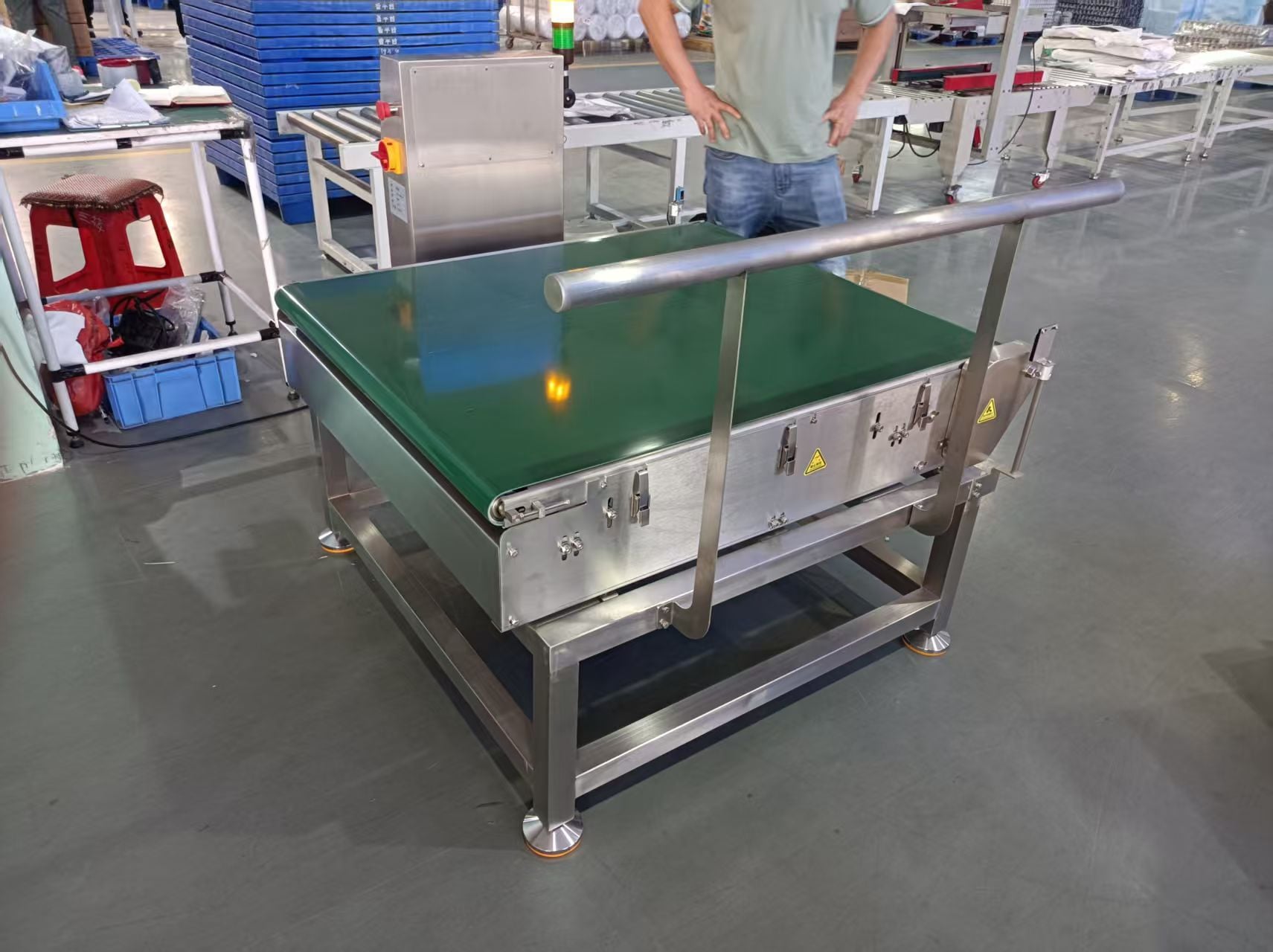
Every unit is assembled, wired and run on our own floor before it is crated. The photograph is that floor: the same green belt and control column, beside the roller lines we build for carton handling.
It does not push anything off the belt. The light alarm is raised and the belt stops, and the operator takes the carton off and restarts the line.
± 5 g to ± 15 g on a carton crossing at a steady speed, with a 1 g minimum scale.
Up to 650 mm long, 590 mm wide and 60 kg, on a 900 × 600 mm belt.
No. The alarm and the belt stop are electric, so the frame runs on AC 220 V, 50 Hz, 400 W alone.
The belt runs at 10 to 30 metres a minute, up to about 30 cartons a minute depending on carton length.
One year whole machine, with parts replaced free inside it. It ships by sea, air or express, and payment can go through Alibaba Trade Assurance.
Not sure whether your carton belongs on a 600 mm belt? Send its size and the weight per carton, and we will come back on fit, on the accuracy you can hold and on how the line should be stopped.

 ONLINE