EN


Home > > Check Weigher

Zero Defects: Stop underweight/overweight products for guaranteed quality and compliance.
No Bottlenecks: Weigh at production line speed to maximize your output.
Plug & Play: Integrate quickly and operate intuitively—minimal setup, minimal training.
Non-Stop Reliability: Engineered for tough 24/7 environments to protect your uptime.
Actionable Data: Turn real-time weight data into smarter decisions and process improvements.
The Result? Flawless products, higher efficiency, and total control.
A 200 g ceiling and a 0.01 g scale, on a belt 250 mm long and 120 mm wide running at 10 to 60 m/min. Nothing here is built for cartons: it is for sachets, stick packs, small bottles, blister strips and machined parts, where the shortfall is a single tablet, one lid, or a nearly empty fill. The verdict is taken on the move, and the pack that fails is taken off the line.
Scale and accuracy are two different numbers and both matter here. The 0.01 g scale is the smallest step the frame can report; the accuracy band, ± 0.05 to ± 0.1 g, is how close that report stays to the truth on a pack crossing at speed. The scale is what lets a one-tablet shortfall be seen at all; the band is what stops a good pack being thrown away.
On packs this light the belt matters as much as the cell. The controller samples across the whole pass and works from the stable part of that curve rather than a single reading, which is what makes a 0.01 g scale usable on a moving line. Zero tracking follows the drift as the belt turns.
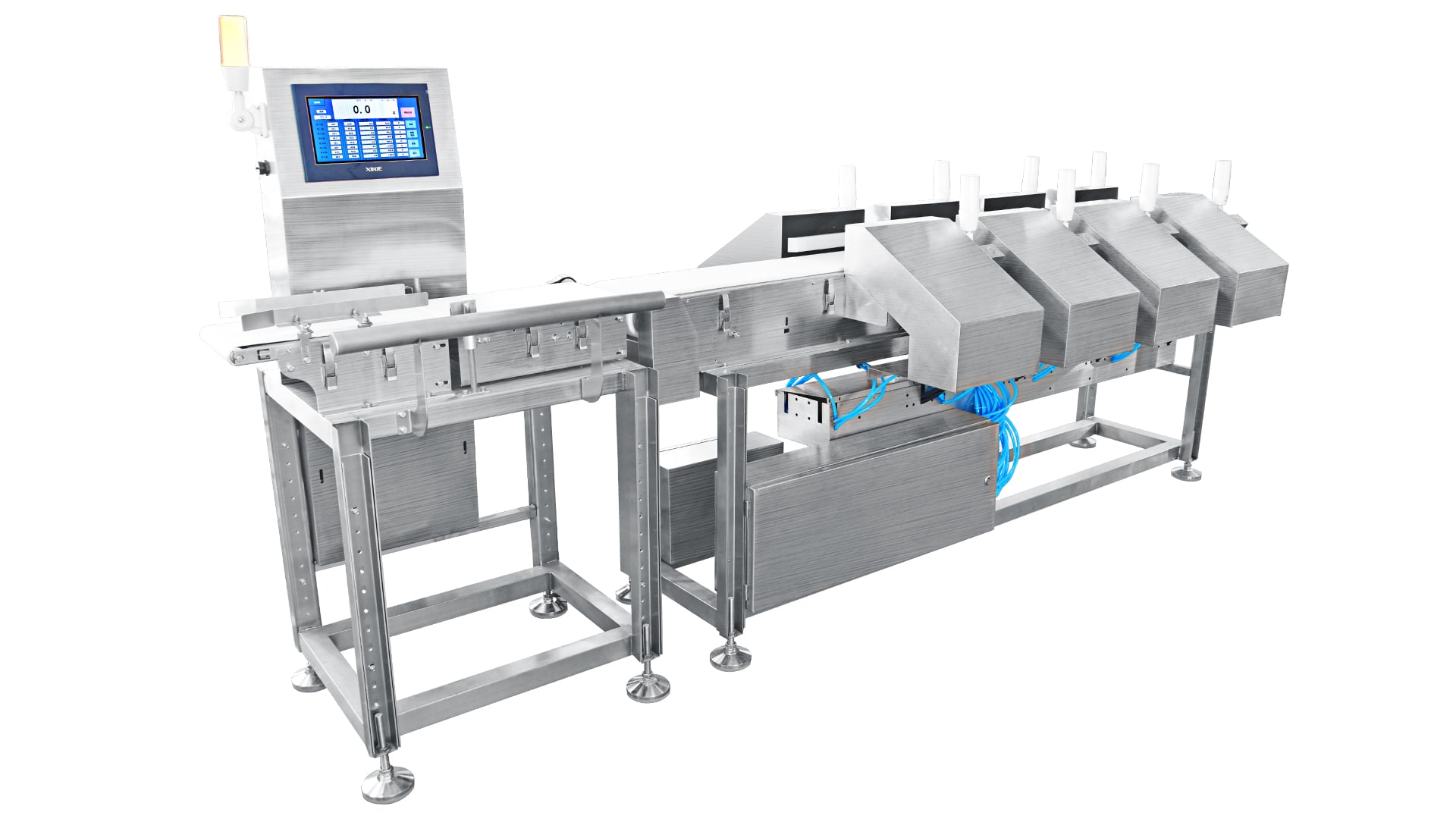
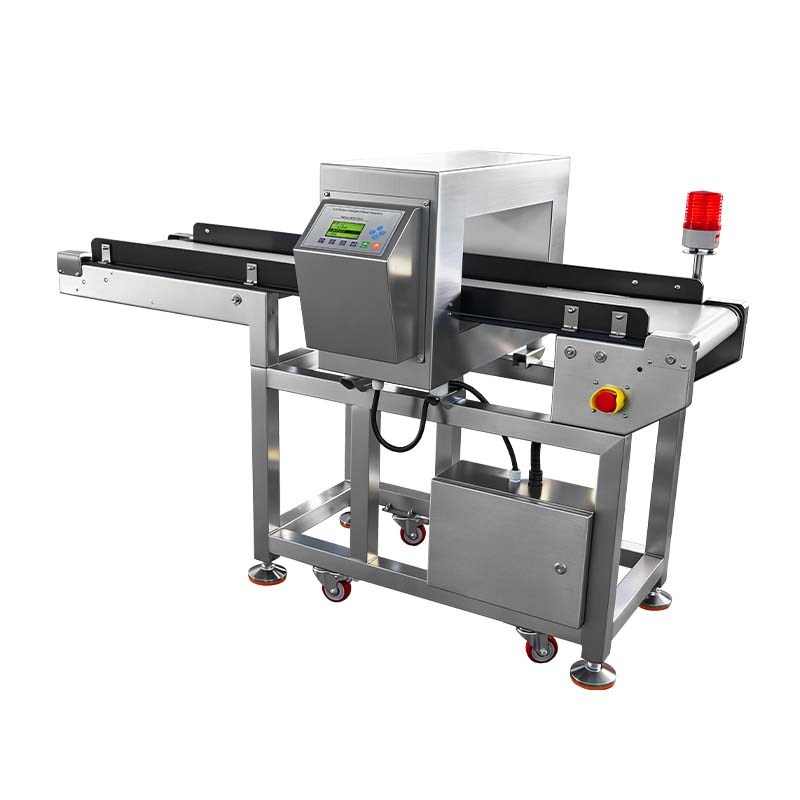
The belt is carried in three sections: the pack is fed in, the weighing section is where the cell reads it, and the short section at the far end is where a failed pack is taken off. Separating them keeps the weighing section from seeing the vibration of the infeed and the thump of a reject — on packs measured in tenths of a gram that is the whole game.

Four removal devices are offered on this frame: a pusher travelling across the belt, a flap, an air blow, or a swing arm. On a pack this light the choice comes down to the pack — a sachet that will not survive being pushed may be happy being blown off, and a rigid blister strip is the other way round.
All four are pneumatic, and the frame carries its own filter and regulator. The clip shows the pusher: one lid is taken out of a pack, and that pack is taken off the belt.


| Feature | Technical Details / Performance |
| Model | CQ-YWXP1010 |
| Weighing range | ≤ 200 g per item |
| Minimum scale | 0.01 g |
| Weighing accuracy | ± 0.05 g to ± 0.1 g On a pack crossing the weighing section at a steady speed |
| Belt speed | 10–60 m/min, adjustable |
| Throughput | Up to 100 pcs/min |
| Weighing conveyor belt | 250 mm (L) × 120 mm (W) |
| Maximum product size | ≤ 100 mm (L) × 100 mm (W) |
| Rejection method | Pusher · flap · air blow · swing arm Matched to the pack and the line |
| Stored product programmes | 100, with automatic learning storage |
| Load cell and control | ZEMIC L6D16 load cell High-speed A/D sampling controller |
| Body material | SUS 304 stainless steel, IP54 |
| Conveyor belt material | Food grade PU |
| Control and data | 7-inch colour touch screen USB · RS232 · RS485 |
| Power supply | AC 220 V ± 10 %, 50 Hz, 90 W |
| External air supply | 0.6–1 MPa For the pneumatic rejection device |
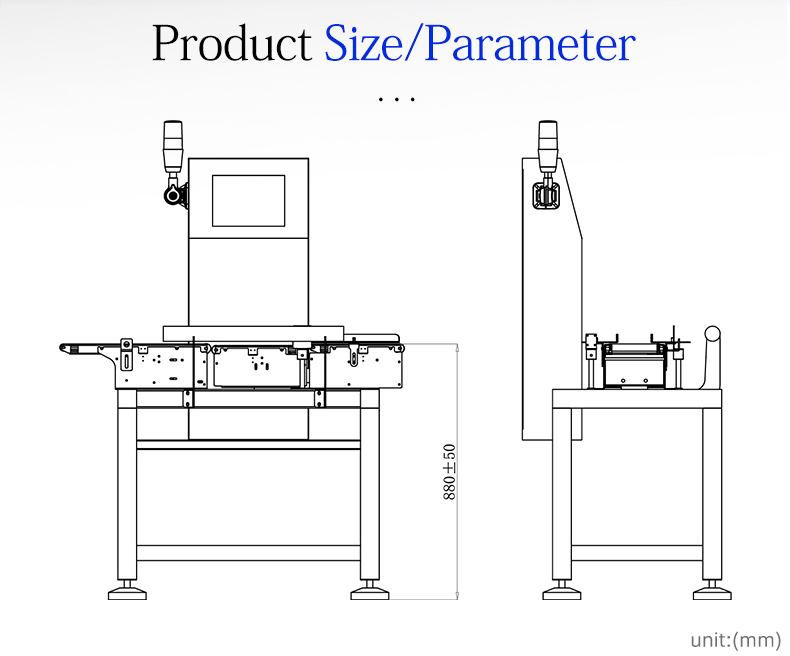
| Dimensions (L × W × H) | 900 × 500 × 1250 mm |
| Working environment | 0–40 °C, 30–95 % RH |
The electricals sit in a lockable stainless cabinet rather than being spread through the frame, with the earth stud and the warning labels outside where an engineer expects them. The air filter and regulator sit on the frame within reach, so the drop that feeds the reject can be set without opening anything. The belt is guarded over the weighing section and the guard lifts clear for cleaning.

The 200 g range on a 250 × 120 mm belt is for packs up to 100 × 100 mm, at up to about 100 packs a minute. It suits lines where a missing tablet, a missing lid or an empty blister is the failure you are chasing — and where catching it by eye has stopped working.
It is not the frame for cartons, sacks or anything weighed in tens of grams upward; those want a wider belt and a heavier cell. Nor is it a laboratory balance: the accuracy above assumes a pack crossing at a steady speed. Send the pack and the line speed and we will say which frame the job belongs on.

The scale is the smallest step the machine can report. The accuracy band, ± 0.05 to ± 0.1 g, is how close that report stays on a pack crossing at speed.
Packs up to 100 mm long and 100 mm wide, up to 200 g each — sachets, stick packs, small bottles, blister strips and small machined parts.
A pusher across the belt, a flap, an air blow or a swing arm — chosen against the pack. All four are pneumatic and the frame carries its own regulator.
Yes. It weighs in motion with no manual step, and the verdict can go out through USB, RS232 or RS485 to a printer, a PLC or a line system.
In an export crate on a pallet, by sea, air or international express. Whole machine one year, with parts replaced free inside it, and payment can go through Alibaba Trade Assurance.
Pack size, weight per piece and line speed is enough for us to come back on fit, accuracy and how a failed pack should leave your line.

 ONLINE