EN


Home > > Check Weigher

Ultimate Accuracy: Ensures every product meets strict weight standards with advanced sensor technology, guaranteeing quality and compliance while reducing giveaway.
Maximum Speed: Handles high-volume lines with ease, weighing hundreds to thousands of items per minute to boost your overall productivity.
Easy Integration & Operation: Modular design plugs seamlessly into your existing line. The intuitive interface requires minimal training, ensuring quick setup and smooth operation.
Built to Last: Robust construction withstands harsh industrial environments, providing reliable, long-term performance with minimal downtime.
Smart Data Insights: Real-time monitoring and advanced reporting give you clear visibility into production trends for quick, data-driven decisions and process optimization.
Energy Efficient: Designed with low-power components to cut operational costs and minimize environmental impact.
A 3 kg range with a 0.1 g scale, on a belt 450 mm long and 300 mm wide running at 15 to 90 m/min. The pack this frame is built around is a bag of something that pours: rice, pulses, seeds, pellets, dried fruit, where the product moves inside the bag and the bag changes shape between one pack and the next. Weigh the pack against the target held for it, and take off the one that is short.
A bag of grain is not a solid. The product shifts inside it, the bag slumps as it settles, and the shape reaching the weighing section is never the shape that left the filler. Hence a 0.1 g scale and a ± 0.5 to ± 1 g band rather than a coarser one: on a 2 kg bag the shortfall worth catching is a few grams, and a coarse scale would read the bag, not the fill.
Zero tracking runs continuously for the same reason. Rice dust, a crumb left on the belt or a change in belt tension all drift the zero over a shift, and on a band this fine that drift would be reported as product loss.
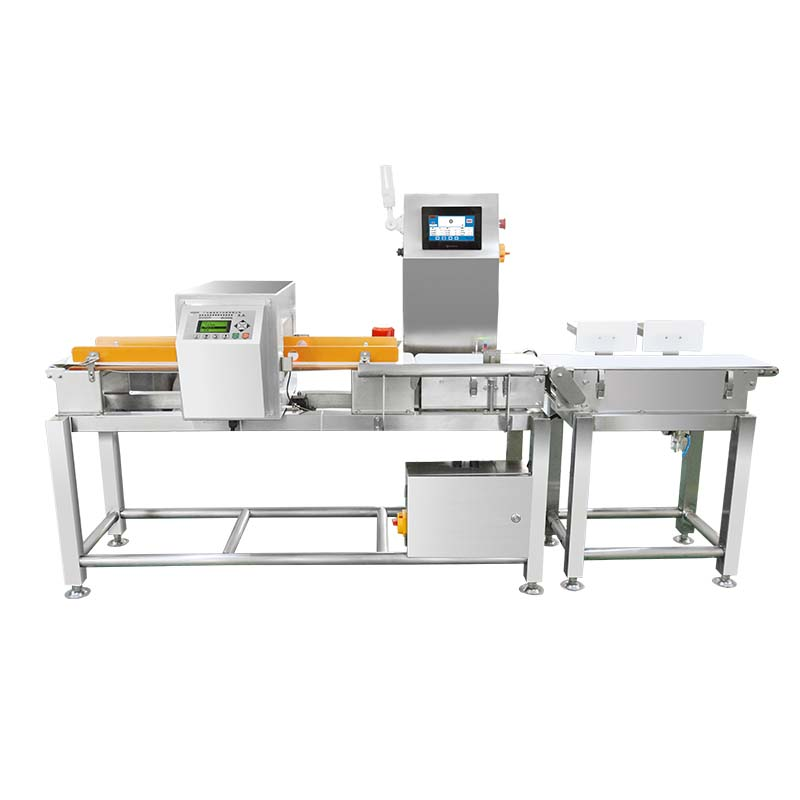
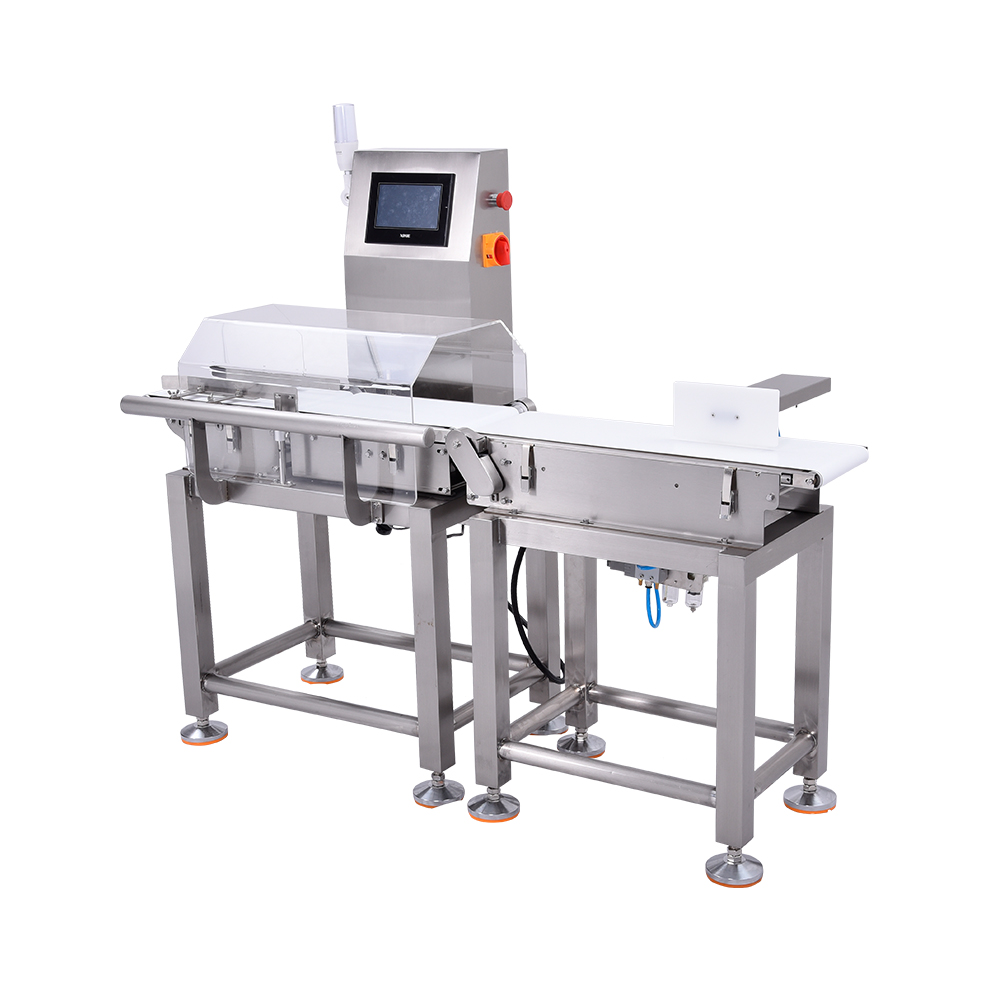
Two stainless frames bolted in line carry three belt sections: the infeed that takes the bag from your sealer, the short weighing section where the cell reads it, and the reject section at the far end. Splitting the run matters more on a bag than a box — a bag still settling when it reaches the cell reads light.

Four removal devices are offered on this frame: a pusher across the belt, a flap, an air blow, or a swing arm. On a sealed bag of grain the pusher is the usual answer — it takes the whole bag off squarely, where an air blow that suits a light sachet will not move 2 kg. All four are pneumatic, and the machine carries its own filter and regulator.


| Feature | Technical Details / Performance |
| Model | CQ-YWXP300 |
| Weighing range | ≤ 3000 g per item |
| Minimum scale | 0.1 g |
| Weighing accuracy | ± 0.5 g to ± 1 g On a pack crossing the weighing section at a steady speed |
| Belt speed | 15–90 m/min, adjustable |
| Throughput | Up to 80 pcs/min |
| Weighing conveyor belt | 450 mm (L) × 300 mm (W) |
| Maximum product size | ≤ 300 mm (L) × 290 mm (W) |
| Rejection method | Pusher · flap · air blow · swing arm Matched to the pack and the line |
| Stored product programmes | 100, with automatic learning storage |
| Load cell and control | ZEMIC L6D16 load cell High-speed A/D sampling controller |
| Body material | SUS 304 stainless steel |
| Conveyor belt material | Food grade PU |
| Control and data | 7-inch colour touch screen USB · RS232 · RS485 |
| Power supply | AC 220 V ± 10 %, 50 Hz, 400 W |
| External air supply | 0.6–1 MPa For the pneumatic rejection device |
| Dimensions (L × W × H) | 1806 × 855 × 1180 mm |
| Working environment | 0–40 °C, 30–95 % RH |
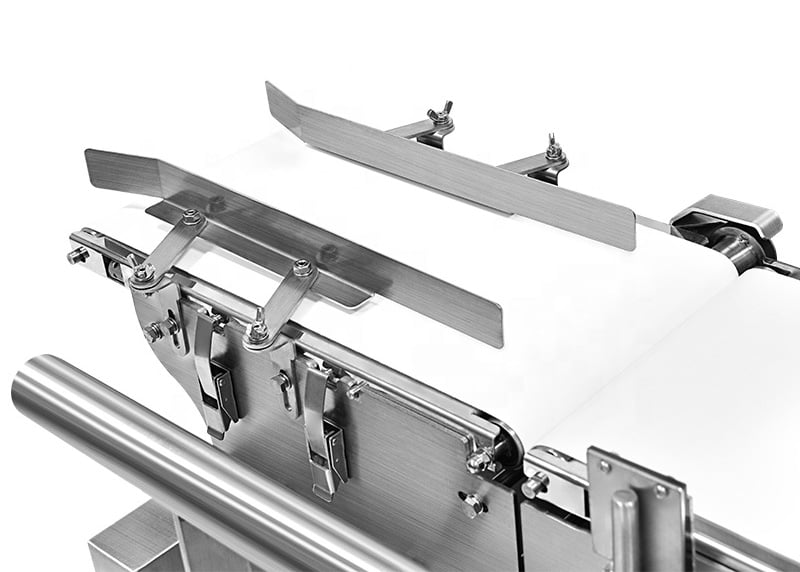
The side plates along the belt are slotted and lock with hand screws, so the channel can be set to the bag you are running without tools. That matters on a bagged line: a bag that wanders sideways crosses the cell at an angle, and an angled bag reads wrong. The electricals sit in a lockable stainless cabinet on the rear of the weighing frame, and the air filter and regulator hang within reach.

The 3 kg range on a 450 × 300 mm belt is for packs up to 300 × 290 mm, at up to about 80 bags a minute: rice, pulses, sugar, seeds, dried fruit, frozen pieces, small hardware in bags. It suits a bagging line where the failure that matters is a bag a few grams light — enough to fail a net-content check, not enough to show on a coarse scale.
It is not the frame for sachets and stick packs, nor for cartons and sacks in the tens of kilograms. Send the bag sizes and weights you run and we will say whether one frame covers them.
Every unit is assembled, wired and run on our own floor before it is packed — the clip above was shot there, with the rest of the build behind it. It splits into its two frames for shipping and travels in export crates on pallets, by sea, air or international express. Whole machine one year, with parts replaced free inside it.
That is the case it is built for. The weighing section is short and separate from the infeed, so the bag crosses it after the worst of the settling.
Bags and packs up to 300 mm long, 290 mm wide and 3000 g each, crossing at a steady speed.
A pusher takes it off across the belt, or a flap, an air blow or a swing arm can be fitted instead. All four are pneumatic and the machine carries its own regulator.
100 stored programmes, each with its own target and tolerance, recalled from the touch screen or learned from a run of good bags.
AC 220 V, 50 Hz, 400 W, compressed air for the reject device, and a level floor to stand it on.
Bag size, weight per piece and line speed is enough for us to come back on fit, accuracy and how a short bag should leave your line.

 ONLINE