EN


Home > > Check Weigher

Precision Weighing: Guarantees every product meets exact weight requirements for quality and compliance.
Maximum Speed: Built for high-speed lines to boost your productivity without slowing you down.
Plug-and-Play: Easy to integrate and operate, getting you up and running quickly.
Smart Data: Real-time monitoring and reports help you optimize your process effortlessly.
Built Tough: Reliable performance designed for 24/7 operation in demanding environments.
Bottom Line: Ensure accuracy, maximize output, and simplify quality control.
This frame is built to weigh a sealed carton while it is still travelling. Nothing stops for the reading: the box crosses a 900 × 600 mm belt at 10 to 30 metres a minute and the weight is taken on the move. If the box is outside the tolerance held for it, the machine alarms and the belt stops, and the operator lifts it off.
Two things have to be true at once for a box to be weighed in motion. It must be travelling at a settled speed by the time it reaches the load cell, and the reading must be taken across the whole pass rather than at a single instant. The first is a matter of belt layout; the second is a matter of how the controller reads the cell.
The cell samples continuously, so what arrives is a curve of weight against time for that one carton. The controller takes the stable stretch of that curve, sets it against the target and tolerance held for the item, and returns a verdict. This is why a box that is still being accelerated reads badly, and why a part-filled carton whose contents shift on the way can be a harder job than a full one.
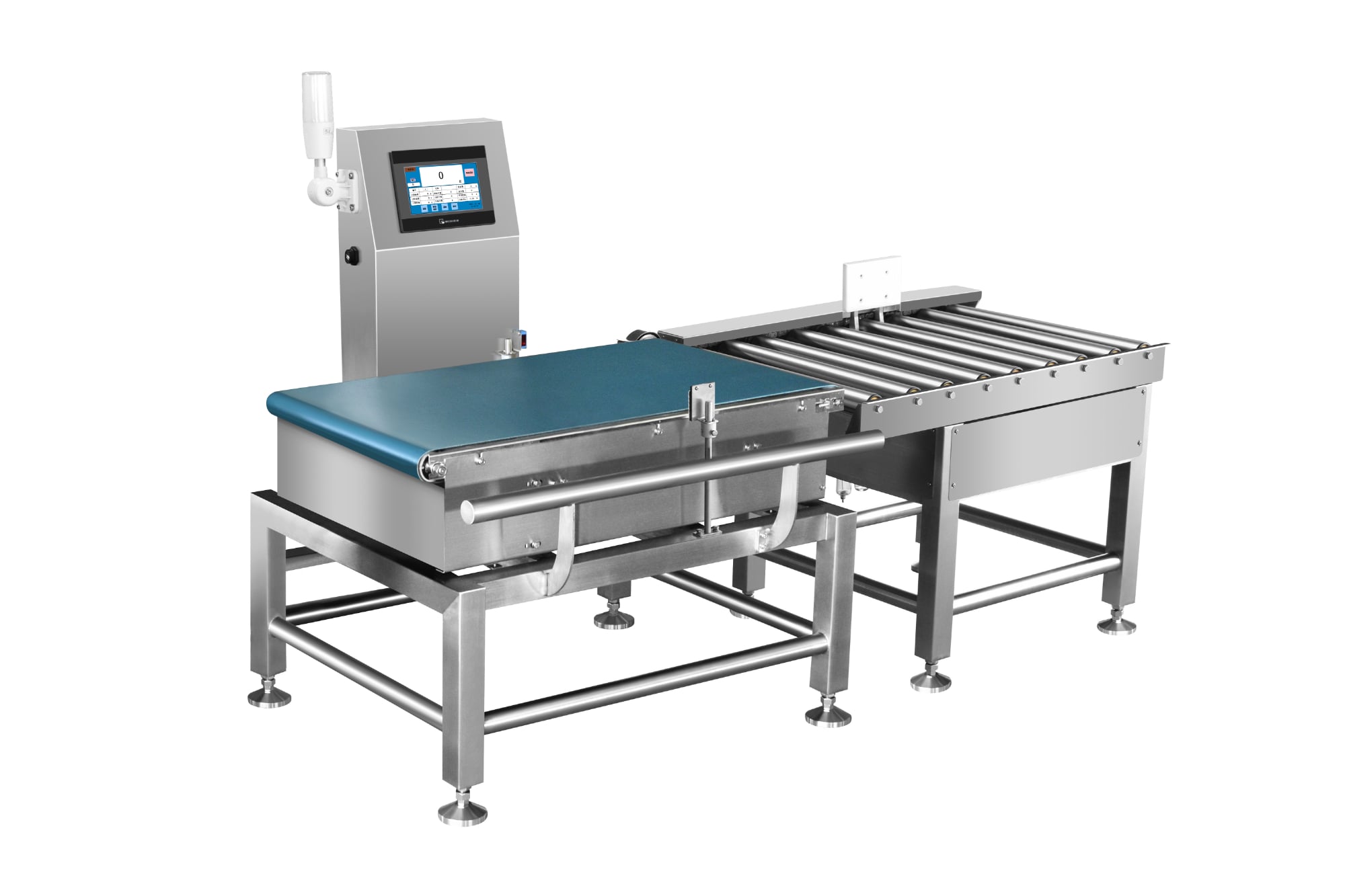
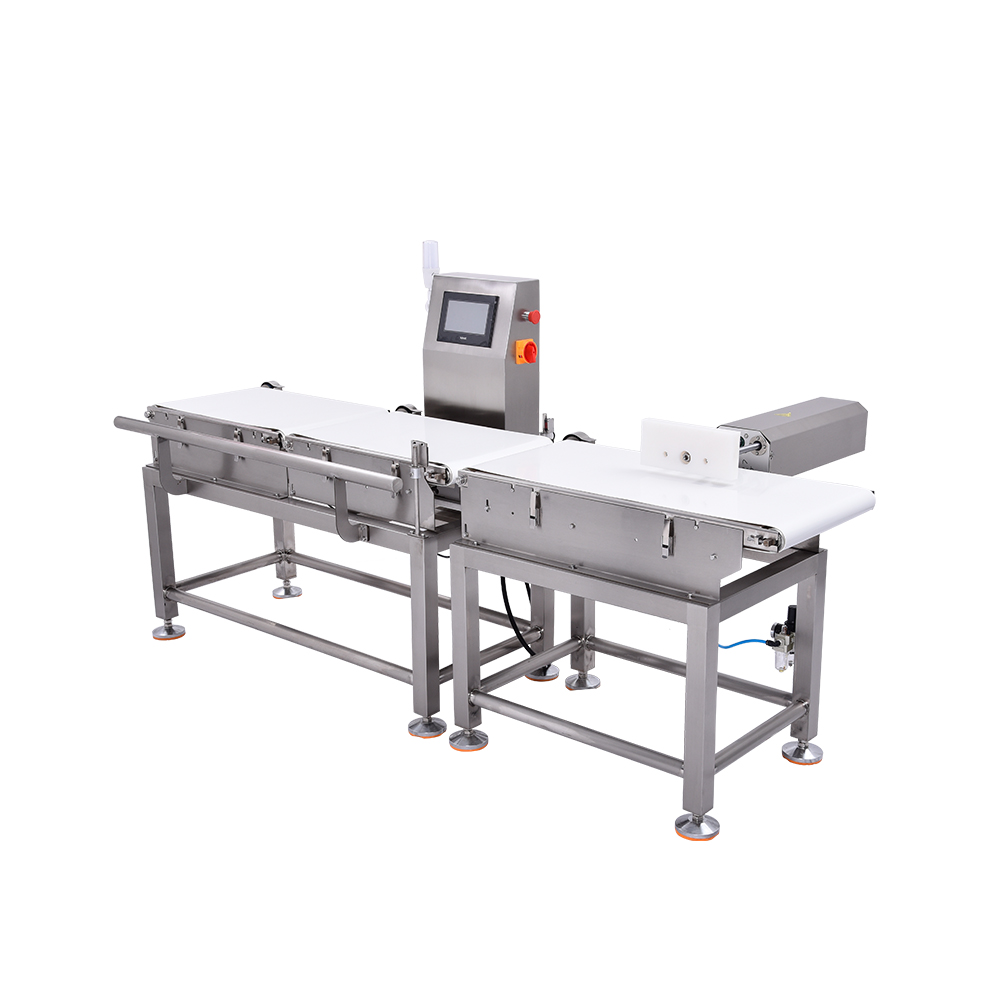
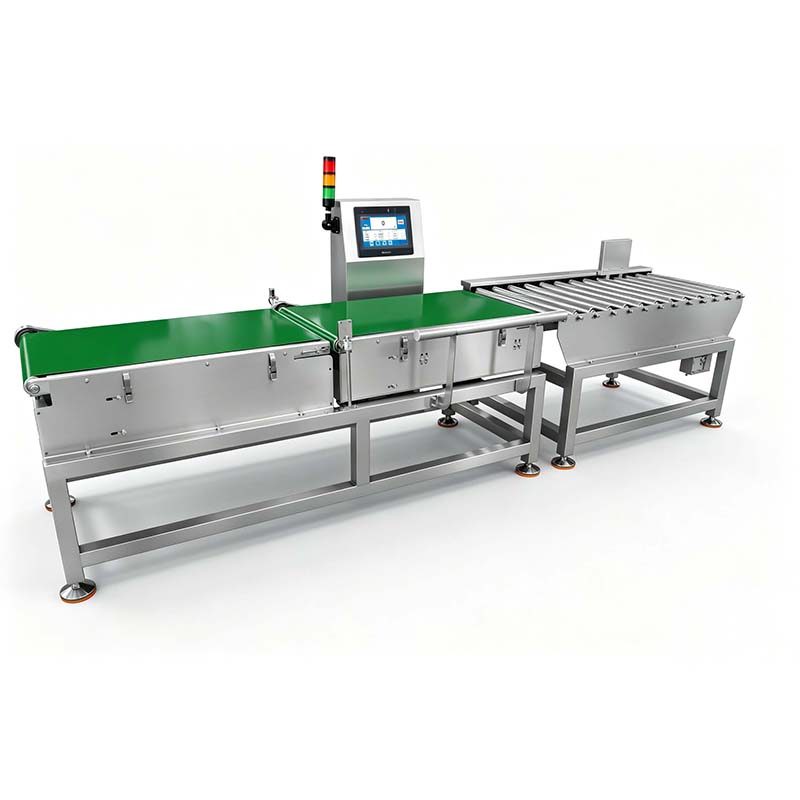
Studio views from the two sides of the same build. A stainless frame on threaded feet carries one wide green belt with the control column set behind it: colour touch screen, red emergency stop, yellow button, tower light on top. A round stainless handrail runs along the front, and a photoelectric sensor sits at the belt edge to see each carton onto the weighing section.

Figures we build to for the standard frame. Anything described as agreed is settled with you before cutting starts.
| Item | The Specification, In Full |
| Model | CQ-YWXP600 |
| Weight range | Up to 60 kg a carton |
| Readable to | 1 g |
| Tolerance | Within ± 5 g to ± 15 g For a carton crossing the weighing section at a settled speed |
| Line speed | 10–30 m/min, set on the drive |
| Cartons per minute | Up to 30 |
| Belt size | 900 mm long × 600 mm wide |
| Largest carton | 650 mm long × 590 mm wide |
| When a carton is out of tolerance | Light alarm, belt stop, carton lifted off by hand No actuator, so no compressed air is required |
| Recipes held | 100, with self-learning set-up |
| Weighing cell | ZEMIC L6D16 |
| Electronics | High-speed A/D sampling controller |
| Frame | SUS 304 stainless steel |
| Belt material | Food grade PVC |
| Screen and outputs | 10-inch colour touch screen, USB, RS232, RS485 |
| Supply | AC 220 V ± 10 %, 50 Hz, 400 W |
| Footprint | 900 mm × 1000 mm, 1070 mm high |
| Room conditions | 0–40 °C, 30–95 % RH |
Weighing something while it moves is harder than weighing it at rest, and it is worth being plain about the trade. A static balance holds the item still; a dynamic frame has to take its reading from a carton that is travelling, which is why the band is quoted for a settled speed rather than for any speed.
Against a 60 kg range, ± 5 g is a fraction of a tenth of a percent, and it is the honest figure for a frame of this class. What it will not do is tell you whether one bag inside the box is a couple of grams light. Two conditions push the reading to the wider end of the band: a carton that is only part full, so its contents can shift as it travels, and a line run at the top of the speed range.
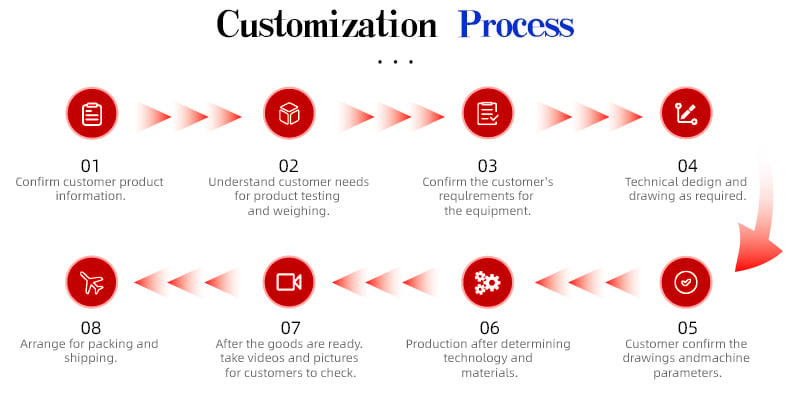
A frame built to your line is not ordered off a shelf, so here is the sequence it goes through. You tell us the product and the weighing job; we agree the requirement and put it into a drawing; you approve the drawing and the machine parameters; production follows; and before the crate is closed we send photographs and running video of your own machine. Packing and shipping come last.
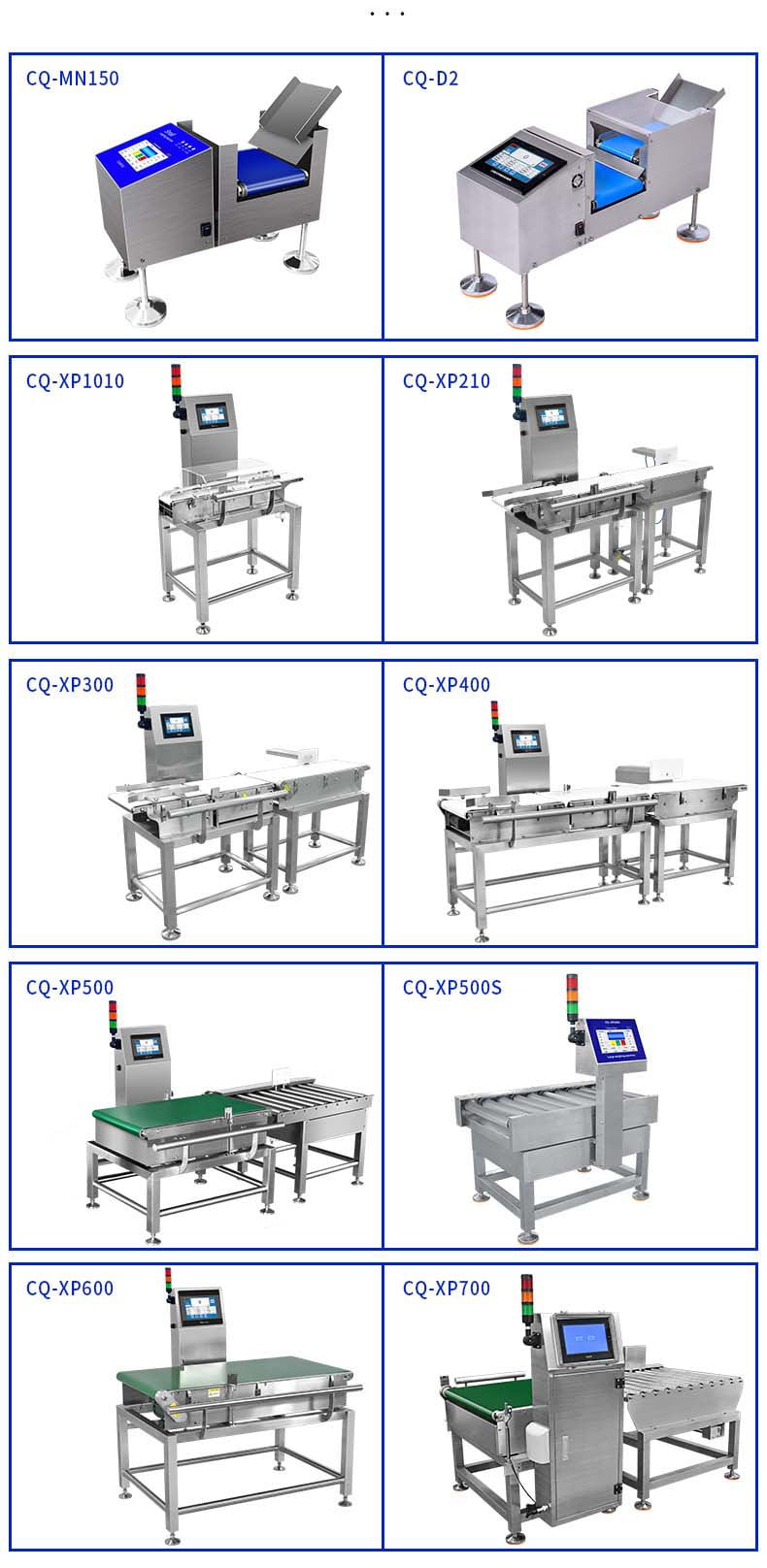
The XP600 is the heavy end of what we build for cartons. The same range covers the micro frames down at 0.01 g for sachets and blister packs, the mid-sizes around 1 kg to 15 kg, and the roller-transfer variants for lines that will not run a belt.
If your carton is nowhere near 60 kg, say so before you order — a smaller frame on a narrower belt will hold a tighter band for the same money, and we would rather sell you that one than this.
The frame draws AC 220 V, 50 Hz at 400 W and needs nothing else: because the out-of-tolerance response is an alarm and a belt stop rather than an actuator, there is no compressed air to provide and no airline to maintain.
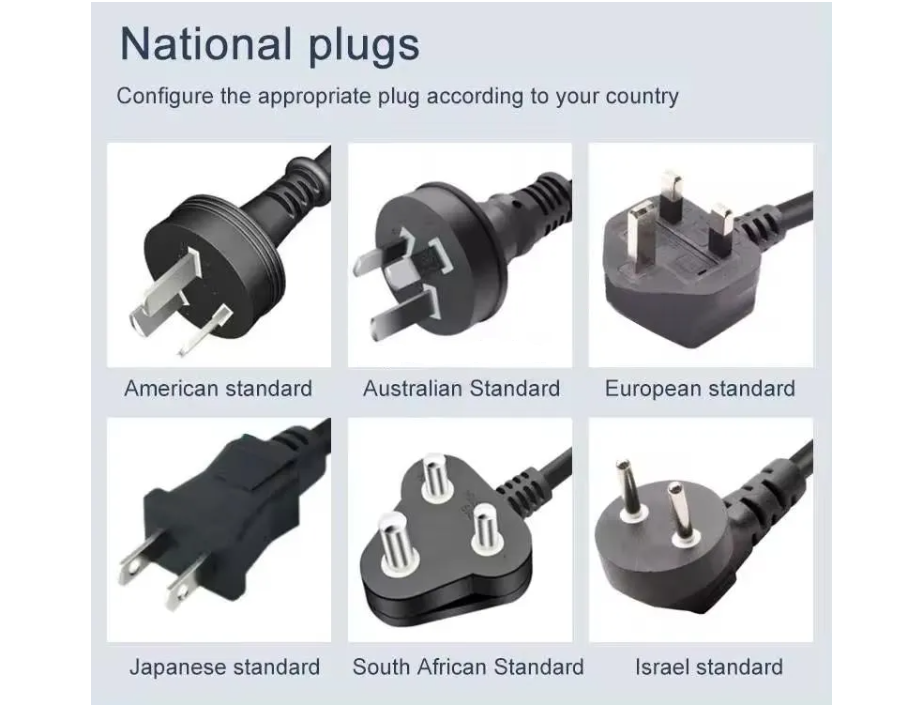
It ships with the plug your destination uses, so the machine can be run as soon as it is set down. Tell us the country and the voltage you have on site and we will match it.
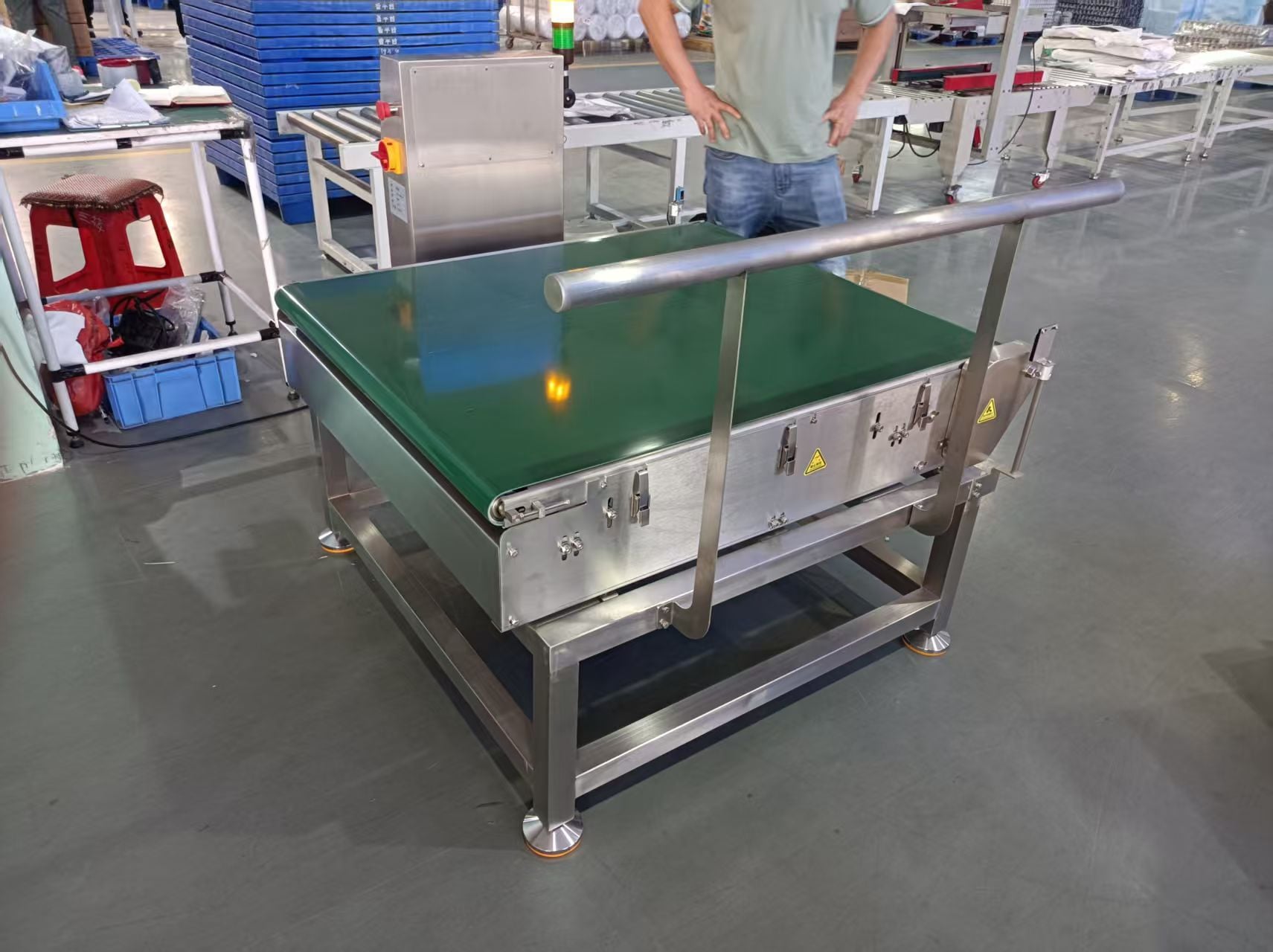
No frame leaves without being built up, wired and run on our own floor first. The photograph below is that floor: the same green belt and control column mid-build, with storage crates to one side and the rest of the shop behind it.
It is not pushed off. The light alarm is raised and the belt stops, and the operator lifts the carton off. Nothing on this frame touches the box.
± 5 g to ± 15 g for a carton crossing at a settled line speed, reading to 1 g.
Up to 650 mm long, 590 mm wide and 60 kg, on a 900 mm × 600 mm belt.
No. There is no actuator, so the frame runs on mains electricity alone.
Yes — that is what the drawing stage is for. Send the height your line runs at and the frame is made to suit.
One year on the whole machine, parts replaced free within it. Ships by sea, air or express; payment through Alibaba Trade Assurance if you prefer.
Send one line about what you are packing and how fast you run it, and we will come back on fit, on the band you can hold and on how the line should stop when a box is wrong.

 ONLINE