
Accipe Aestimationem Gratuitam

Legatus noster te mox contactabit.
Epistula electronica
Nomen
Nomen societatis
Nuntius
0/1000
Reprehendo ponderator

Reprehendo ponderator

Pagina prima>>Reprehendo ponderator

CQ-YWXP1010 Systema ponderationis altissimae praecisionis

CQ-YWXP1010 Systema ponderationis altissimae praecisionis

CQ-YWXP1010: Precision Weighing. Simplified.

  • Nullae Vitia: Siste productos leviore/graviore ad qualitatem et conformitatem garantitas.

  • Nullae Restrictiones: Pondere velocitate lineae productionis ut producat maximum.

  • Conecta et Utere: Integra cito et opera intuitable—parum praeparationis, parum disciplinae.

  • Fides Perpetua: Parata pro dura mediola 24/7 ut tueatur tempus operis tui.

  • Data quae Agi Possunt: Verte data pondus in tempore reali in meliores decisiones et meliorationes processus.

Quod resultat? Producta perfecta, maior efficentia, et totus controlus.

  • Conspectus
  • Inquisitio
  • Producta similia
CQ-YWXP1010 — Sub-Gram Inline Check Weigher

CQ-YWXP1010 Check Weigher With 0.01 g Resolution for High-Speed Small-Pack Lines

A 200 g ceiling and a 0.01 g scale, on a belt 250 mm long and 120 mm wide running at 10 to 60 m/min. Nothing here is built for cartons: it is for sachets, stick packs, small bottles, blister strips and machined parts, where the shortfall is a single tablet, one lid, or a nearly empty fill. The verdict is taken on the move, and the pack that fails is taken off the line.

Minima scala
0.01 g
Rangus ponderandi
Up to 200 g per pack
Velocitas lorum
10–60 m/min
In the clip: a sachet of normal weight passes, one lid is taken out of the next pack, and that pack is pushed off the belt.

Why 0.01 g On A Moving Belt

Scale et accuratio sunt duo numeri distincti, uterque hic magni momenti est. Scala 0.01 g est minimum gradus quem machina indicare potest; fascia accuratiōnis, ±0.05 ad ±0.1 g, est quantitas qua indicātiō ad veritātem appropinquat dum pācēs celeriter transeunt. Scala est quae unum tantum tabulam deesse detegere permittit; fascia est quae bonam pācem ab iactū prohibet.

In pācibus tam levis cingulum aeque magni momenti est atque cellula. Controller per totum transitum exempla sumit et ex parte stabili huius curvae operatur, non ex una tantum lectione, quod facit scalam 0.01 g in linea movēnte utilem. Zero tracking sequitur derivationem dum cingulum vertitur.

Tres Sectiōnēs Cingulī

The belt is carried in three sections: the pack is fed in, the weighing section is where the cell reads it, and the short section at the far end is where a failed pack is taken off. Separating them keeps the weighing section from seeing the vibration of the infeed and the thump of a reject — on packs measured in tenths of a gram that is the whole game.

Side elevation of the checkweigher on a white background: the narrow white belt running the length of the stainless frame between its side plates and end rollers, the clear guard cover standing over the weighing section, the control column behind with its touch screen and the signal tower lamp, a red emergency stop and an orange rotary switch on the column, and the air filter and regulator on the frame below with a blue air line
From the side: the belt between its side plates, the clear guard over the weighing section, and the filter and regulator on the frame.

How A Reject Leaves The Line

Four removal devices are offered on this frame: a pusher travelling across the belt, a flap, an air blow, or a swing arm. On a pack this light the choice comes down to the pack — a sachet that will not survive being pushed may be happy being blown off, and a rigid blister strip is the other way round.

All four are pneumatic, and the frame carries its own filter and regulator. The clip shows the pusher: one lid is taken out of a pack, and that pack is taken off the belt.

Close-up of an air blow nozzle on the checkweigher: a stainless nozzle body with a flat fan-shaped tip lying across the belt line, held in a stainless bracket, fed through a brass fitting and a bright blue air line that loops away to the frame, with brushed stainless panelling behind and the belt edge below
The air blow option: the flat-fan nozzle on its bracket, on the blue air line.

Machine Views

The checkweigher straight on from the front on a white background: the control column rising centrally with its touch screen, red emergency stop and orange rotary switch, the signal tower lamp on a bracket to its left, the narrow white belt below with a clear guard cover over the weighing section, a stainless guard rail across the front of the frame, the air filter and regulator on the right of the frame with a blue air line, and four threaded feet with orange pads
Front on: the column and screen, the belt below it, and the guard rail across the frame.
The checkweigher on a white background in three-quarter view: the stainless frame on its legs, the belt running through it with the clear guard cover over the weighing section, the perforated stainless housing of the reject pusher standing across the belt to the right, the control column behind with the screen and the signal tower lamp, the guard rail across the front, and the air regulator on the frame below
Three-quarter view: the belt and guard, the reject housing across the belt, and the column behind.
The checkweigher from the far three-quarter on a white background: the guard cover lifted clear of the belt so the weighing section is open, the belt and its side plates visible through the frame, the control column with the screen and tower lamp behind, the stainless guard rail running along the front on its risers, and the air regulator and its blue air line below the right-hand frame
From the far side, with the guard lifted clear so the weighing section is open.

Dētaillia Technica / Praestātiō

Characteristica Dētaillia Technica / Praestātiō
Modellum CQ-YWXP1010
Rangus ponderandi ≤ 200 g per item
Minima scala 0.01 g
Praecisio in pondere ± 0.05 g to ± 0.1 g
In superpositione quae sectionem ponderationis transversat celeritate constante
Velocitas lorum 10–60 m/min, regulabilis
Perfusio Up to 100 pcs/min
Convector ponderans 250 mm (long.) × 120 mm (lat.)
Maxima Magnitudo Producti ≤ 100 mm (L) × 100 mm (L)
Modus Reiectionis Impulsor · lamella · flatus aeris · bracchium oscillans
Ad lineam et ad pachetum aptatum
Programmata productorum servata 100, cum automatica memoria discendi
Cellula oneris et regula Cellula oneris ZEMIC L6D16
Controller celeris A/D campionis
Materia corporis Accipiter inox SUS 304, IP54
Materialis cinguli transportantis Cibus gradus PU
Control and data schermum coloratum tactilis septem-pollicare
USB · RS232 · RS485
Fons Potentiae AC 220 V ± 10 %, 50 Hz, 90 W
Suppētītiō Aeris Externae 0,6–1 MPa
For the pneumatic rejection device
Dimensiones (L × L × A) 900 × 500 × 1250 mm
Ambitus operativus 0–40 °C, 30–95 % RH
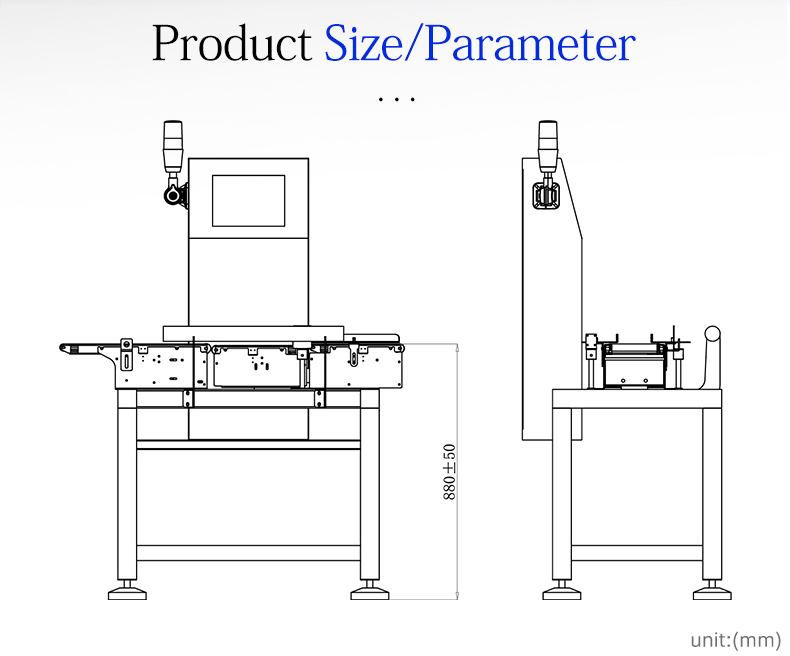
Two-view technical drawing of the checkweigher headed Product Size / Parameter and marked unit:(mm): the front elevation on the left showing the belt, the guard cover, the control column and its tower lamp above the frame, and the side elevation on the right showing the column, the belt section and the discharge end; a single dimension line measures from the floor to the belt surface
The drawing on this record: the belt surface stands 880 ± 50 mm above the floor.

Inside The Frame

The electricals sit in a lockable stainless cabinet rather than being spread through the frame, with the earth stud and the warning labels outside where an engineer expects them. The air filter and regulator sit on the frame within reach, so the drop that feeds the reject can be set without opening anything. The belt is guarded over the weighing section and the guard lifts clear for cleaning.

The checkweigher seen from behind on a white background: the tall stainless electrical cabinet with its hinged door, handle and a yellow warning triangle label at the top left, an earth label at the bottom, the control column and signal tower lamp rising above it, the belt and frame running out to either side behind the cabinet, the air filter and regulator on the left of the frame with a blue air line, and a coiled mains cable and plug hanging below
From behind: the electrical cabinet, its warning labels, and the coiled supply cable.

Where The XP1010 Earns Its Place

The 200 g range on a 250 × 120 mm belt is for packs up to 100 × 100 mm, at up to about 100 packs a minute. It suits lines where a missing tablet, a missing lid or an empty blister is the failure you are chasing — and where catching it by eye has stopped working.

It is not the frame for cartons, sacks or anything weighed in tens of grams upward; those want a wider belt and a heavier cell. Nor is it a laboratory balance: the accuracy above assumes a pack crossing at a steady speed. Send the pack and the line speed and we will say which frame the job belongs on.
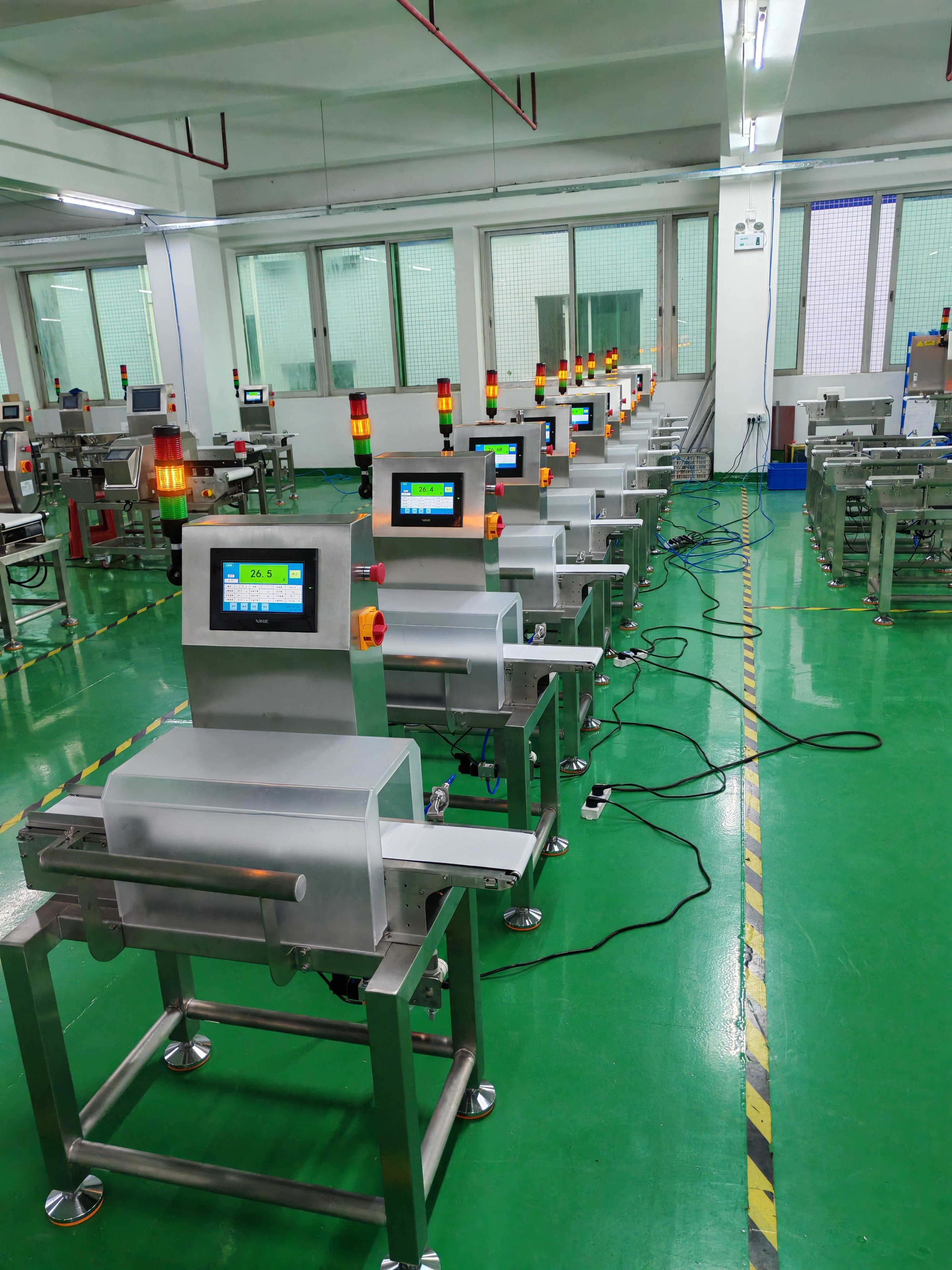
Built And Shipped From Our Floor

A row of completed checkweighers standing on a green workshop floor, each with its stainless frame, narrow white belt and clear guard cover, its control column showing a colour screen and its three-colour signal tower lit, the machines receding into the length of the workshop with yellow hazard markings on the floor alongside
Machines built and run on our floor before packing.
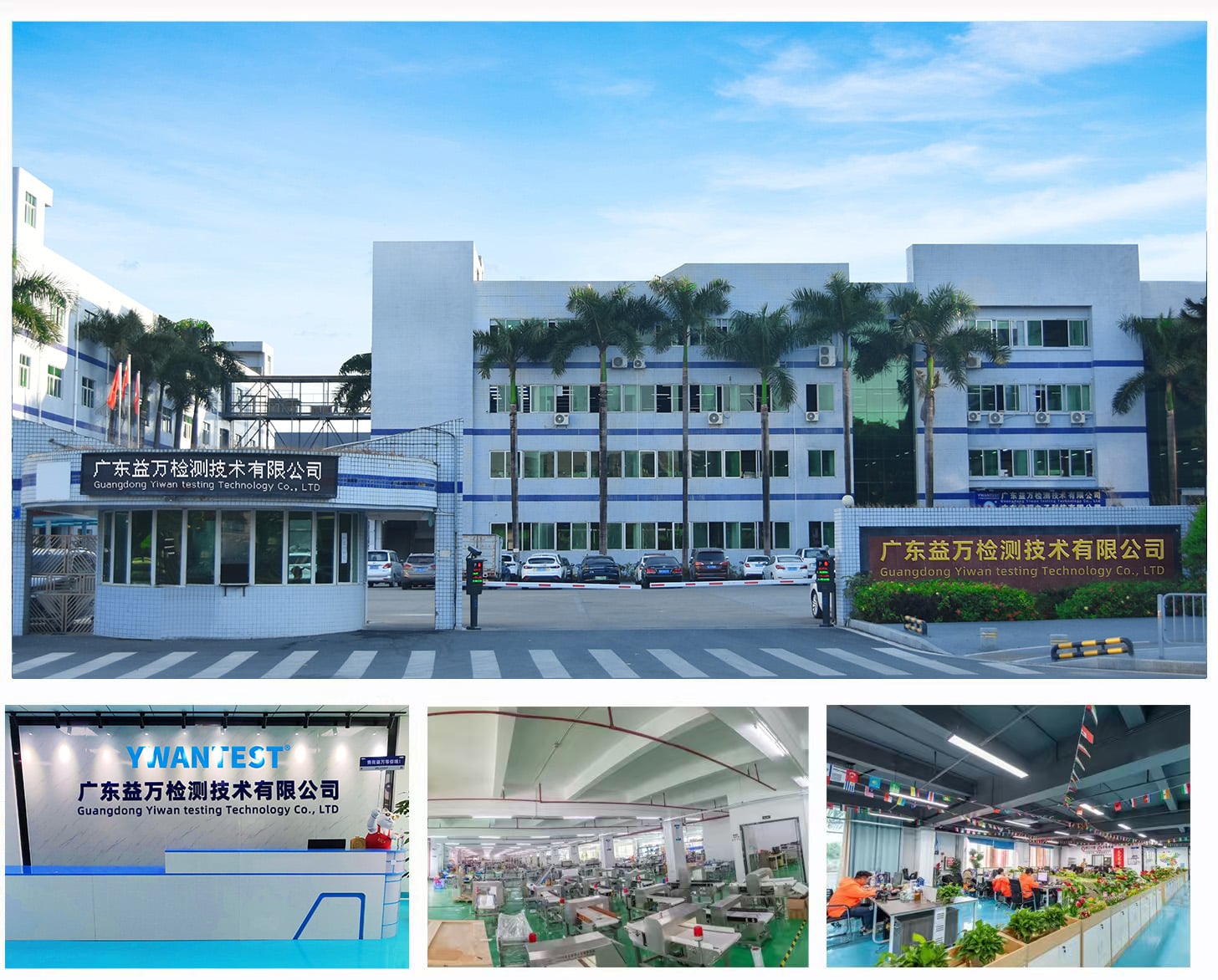
A composite of four views of the factory: the entrance gate and signboard of Guangdong Yiwan Testing Technology Co Ltd with palm trees and parked cars, the reception area with the company name in blue on the wall, a long machine-assembly workshop with benches and equipment, and an office area with staff at desks
Our own premises: the gate, the reception, the assembly hall and the office.

Quaestiones Communes

What is the difference between the 0.01 g scale and the accuracy band?

Scala est minimum gradus quod machina indicare potest. Fascia accuratiae, ± 0.05 ad ± 0.1 g, est quam prope istud indicium manet in pacco transiente ad velocitatem.

Quid in cingulo 250 × 120 mm capi potest?

Pacca usque ad 100 mm longa et 100 mm lata, usque ad 200 g singula — saccelli, stick packs, parvae bottellae, strigae blister et parvae partes machinatae.

Quomodo paccus defectuosus lineam reliquit?

Impulsor transversus cinguli, valvula, insufflatio aera aut brachium oscillans — electum secundum paccum. Omnes quattuor sunt pneumatici et structura suum proprium regulatorem habet.

Potestne ut automaticum suppeditari reprehendo ponderator ad lineam impachetandi?

Ita. Pendet in motu sine passu manu facto, et iudicium per USB, RS232 aut RS485 ad impressoram, PLC aut systema lineae emitti potest.

Quomodo impachetatur et mittitur?

In crate exportationis super palletam, per mare, aerem aut expressum internationale. Totum machinam unum annum, cum partibus gratis repositis intra eum, et solutio per Alibaba Trade Assurance fieri potest.

Mitte das Paket, und wir teilen dir mit, was dieser Rahmen aufnehmen kann.

Die Packgröße, das Gewicht pro Stück und die Fördergeschwindigkeit genügen uns, um Rückmeldung zu Passform, Genauigkeit und zum Abtransport eines fehlerhaften Pakets von deiner Linie zu geben.

Epistula electronica [email protected]· Telephonum +86 185 7599 3435 · Fabbrica: Oppidum Liaobu, Urbs Dongguan, Provincia Guangdong, Sina

Contactum Fac

Inscriptio electronica *
Nomen
Numerus Telephonicus
Nomen societatis
Nuntius *

Inquisitio Affinis

iNTERRETIALISINTERRETIALIS