
Get a Free Quote

Our representative will contact you soon.
Email
Name
Company Name
Message
0/1000
X Ray Machine

X Ray Machine

Home >   >  X Ray Machine

CQ-YW900 X-Ray Inspection System for Canned & Bottled Products | Foreign Body & Liquid Level Detector

CQ-YW900 X-Ray Inspection System for Canned & Bottled Products | Foreign Body & Liquid Level Detector

Every container is checked for two things on one pass: a foreign body, and the fill level.

Glass jars Through a filled jar the demo reported the same 0.6 mm as the empty-belt spec.
Cans and bottles They cross the beam standing up. The tunnel is 300 mm high and 250 mm wide.
Fill level The reading replaces the check your filler operator does by eye.

Tell us your container and its filled height, and we will check the fit and the fill-level setting.

  • Overview
  • Inquiry
  • Related Products
CQ-YW900 — Canned & Bottled Line

Canned and Bottled X-Ray Inspection System with Liquid Level Verification

A can or a bottle is checked twice on one pass: what is inside it, and how much. The tunnel is 250 mm wide and 300 mm high, so the container passes standing up, and the X-ray image that finds a fragment also reports the fill line.

Tunnel
250 × 300 mm
Detection, SUS 304
0.6 mm
Checks per pass
Foreign body + fill level
In the video: a filled glass jar goes through standing up, the X-ray screen boxes what it finds, and the test cards are held to it. The caption reads “Minimum SUS detection sensitivity: 0.6 mm”.

Built for Upright Cans and Bottles

The opening is taller than it is wide: 300 mm of height against 250 mm of width. A filled jar, can or bottle stands up as it crosses the beam, so the whole container is imaged in one pass instead of lying on its side.

Guide rods run along both sides of the belt, which is how a tall container stays where it should. The belt is food-grade PU, the frame SUS 304, and the machine runs from 10 to 70 m/min. A failed container is taken off by the pusher.
Tunnel
250 × 300 mm
Containers
Canned · bottled · boxed
Max. container
250 × 300 mm, up to 5 kg
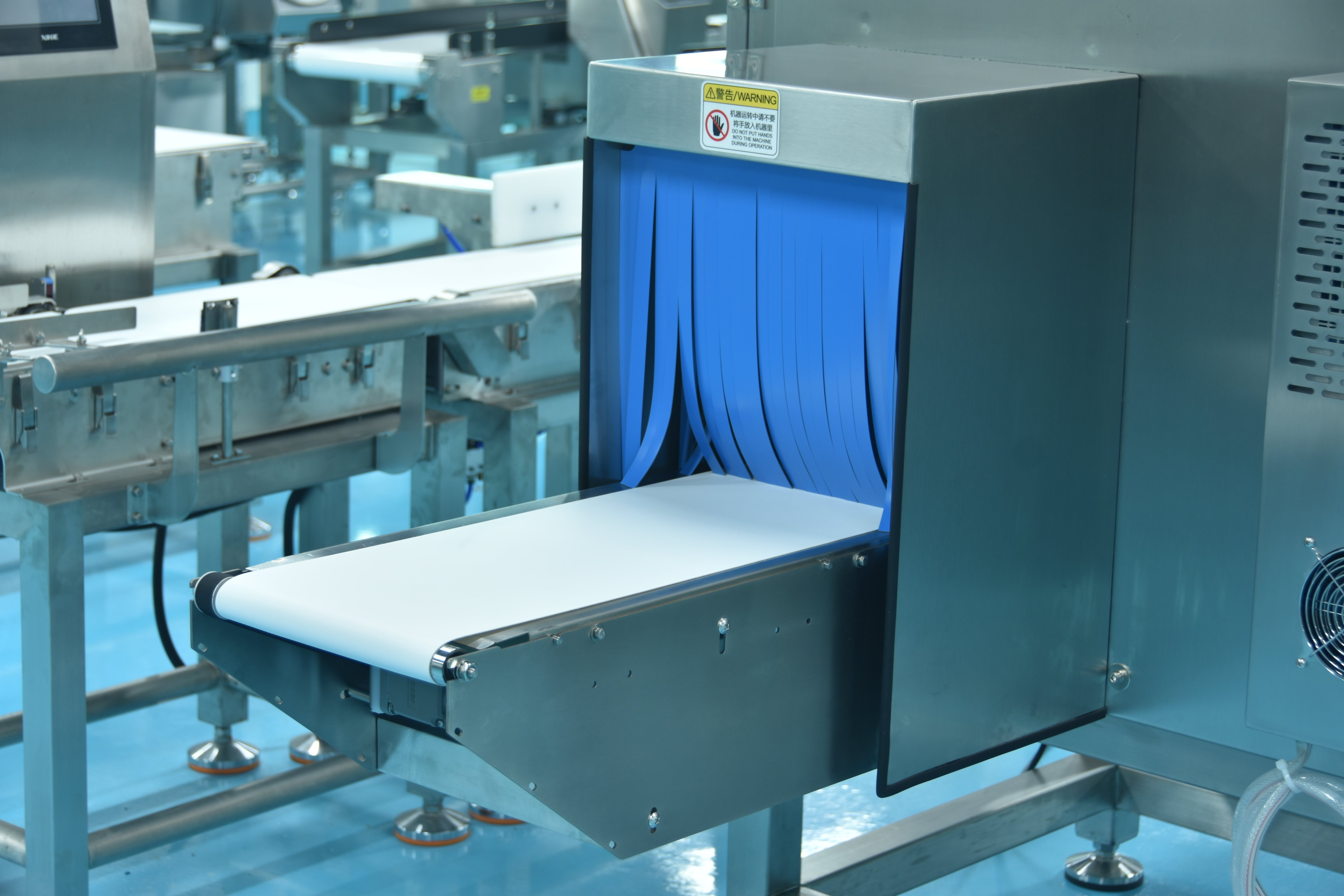
Close-up of the tunnel mouth on the CQ-YW900: blue curtain strips over the white belt, the warning label on the stainless housing, and the belt running out of the opening
The tunnel mouth: blue curtain strips over the belt, and the warning label on the housing above it.

Machine Views

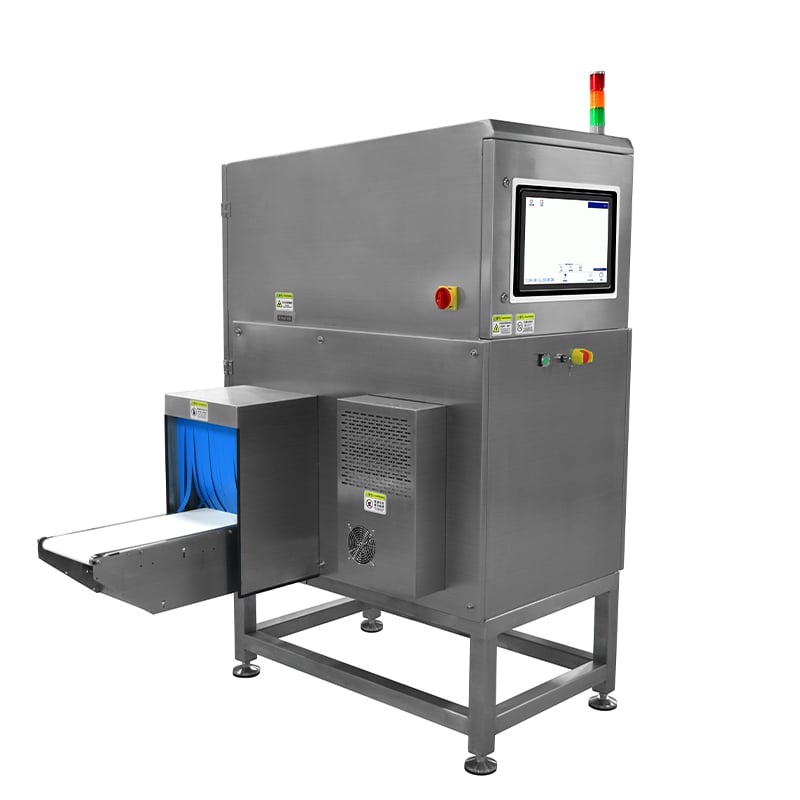
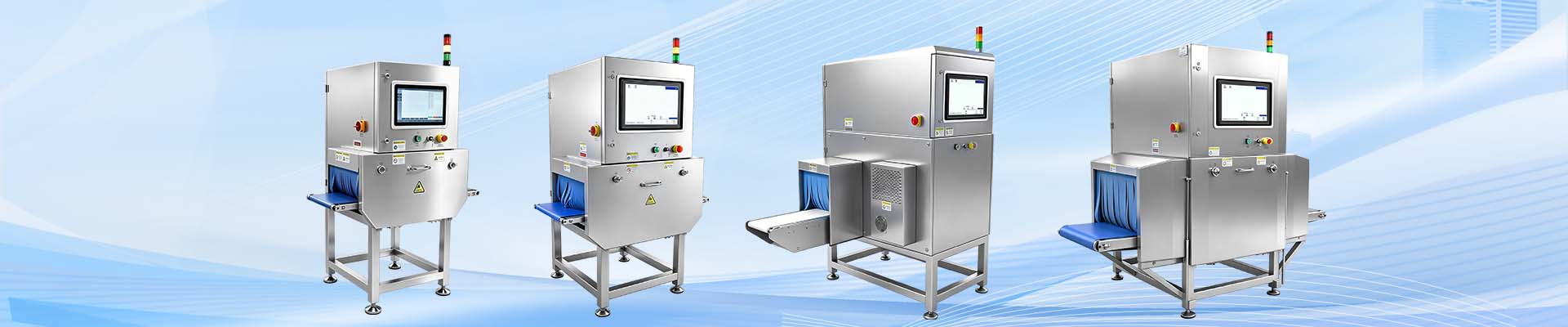
CQ-YW900 three-quarter view on white: tall stainless cabinet with touchscreen and tower light, cooling panel with fan grille, blue curtain strips and white belt
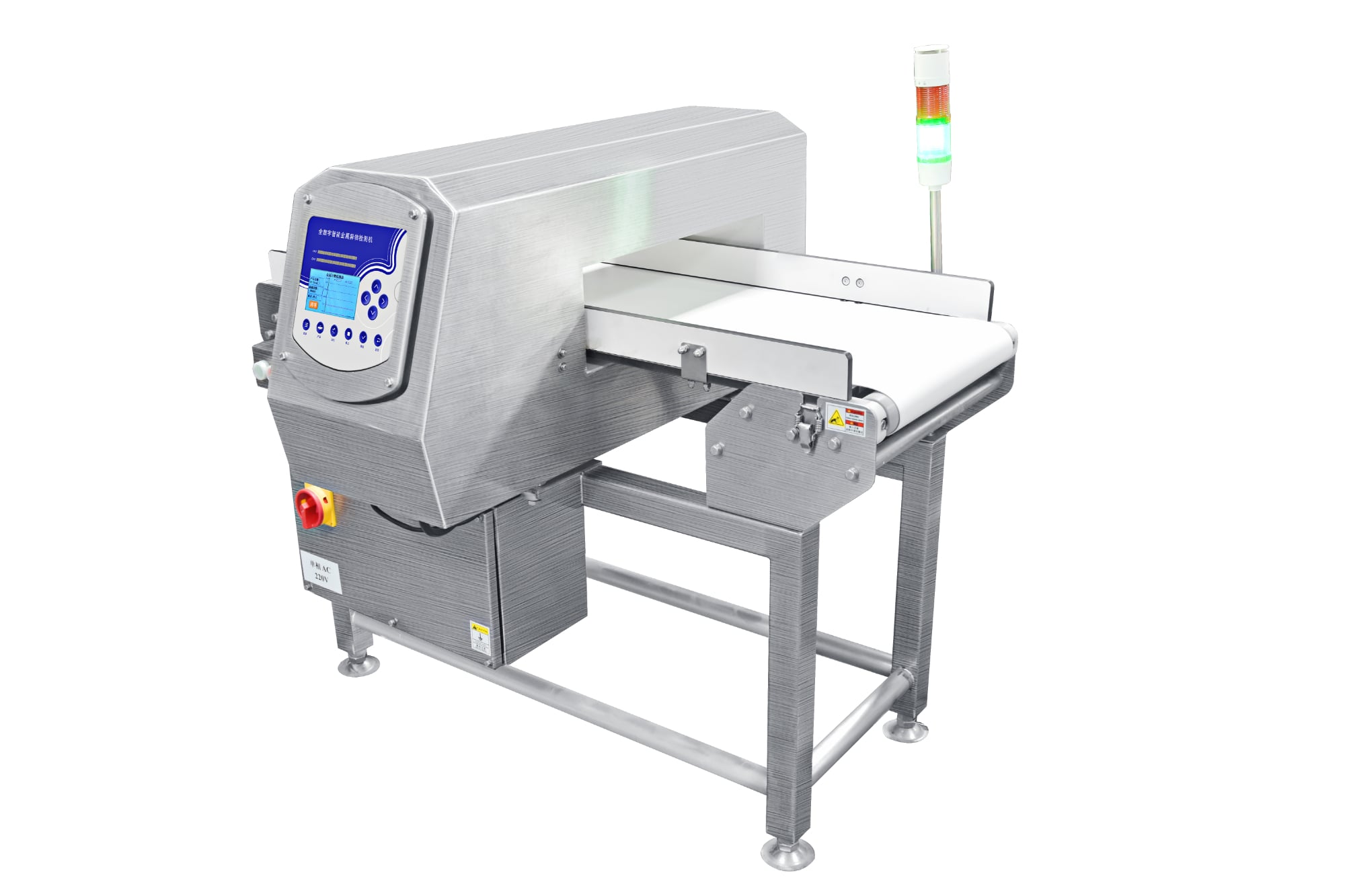
Three-quarter: the cabinet with its touchscreen, tower light and cooling panel, and the belt at the opening.
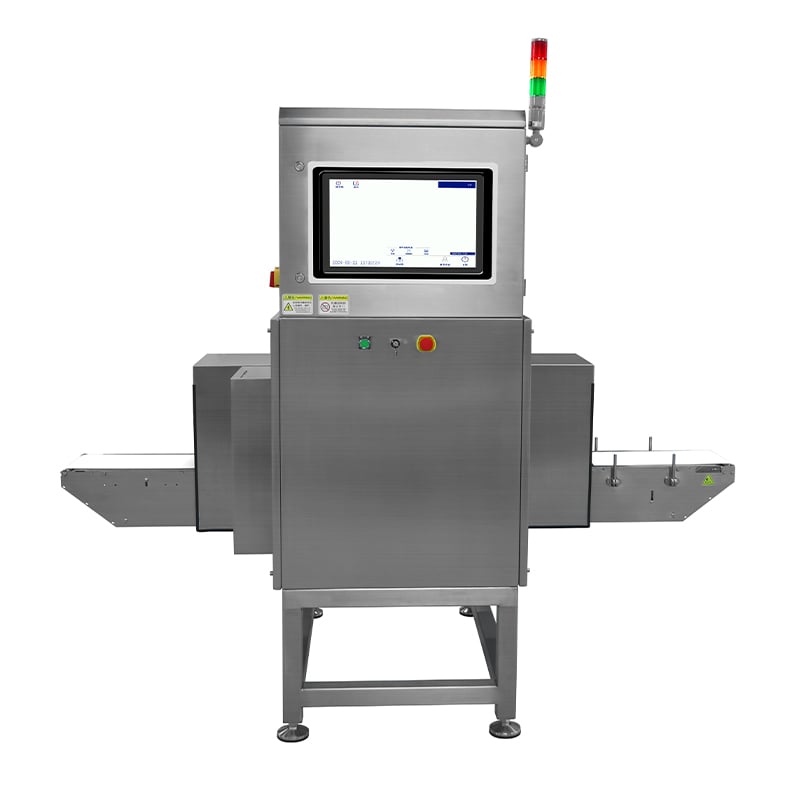
CQ-YW900 straight-on front view on white: touchscreen with the inspection software, start button, key switch and emergency stop, belt running through with guide rods on it
Straight on: the touchscreen, the start and stop buttons, the emergency stop, and the belt with its guide rods.
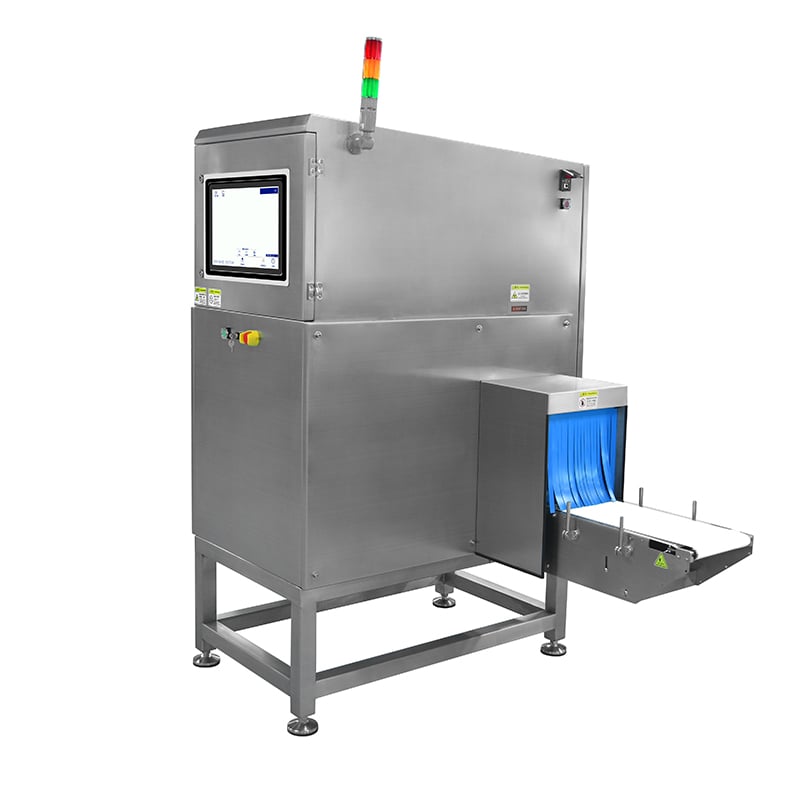
CQ-YW900 from the far side on white: touchscreen and emergency stop on the cabinet, blue curtain strips at the opening, white belt leaving with guide rods
From the far side: the same cabinet, the curtain strips, and the belt leaving the tunnel.

Technical Details / Performance

Feature Technical Details / Performance
Model / series CQ-YW900 — canned and bottled build
Checks Foreign body detection · fill level verification
Detection accuracy (min. sphere) 0.6 mm SUS 304 · 1.0 mm ceramic · 2.0 mm glass
Empty belt, no product in the beam
Tunnel size (W × H) 250 mm × 300 mm
Max. product size ≤250 mm (W) × 300 mm (H)
Product format Canned · bottled · boxed
Belt speed 10–70 m/min, adjustable
Load capacity Up to 5 kg (11 lbs) per container
Rejection method Pusher exclusion
X-ray source 150 W / 240 W / 350 W, selectable
Machine dimensions (L × W × H) 2480 × 1219 × 1794 mm (+100 mm)
Construction SUS 304 frame, food-grade PU belt
Power supply AC 220 V, 1.5 kVA, 50/60 Hz
Alarm Audible and visual
Ambient temperature −15 °C to +45 °C
Data interface LAN port · USB port
Display & language Touch screen, touch input · Chinese, English and others

Detection Accuracy

The specified figure is 0.6 mm of stainless steel with nothing in the beam; the manual marks that row no product. Through a filled glass jar the demo reports the same 0.6 mm. Ceramic is specified at 1.0 mm, glass at 2.0 mm.

0.6 mm
SUS 304
1.0 mm
Ceramic
2.0 mm
Glass

Specified on an empty belt, no product in the beam.
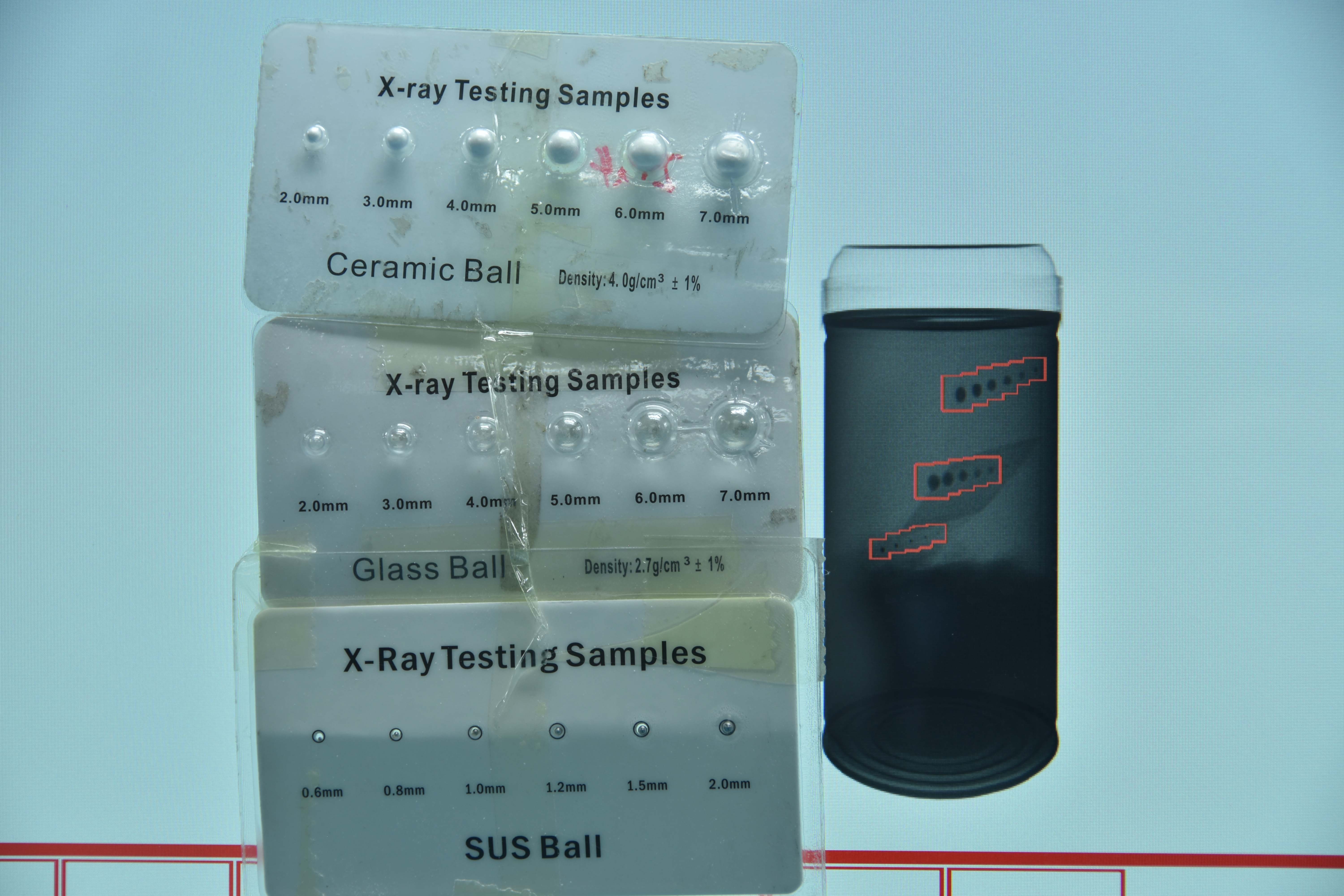
The three X-ray test cards, ceramic ball, glass ball and SUS ball up to seven millimetres, held in front of the machine screen, with the X-ray image of a jar beside them and the detected balls boxed in red
The three test cards — ceramic, glass, SUS up to 7 mm — at the screen, and the jar's image with the detections boxed.
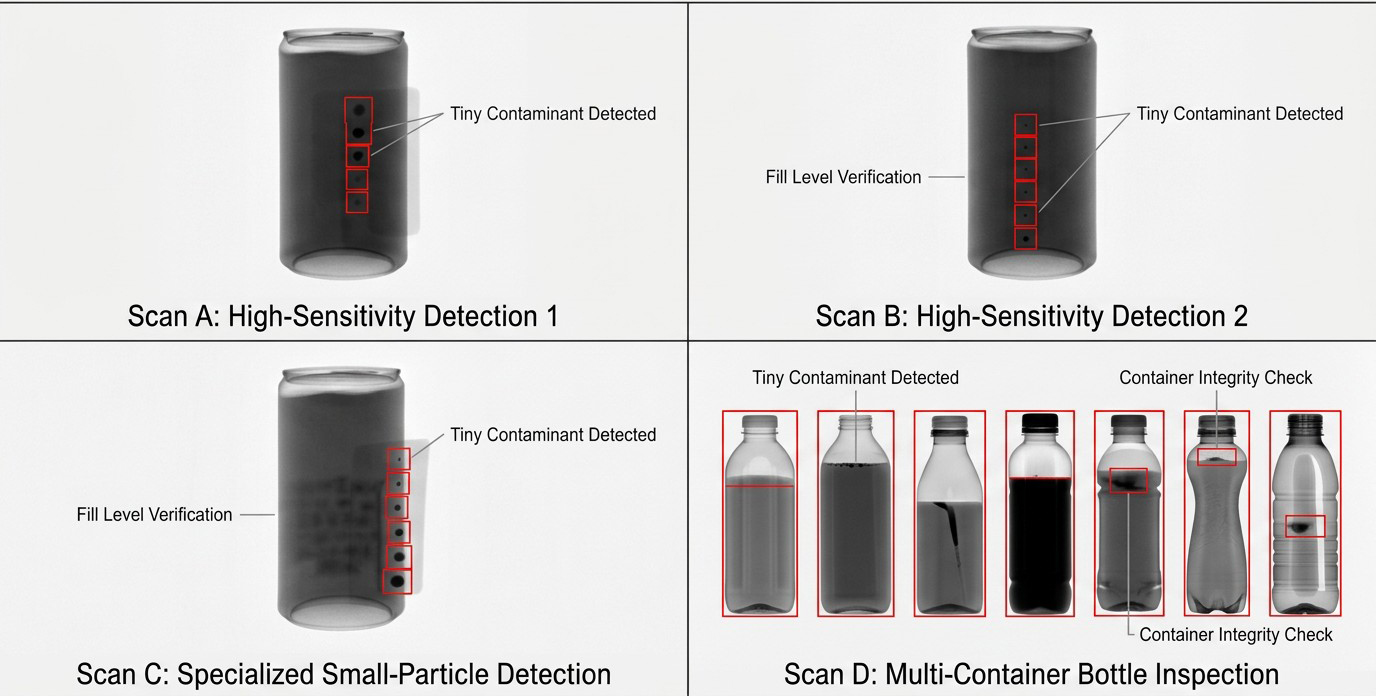
Four scans from the machine: a can with a tiny contaminant boxed, a can read for fill level with a contaminant boxed, a small-particle case, and seven bottles in a row with the fill line and a container defect marked on two of them
Four scans from one machine: a can with a fragment boxed, a can read for fill level, a small-particle case, and seven bottles with the fill line and a defect marked.

The fourth scan is the one buyers ask about. The fill line is read on every container, and a crease or dent is called out separately from contamination.

What The Image Shows

The verdict is drawn from an image, so one pass can be asked several questions at once.
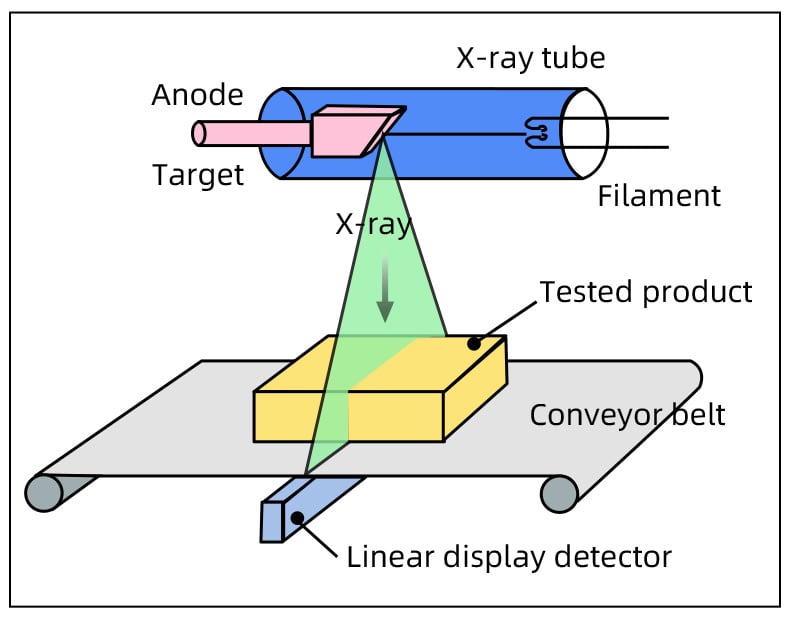
X-ray principle diagram: X-ray tube with anode, target and filament above the belt, tested product on the conveyor, linear display detector below
The tube sits above the belt and the detector below it; the picture is the beam that got through.
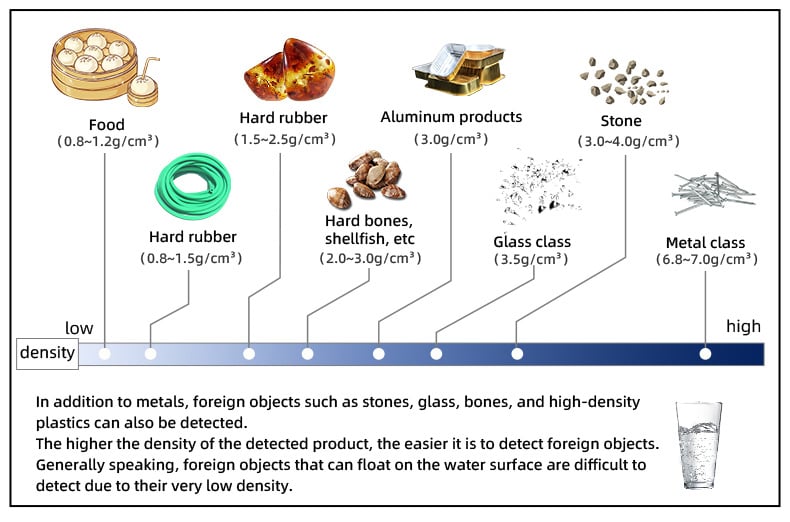
Density scale chart placing food, hard rubber, aluminium, stone, bone and shellfish, glass and metal on a low-to-high density bar
Visibility follows density: food low on the scale, metal at the top, stone, glass, bone and dense plastic between.
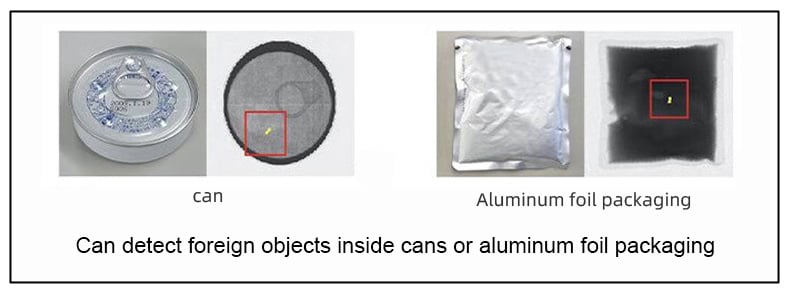
X-ray images of a can and of aluminium foil packaging, with the detected foreign object boxed in red
A can is the case in point: the container gives a metal detector nothing to work with, and the X-ray image is unaffected.
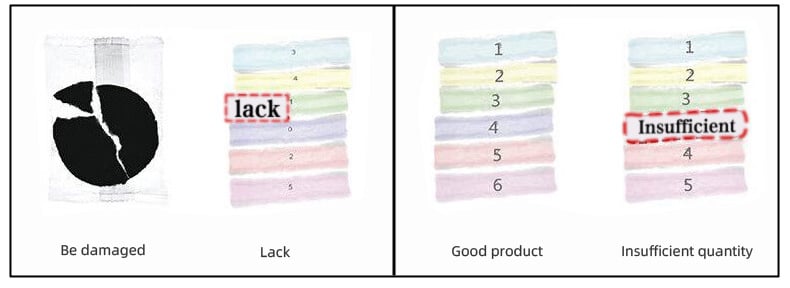
Shape and quantity detection: a damaged pack, a pack with a missing layer, a good stack and a pack with an insufficient quantity
Shape and quantity from the same frame: a dented container, a missing layer, a short count.
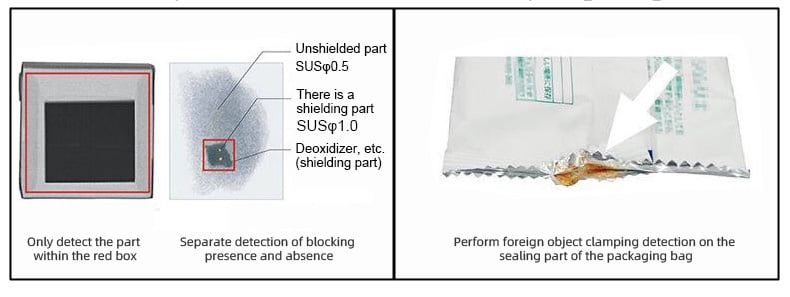
Shielding detection separating a shielding part from the unshielded part, and foreign-object clamping detection on the seal of a packaging bag
A shielded section read on its own, and a foreign body caught in the seal.

How The YW900 Checks A Container

The X-ray tube sends a fan through the standing container and the detector underneath records what arrived, which the software draws as a greyscale image; anything denser than the fill stands out.

Two readings come from that one X-ray image: whether an object is present that should not be, and where the top of the fill sits. Either can fail a container, and the pusher takes it off the belt.

The image, the verdict and the fill reading go to the log, and the live frame stays on the touchscreen.
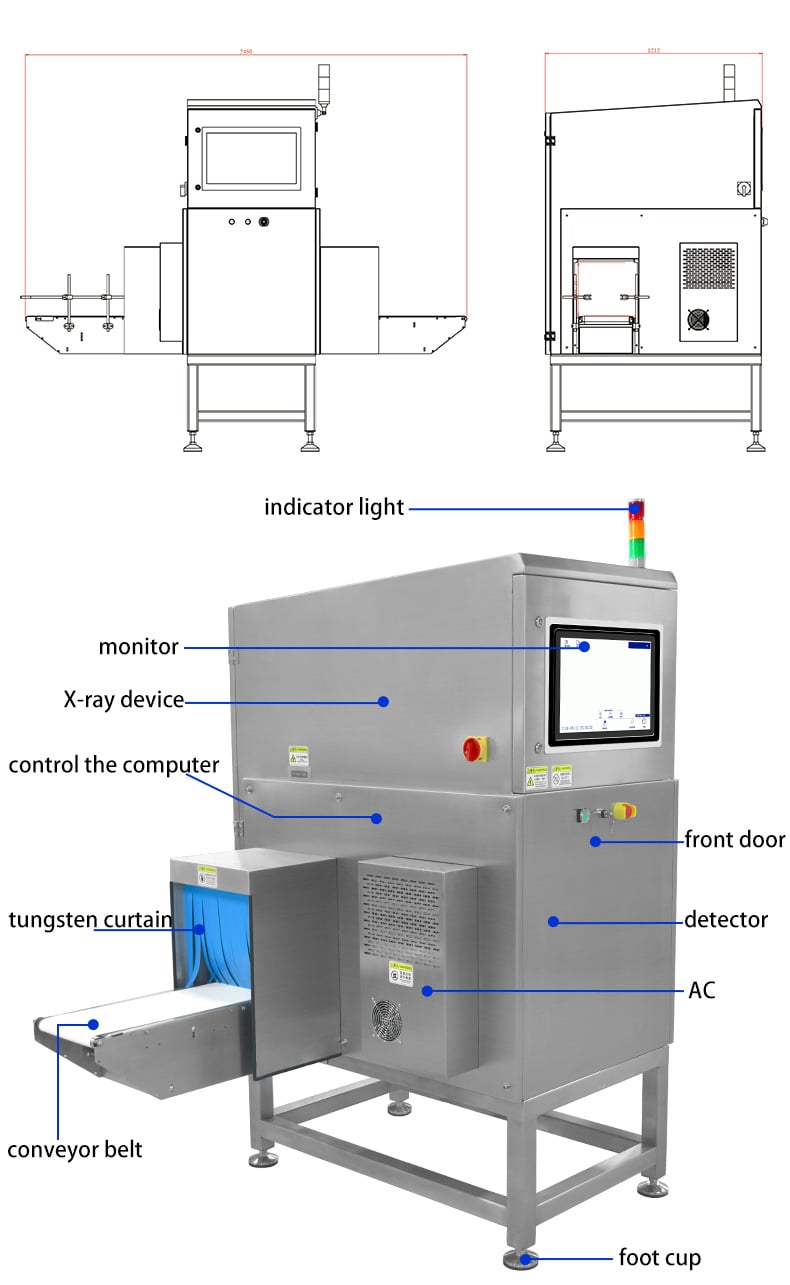
Labelled overview drawing of the machine with callouts for indicator light, monitor, X-ray device, control computer, front door, tungsten curtain, detector, AC unit, conveyor belt and foot cups
What sits where: indicator light, monitor, X-ray device, control computer, front door, tungsten curtain, detector, AC unit, belt, foot cups.

Where This System Fits

Lines that fill a container and then have to prove it: jars, cans, bottles and boxed product. The 300 mm of tunnel height is what a filled jar needs, and the level reading replaces the check your filler operator does by eye.

The container can be glass, metal or plastic and the fill thick or thin, because the X-ray image forms through both. Sauces, jams, drinks and seafood run the same way. What the beam resolves through a fill depends on its density, which is why we ask for the container rather than a category.

On The Floor

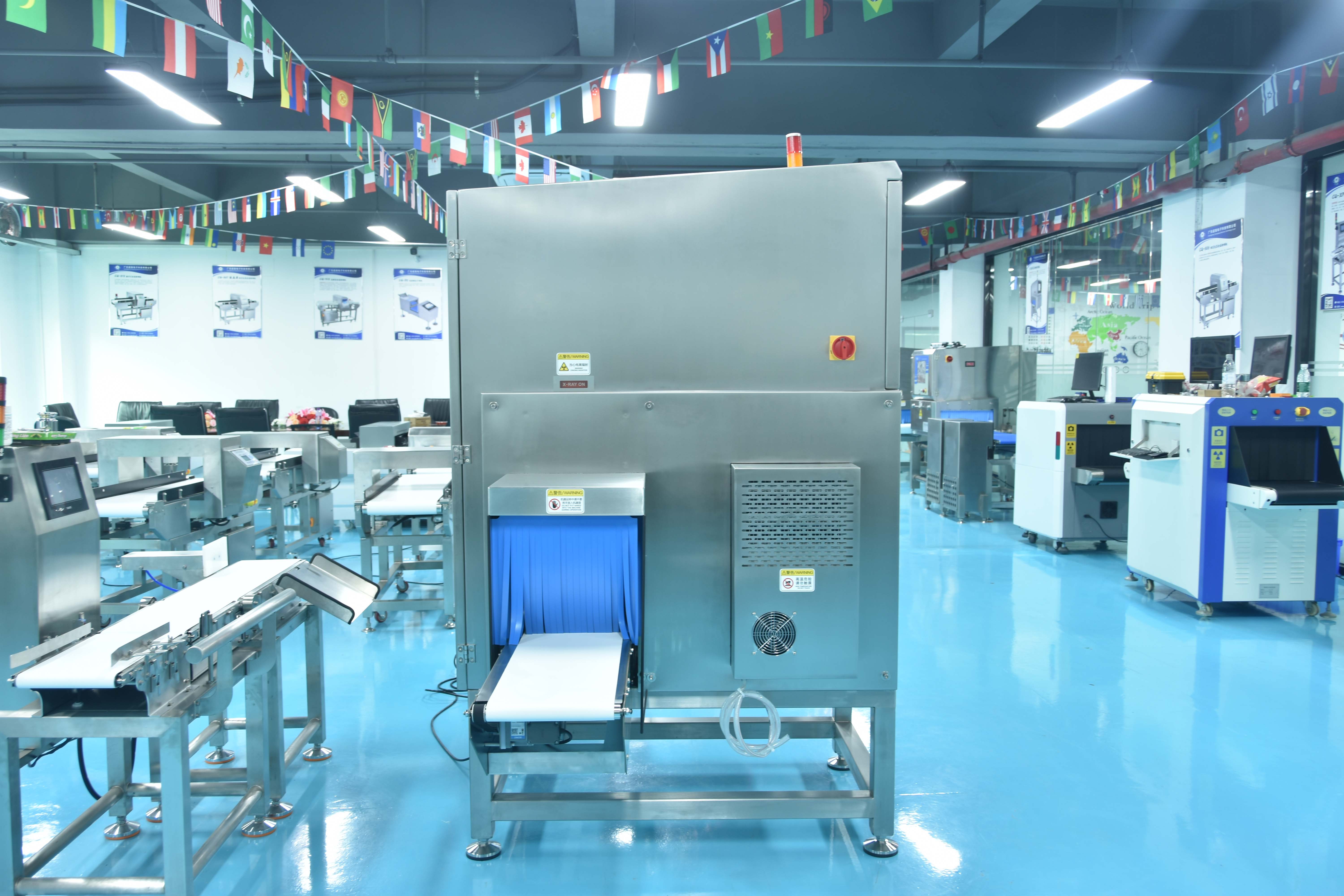
Every unit is assembled, wired and run in at our plant in Dongguan before it is crated. Below: a YW900 on the floor.
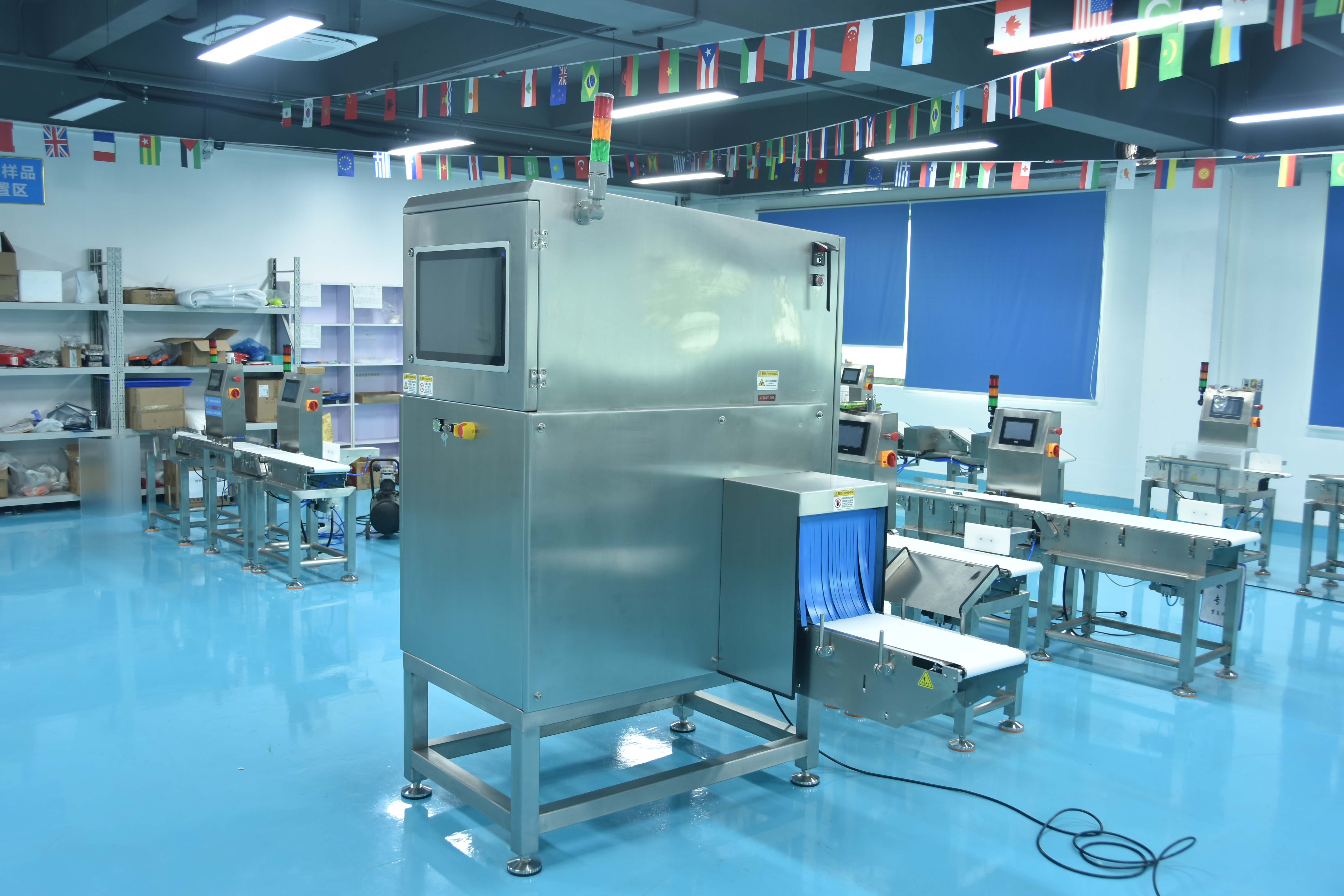
A CQ-YW900 standing on the showroom floor with other inspection machines around it, flags strung across the ceiling and a blue resin floor
On the floor: the cabinet, tower light and curtain strips in place.
A CQ-YW900 seen from behind on the showroom floor, cooling panel and fan grille visible, belt and curtain strips at the opening, product posters on the wall
From the far side: the cooling panel and fan grille, and the belt leaving the opening.

Common Questions

What fits through the YW900 tunnel?

One container at a time, up to 250 × 300 mm and 5 kg: canned, bottled or boxed, standing up.

Does it check anything besides foreign bodies?

The fill level, from the same image, plus container integrity checks such as a crease at a bottle neck.

How small an object will it find?

0.6 mm SUS 304 on an empty belt, and the same through a filled glass jar in the demo. Ceramic 1.0 mm, glass 2.0 mm.

What keeps a tall bottle upright?

The tunnel is 300 mm high, and guide rods run along both sides of the belt.

How does a failed container leave the line?

A pusher takes it off the belt, without an operator stepping in.

How does the data get out?

A LAN port and a USB port. Each verdict is logged with its image and the fill reading.

Running filled jars or cans? Tell us — we will size the YW900 tunnel around your container.

Send the container, its filled height and your belt speed. We will come back on fit, on the level reading and on the pusher.

E-mail [email protected] · Phone +86 185 7599 3435 · Factory: Liaobu Town, Dongguan City, Guangdong, China

GET IN TOUCH

Email Address *
Name
Phone Number
Company Name
Message *

Related Search

cq yw900 canned bottled x ray inspection system-0
onlineONLINE