
Get a Free Quote

Our representative will contact you soon.
Email
Name
Company Name
Message
0/1000
X Ray Machine

X Ray Machine

Home >   >  X Ray Machine

CQ-YW800 Split-Type X-Ray Inspection System | 0.4mm Ultra-Precision Food Scanner

CQ-YW800 Split-Type X-Ray Inspection System | 0.4mm Ultra-Precision Food Scanner

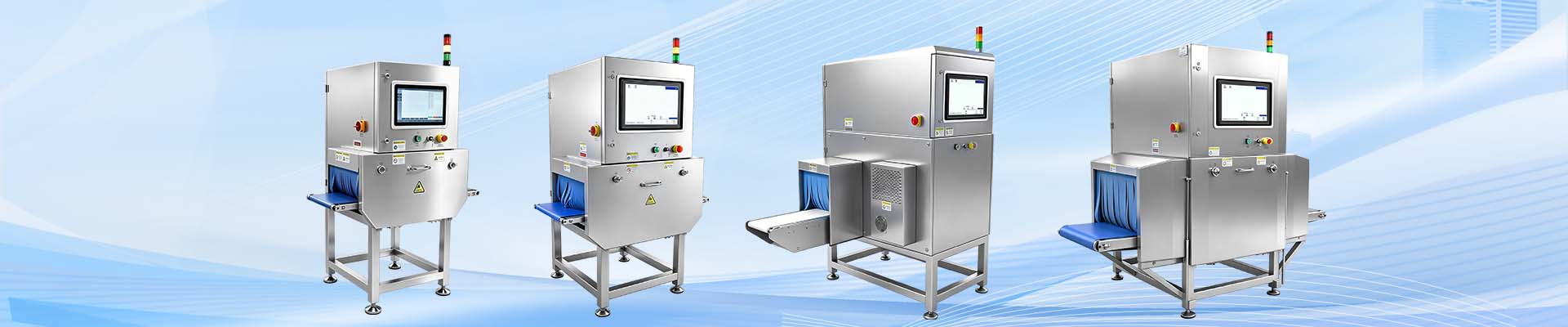
The machine comes in two parts, so it is easy to move and adjust to your production line.

Upper floor Easy to move up by lift or stair. One long machine will not go.
Boxed-in lines Fits and adjusts into a line where other equipment leaves no room.
Hotpot-base packs The demo found 0.8 mm SUS through the pack. The empty-belt figure is 0.4 mm.

Tell us how the machine gets in and where it has to sit. We will check both parts fit.

  • Overview
  • Inquiry
  • Related Products
CQ-YW800 — 4020 Split-Type Push Rod

Split-Type 4020 X-Ray Inspection System with Pusher Rejection

This machine arrives as two frames: the inspection cabinet, and the reject conveyor that carries the pusher. The belt bridges them, so a 2143 mm body can be taken apart for the journey and rejoined on site — with the pusher kept clear of the detector.

Machine size
2143 × 990 × 1845 mm
Detection, SUS 304
0.4 mm
Load per pack
Up to 5 kg (11 lbs)
In the video: a hotpot-base pack crosses the beam, then test balls go into the next one. Through the pack the captions give SUS 0.8 mm, ceramic 1.0 mm, glass 2.0 mm.

Split Frame with Pusher Rejection

The cabinet holds the X-ray source, the detector and the control computer. The second frame carries the belt running out of the tunnel and the pusher that clears a failed pack, and a bridge of belt spans the join so the product crosses without a hand-off.

Buying it this way is usually about the building rather than the food: two short frames go through doorways and lifts that one 2143 mm body will not, and once in place the machine behaves as one line. Nothing mechanical happens over the X-ray beam itself.
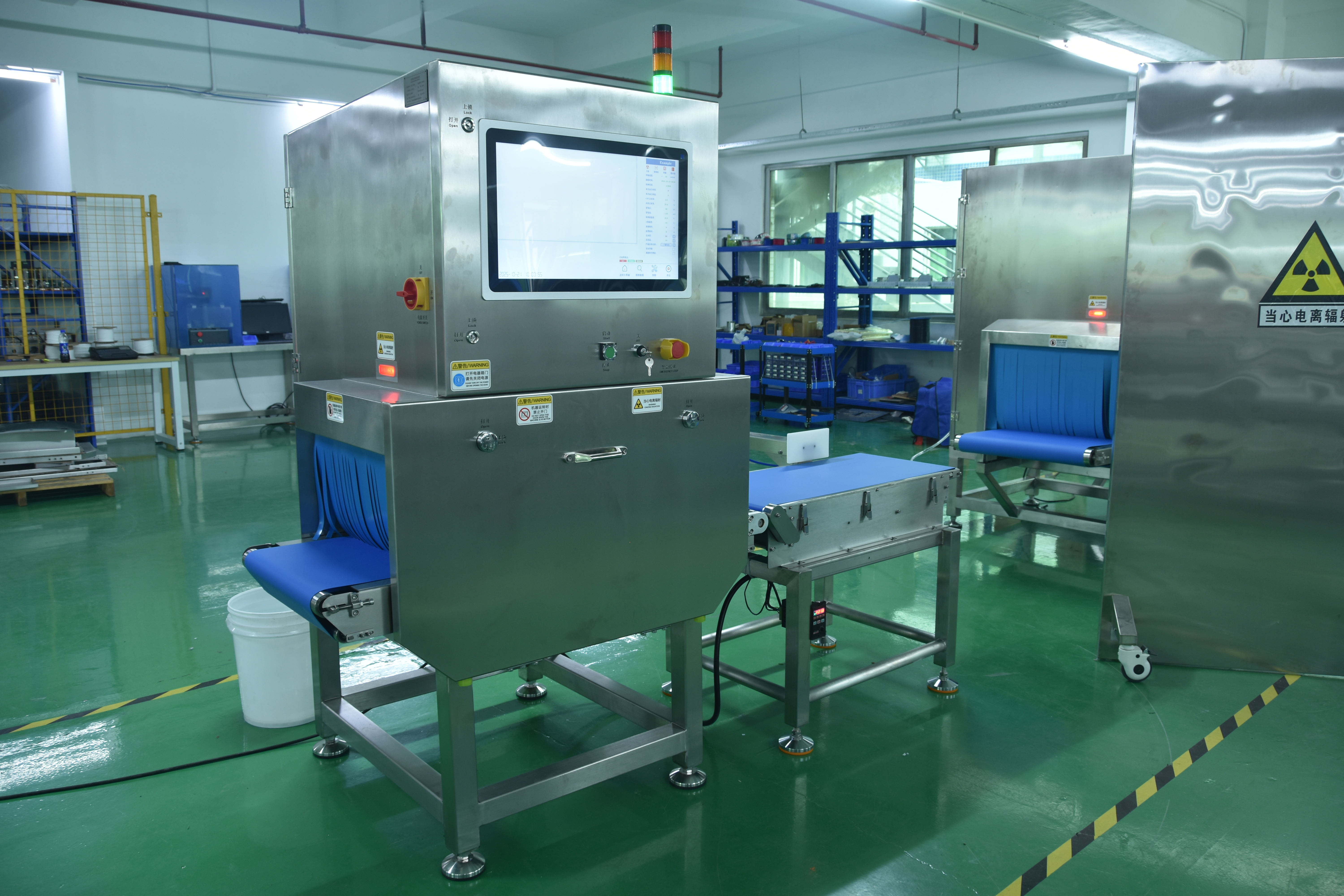
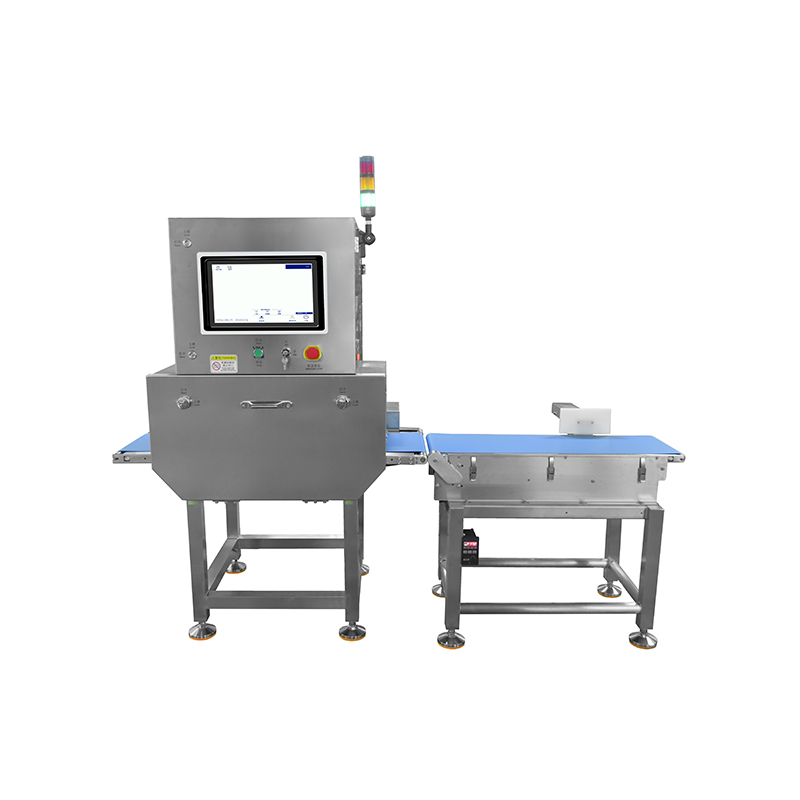
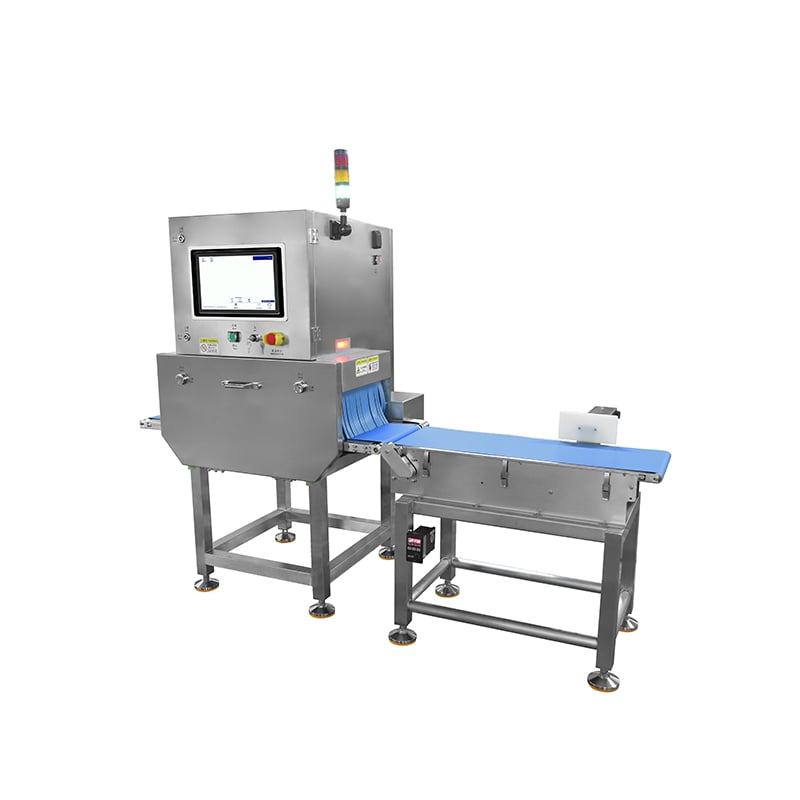
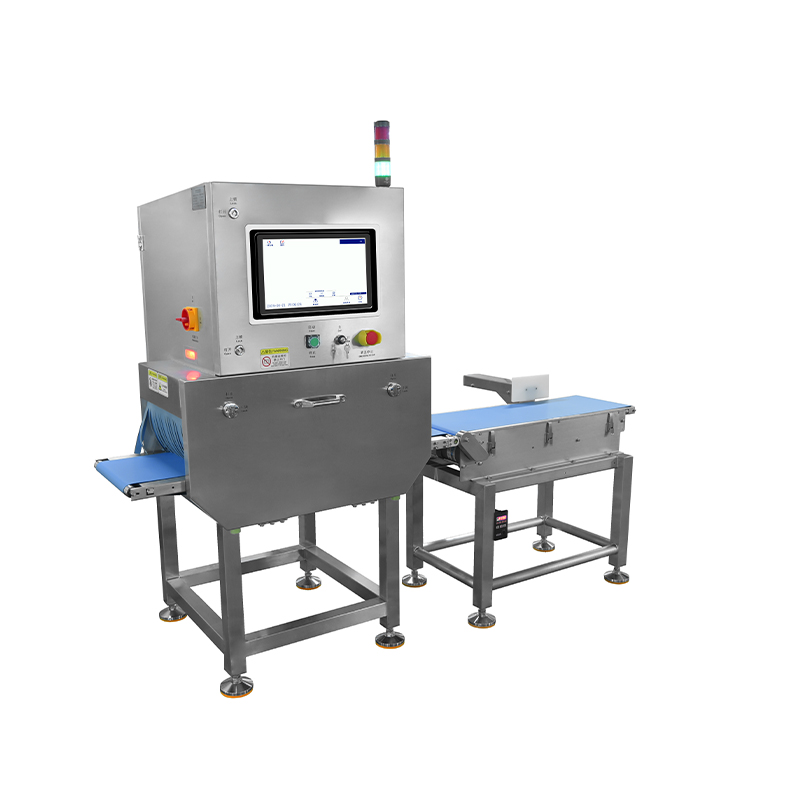
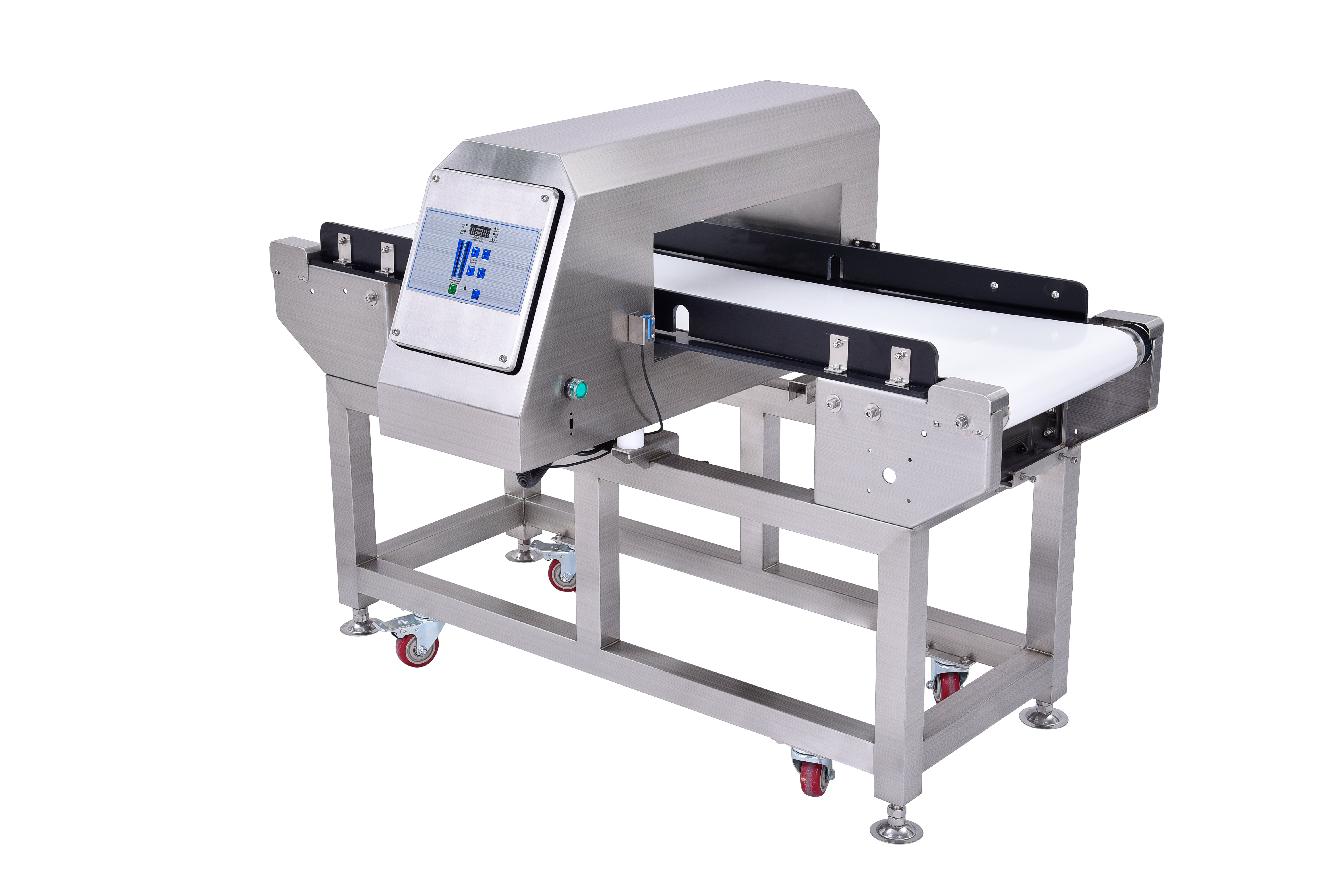
A CQ-YW800 4020 split-type machine in the workshop: the inspection cabinet with its touchscreen and emergency stop, the fluted belt bridging to the second frame, and the pusher unit sitting over the reject belt
The two frames in the workshop: the cabinet, the belt bridging the join, and the reject belt with the pusher unit above it.
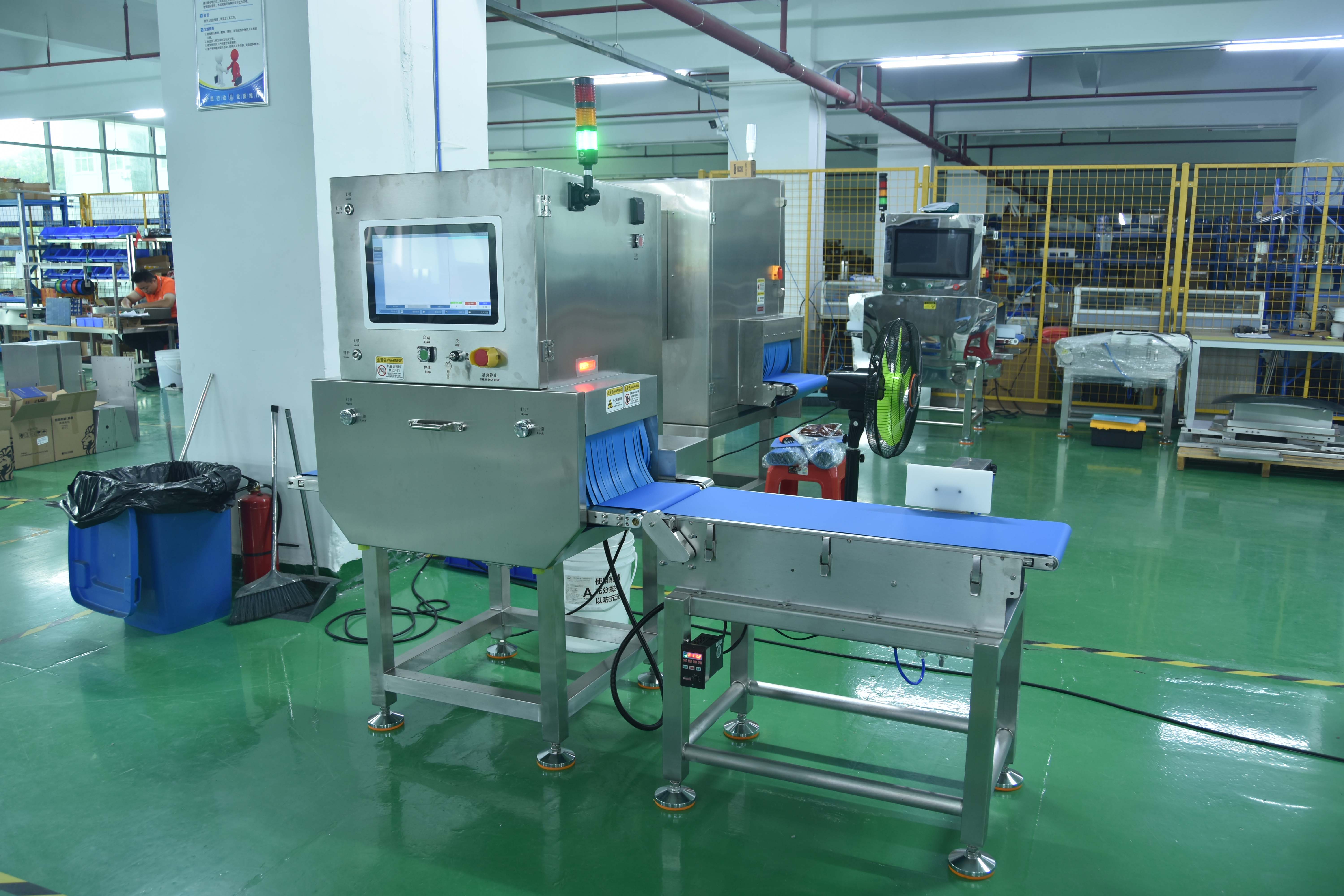
The split-type machine during assembly, cabinet and reject conveyor lined up on the workshop floor with a second machine behind and a worker at a bench
Lined up during assembly, with the reject conveyor set to the cabinet before the belt is joined.

Machine Views

CQ-YW800 4020 split-type machine front view on white: the inspection cabinet with touchscreen, tower light and warning labels, and the separate reject conveyor frame to its right
Front on: the cabinet with its touchscreen and tower light, and the reject conveyor as its own frame.
CQ-YW800 4020 split-type machine three-quarter view on white: cabinet with screen and controls, fluted belt bridging to the second frame, pusher device over the reject belt
Three-quarter: the cabinet and controls, the belt crossing the join, and the pusher over the reject belt.
CQ-YW800 4020 split-type machine from the far side on white: touchscreen and emergency stop on the cabinet, belt running through, second frame with the reject belt beyond
From the far side: the same cabinet past the belt, with the second frame beyond.

Technical Details / Performance

Feature Technical Details / Performance
Model / series CQ-YW800 — 4020 split-type push rod
Rejection method Pusher exclusion, on the second frame
Detection accuracy (min. sphere) 0.4 mm SUS 304 · 1.0 mm ceramic · 2.0 mm glass
Empty belt, no product in the beam
Tunnel size (W × H) 400 mm × 200 mm
Max. product size ≤280 mm (W) × 200 mm (H) · or ≤400 mm (W) × 60 mm (H)
Belt speed 10–70 m/min, adjustable
Load capacity Up to 5 kg (11 lbs) per pack
X-ray source 150 W / 240 W / 350 W, selectable
Machine dimensions (L × W × H) 2143 × 990 × 1845 mm (+100 mm), two frames
Product formats Bagged · boxed · bulk
Construction SUS 304 frame, food-grade PU belt
Power supply AC 220 V, 1.5 kVA, 50/60 Hz
Alarm Audible and visual
Ambient temperature −15 °C to +45 °C
Data interface LAN port · USB port
Display & operation Touch screen, touch input
Display language Chinese, English and others

Detection Accuracy

With nothing in the beam the manual specifies 0.4 mm of stainless steel, 1.0 mm ceramic and 2.0 mm glass, and marks that row no product. Put a pack in the X-ray beam and the figures move with what the beam has to cross: on a hotpot-base pack, SUS 0.8 mm.

0.4 mm
SUS 304
1.0 mm
Ceramic
2.0 mm
Glass

Specified on an empty belt, no product in the beam.
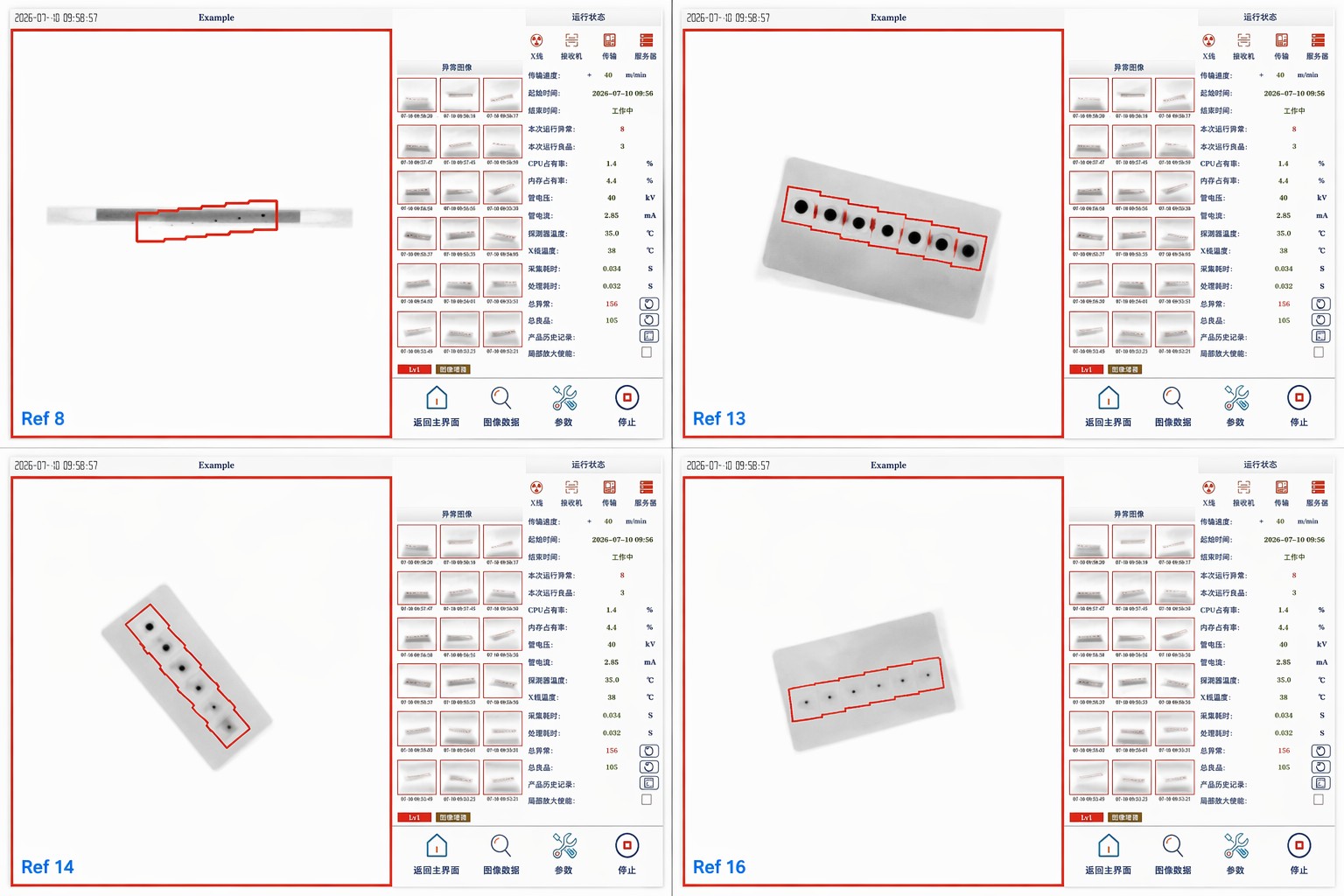
Four screens from the machine software, each showing an X-ray image with the test balls boxed in red, alongside a running status panel reading belt speed, kV, mA, rejects, good packs and a thumbnail history of flagged images
Four screens from one run: test cards with the balls boxed in red, and the status panel alongside — 40 m/min, 40 kV, 2.85 mA, 8 rejects and 3 good packs, with a thumbnail of each flag.

The panel doubles as the shift record — counters, tube voltage and current, and a thumbnail of every rejection.

What The Image Shows

One pass produces one picture, and that picture answers more than one question.
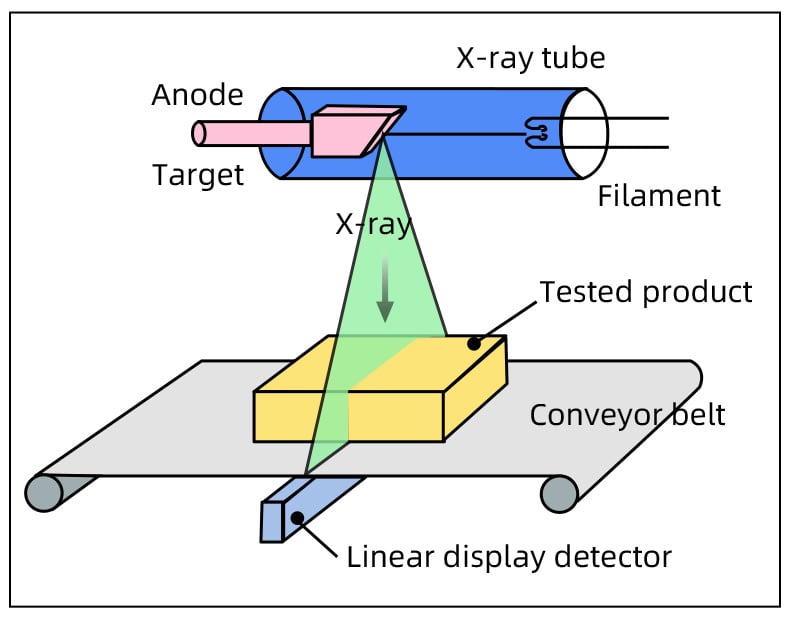
X-ray principle diagram: X-ray tube with anode, target and filament above the belt, tested product on the conveyor, linear display detector below
The beam leaves the tube, crosses the pack on the belt, and lands on the detector below.
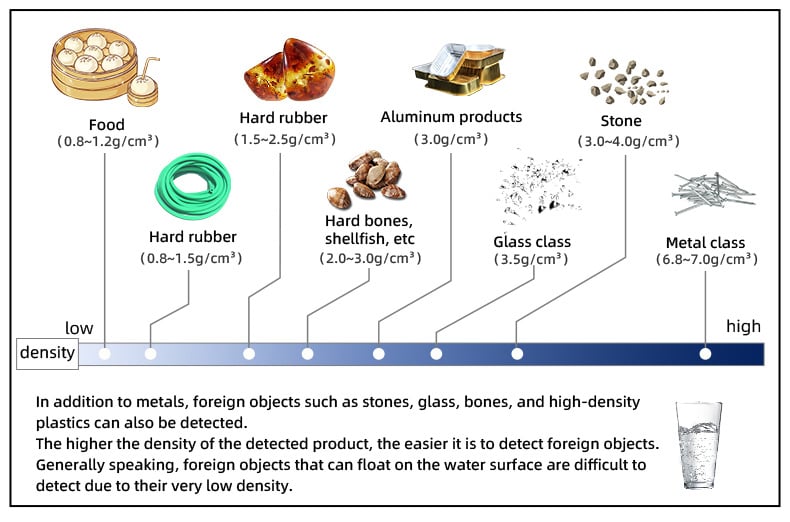
Density scale chart placing food, hard rubber, aluminium, stone, bone and shellfish, glass and metal on a low-to-high density bar
Food sits at the low end of the chart, metal at the top, with stone, glass, bone and dense plastic between.
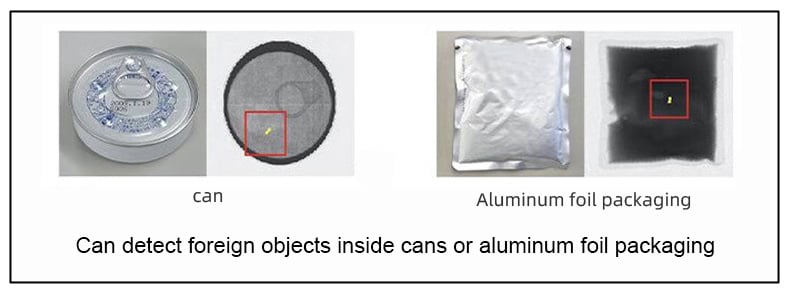
X-ray images of a can and of aluminium foil packaging, with the detected foreign object boxed in red
A can and a foil pouch: the object is inside the pack, the case a metal detector cannot take apart.
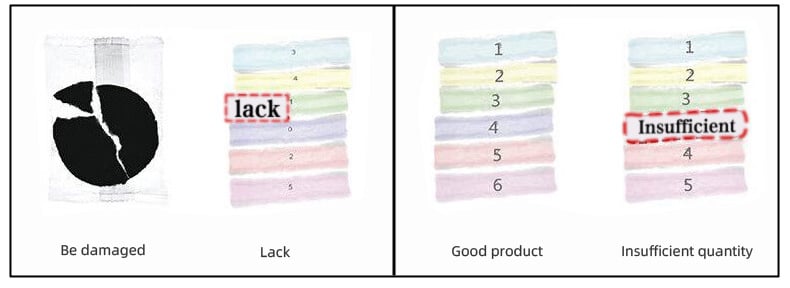
Shape and quantity detection: a damaged pack, a pack with a missing layer, a good stack and a pack with an insufficient quantity
Shape and quantity from one image: a damaged pack, a missing layer, too few inside.
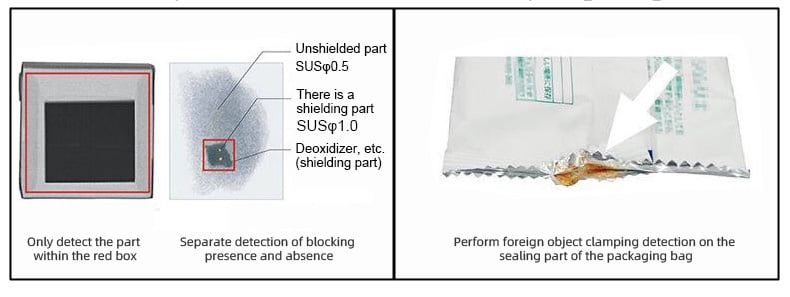
Shielding detection separating a shielding part from the unshielded part, and foreign-object clamping detection on the seal of a packaging bag
A shielded section read separately, and a foreign body caught in the seal.

How The Split 4020 Works

An X-ray tube above the belt throws a fan of radiation through the pack. A detector strip underneath reads how much gets through, and the software draws the difference as a greyscale picture: anything denser than the food around it comes out darker.

The picture is compared against the product's own settings and the machine issues a verdict; a pack that fails is signalled to the pusher on the second frame.

More than contamination comes off that pass: shape, quantity, shielded sections and the seal all come from the one image, and the run is written to the log.
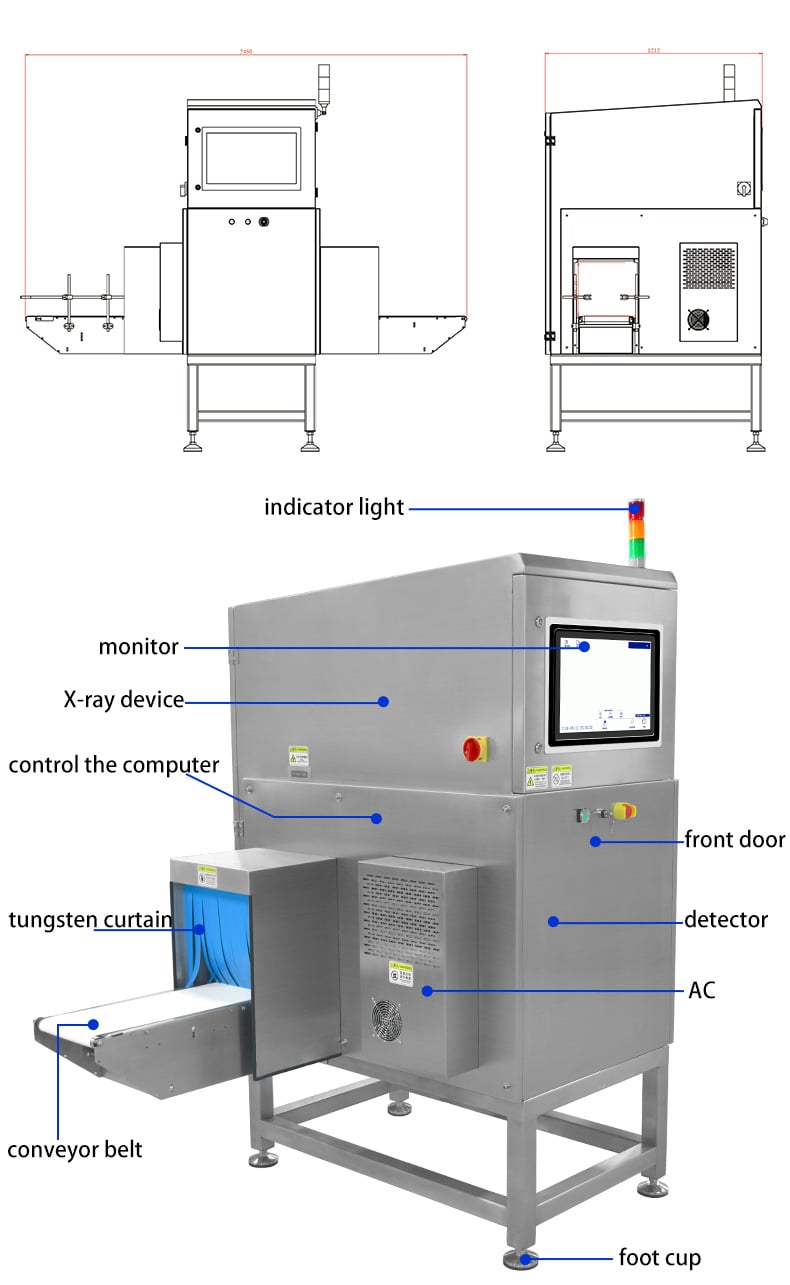
Labelled overview drawing of the machine with callouts for indicator light, monitor, X-ray device, control computer, front door, tungsten curtain, detector, AC unit, conveyor belt and foot cups
The labelled machine: indicator light, monitor, X-ray device, control computer, front door, tungsten curtain, detector, AC unit, belt, foot cups.

Where The Split 4020 Fits

The split frame earns its place when the machine has to reach a room a single 2143 mm body cannot — an upper floor, a mezzanine, or a line boxed in by other equipment. Two short frames go where one long one will not.

On the line the job is the usual one: product in, verdict out, at 10 to 70 m/min and up to 5 kg a pack. Snack bags, bakery, beverages, pharmaceuticals and large meat packs all run the same way, whatever the pack is made of.

On The Floor

Each unit is built, wired and run in at our plant in Dongguan before being split for shipping. Below: the site, and a finished machine.
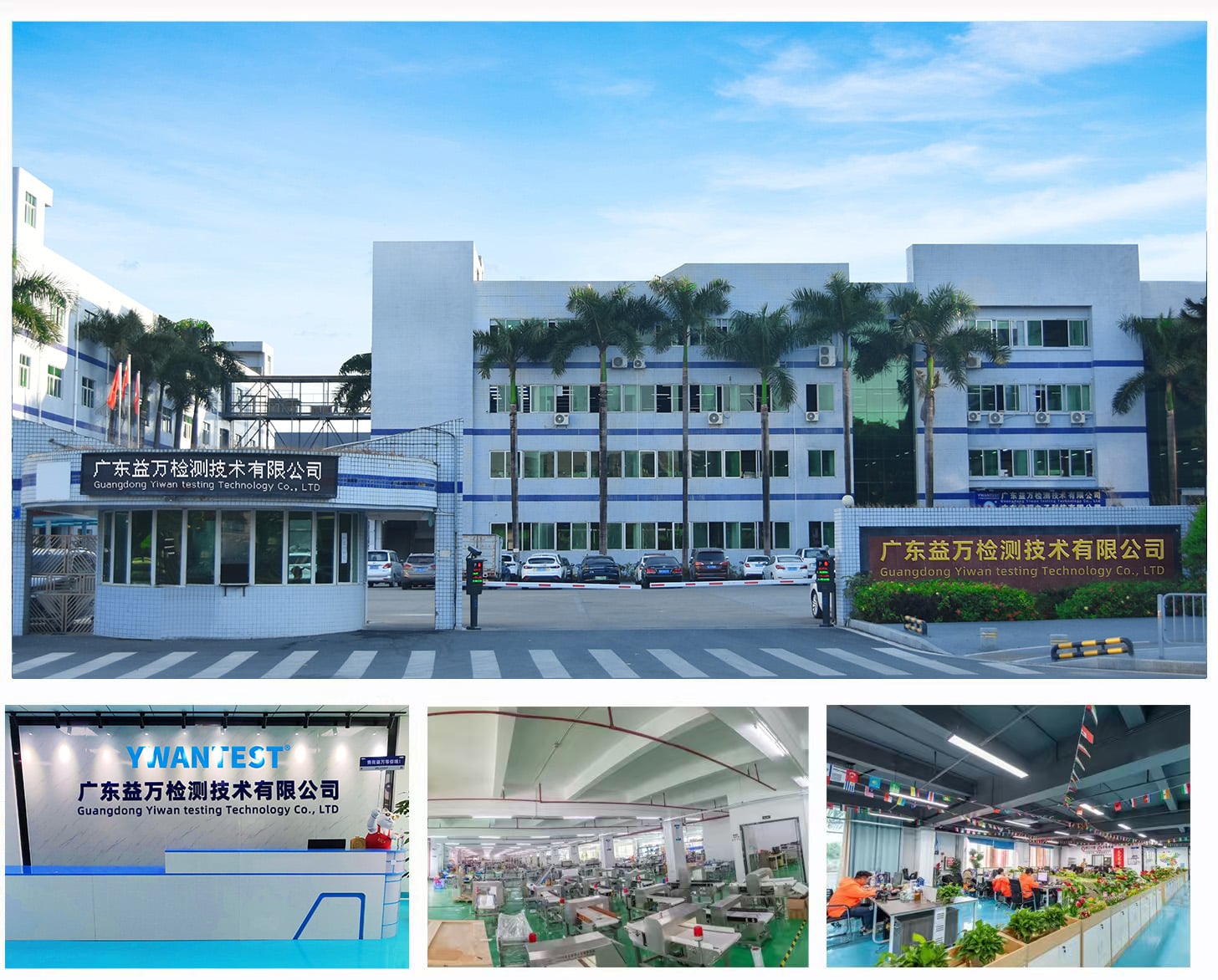
Company composite: the factory gate and office building, the YWANTEST reception desk, a large workshop with machines on the floor, and an assembly area with workers
Our own site: gate and offices, reception, the workshop floor and the assembly bays.
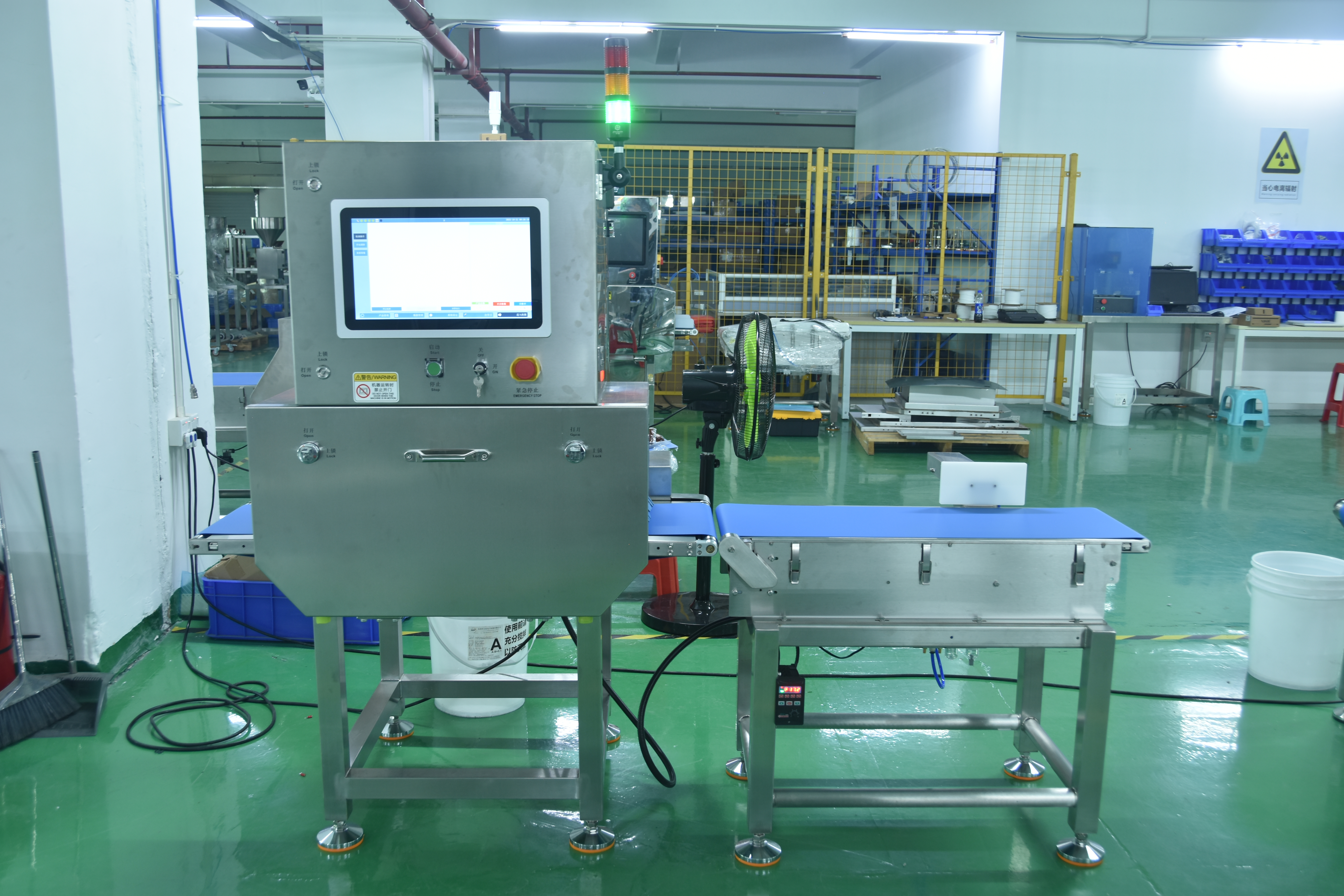
A finished CQ-YW800 4020 split-type machine on the assembly floor with the tower light lit, touchscreen fitted and the reject conveyor standing beside the cabinet
A machine through run-in, tower light lit, with the reject conveyor standing beside the cabinet.

Common Questions

What will fit through the 4020 tunnel?

The tunnel is 400 × 200 mm; the largest pack is 280 × 200 mm upright or 400 × 60 mm flat, up to 5 kg.

What does split-type mean here?

The cabinet and the reject conveyor are separate frames joined by the belt. They travel apart and are put back together on your floor.

How small an object will it find?

With an empty belt the manual gives 0.4 mm SUS 304, 1.0 mm ceramic and 2.0 mm glass. Through a hotpot-base pack the demo reports 0.8 mm SUS.

How does a failed pack leave the line?

The pusher on the second frame pushes it off the belt, downstream of the detector.

Can it check foil pouches and metal containers?

Yes. The picture is made through the pack, so the packaging does not answer for the product.

How does the data get out?

A LAN port and a USB port. Every verdict is logged against its image, and the counters are on the running status panel.

Short of room on the line? Tell us — we will size the split 4020 frame around the space you have.

Send the pack, the weight and the space you have. We will come back on fit, on where the pusher belongs, and on how the two frames go in.

E-mail [email protected] · Phone +86 185 7599 3435 · Factory: Liaobu Town, Dongguan City, Guangdong, China

GET IN TOUCH

Email Address *
Name
Phone Number
Company Name
Message *

Related Search

cq yw800 split type x ray inspection system 04mm-0
onlineONLINE