 EN



Metal Detector and Checkweigher: Combined or Separate?
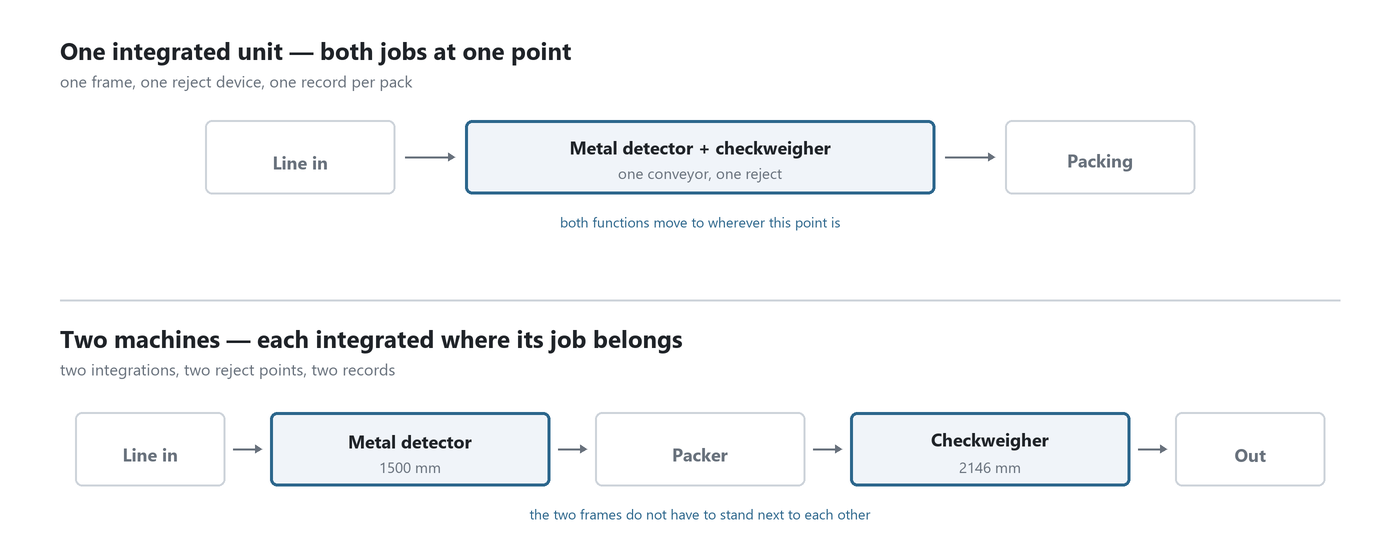
Metal detection and checkweighing are two functions. Buy them as one integrated unit and install it at one point in the line, or buy the two machines separately and integrate each where it belongs in your process. The hardware is the small half of that decision; how many times you integrate is the large half.
What you are choosing between
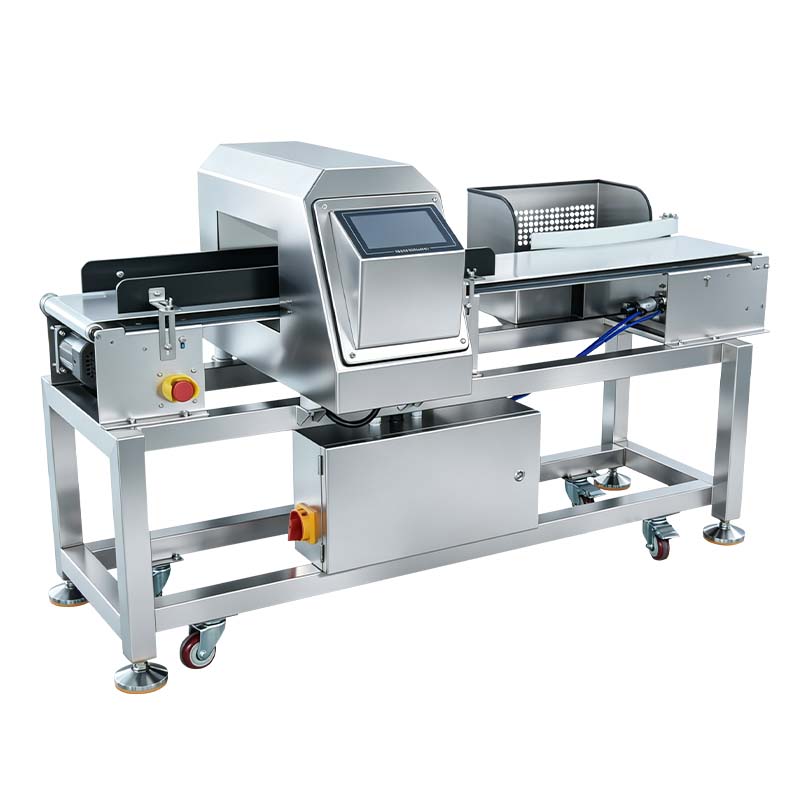
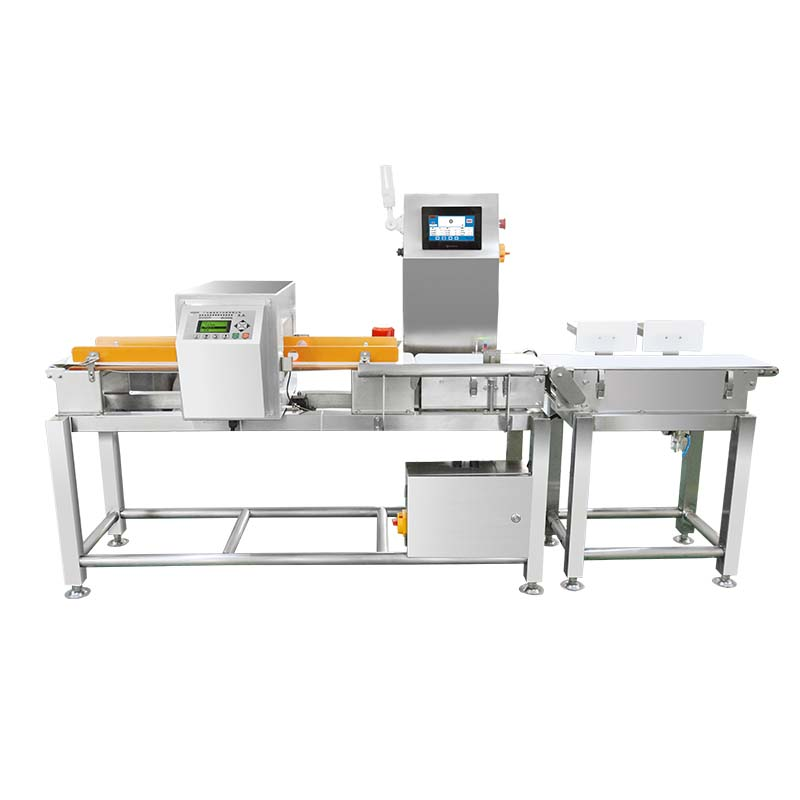
One integrated unit: a metal detector and checkweigher sold as one machine, normally sharing one conveyor, one reject device and one screen. It installs at one point, so both functions live wherever that point is. Check the drawing: some units carry two belts, which is two machines on one base.
Two machines, integrated separately: the detector goes where detection is needed, usually before the packer; the weigher where weight is verified, usually after it. Each brings its own power, air, reject device and record. If the two end up side by side, that is a layout choice, not a requirement.
| Criterion | Separate machines | Integrated unit |
|---|---|---|
| Placement | each where its function belongs | one point, fixed |
| Floor length | the sum of both frames | one frame, shorter than the sum |
| Belt drives | two, set separately | usually one |
| Reject devices | two | one |
| Screens | two | one |
| Power | two supplies | one supply |
| When one side stops | the other keeps running | both stop |
Line length: the number nobody quotes
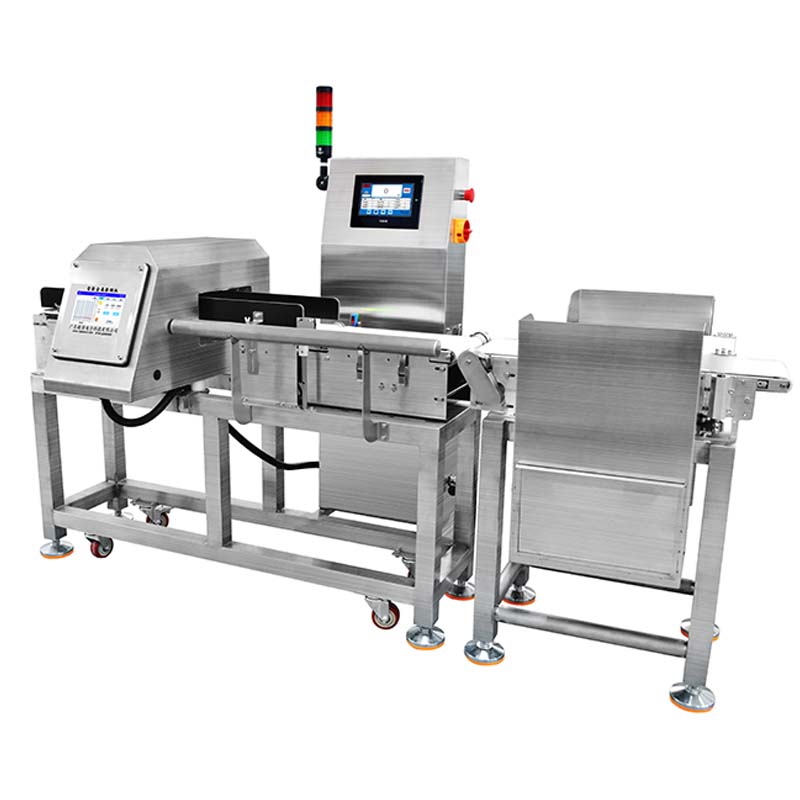
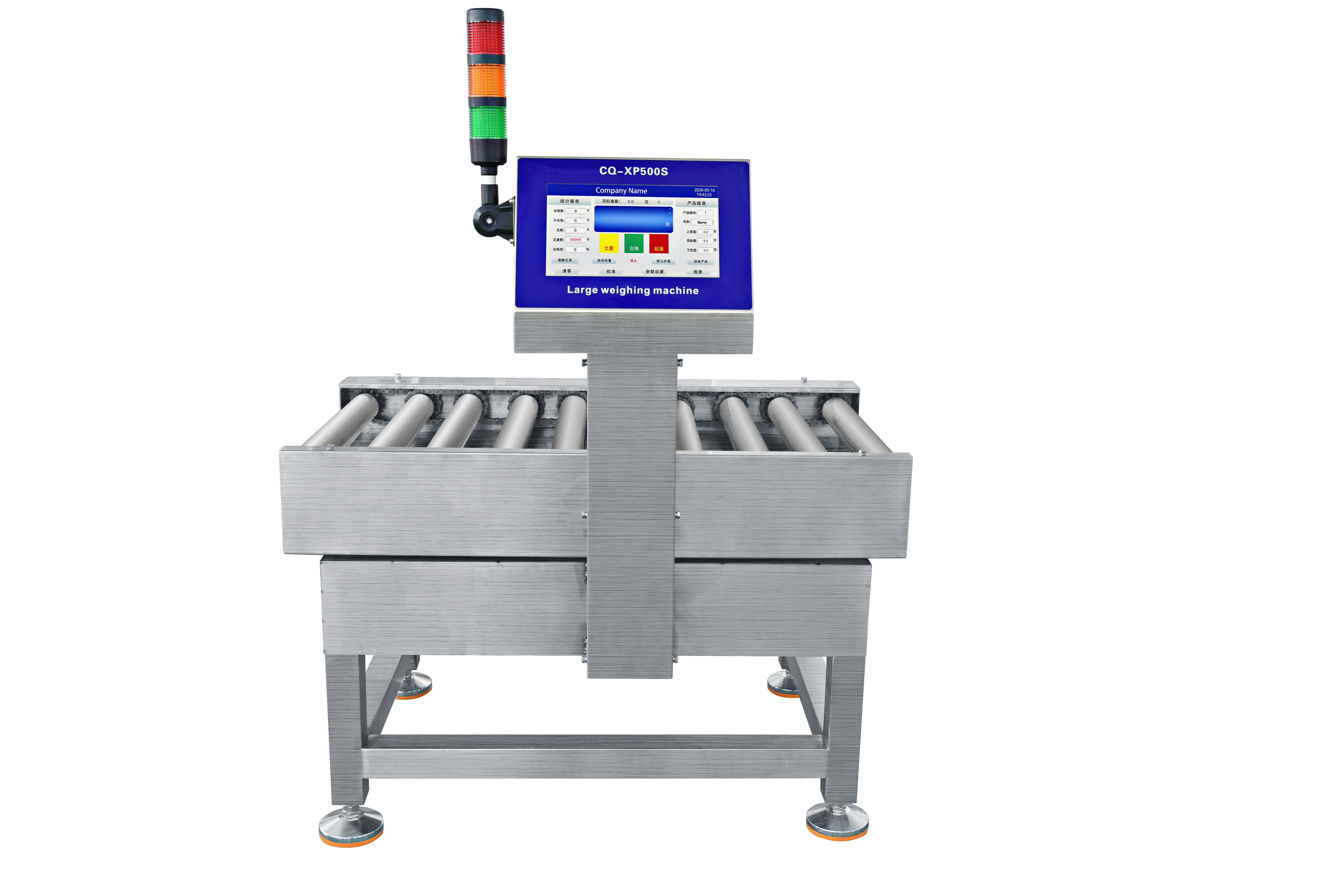
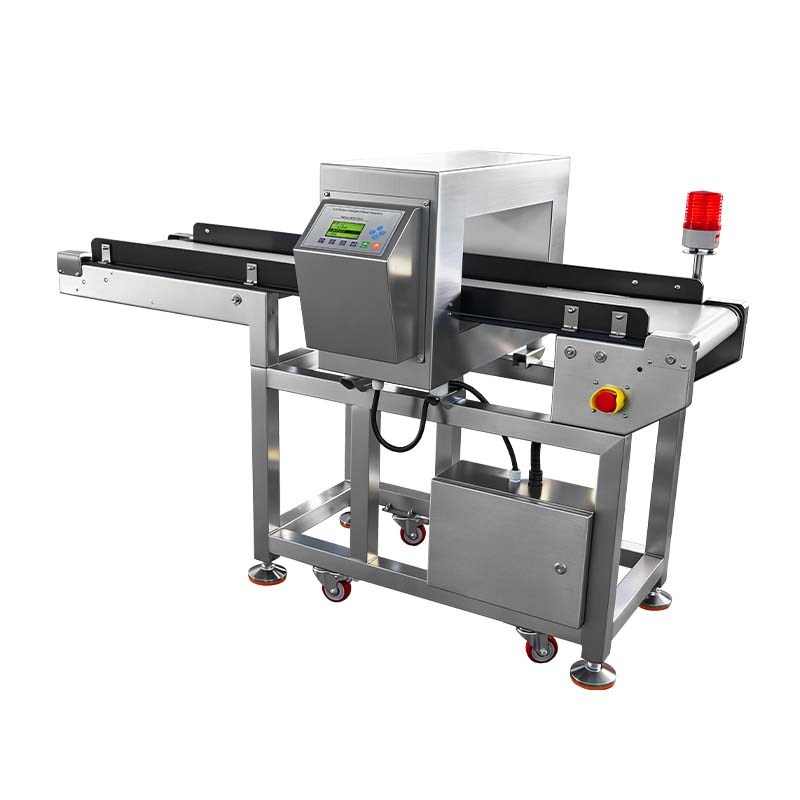
Take a metal detector and checkweigher from our own range: the CQ-YW910K is 1500 x 850 x 950 mm, and the CQ-YWXP400 is 2146 x 1110 x 1231 mm. End to end, that is 3646 mm — 3.65 m — before you count the gap between them and before either reject station. That sum only matters if you install them side by side; at different points in the process, the second integration is the cost.
Put the CQ-YW6040 X-ray system in front instead, and the run becomes 4366 mm, since that frame is 2220 mm.
A metal detector and checkweigher on one frame is shorter than that sum, but not free: length depends on tunnel size and belt width, so ask for the drawing.
The detector's belt speed is the line's speed
The 910K runs at 25 to 30 m/min, and as delivered that speed is not adjustable. A speed controller can be fitted if a buyer needs to vary it, but that is an option ordered with the machine, not a setting anyone changes on site. The XP400 adjusts from 10 to 60 m/min out of the box.
Put the two in series and the line runs inside the detector's band. If the product has to cross slower than 25 m/min, or faster than 30, the constraint sits at the metal detector, and it is settled on the purchase order, not at commissioning. A slower belt only gives the load cell more time on the pack, not less.
On one frame the sections share a conveyor, so the speed the frame is built to run is the only number in play: one machine to specify instead of two. That is the case for one unit — and against it: the frame inherits whichever section is least flexible.
Two reject devices, two places to lose a pack
In a metal detector and checkweigher pair, the 910K rejects on metal and the XP400 rejects on weight. Two criteria, two devices, two bins, two air drops, and two separate things to verify.
A metal detector and checkweigher on one frame can still carry two reject devices, or one serving both criteria — but that is a controls decision. Who decides, and in which order, has to be written down.
Either way the question from our rejection system guide comes back: is anything confirming that the pack actually left the line? A line with two reject points has twice the places for a rejected pack to sit unnoticed.
Power, air and the parts you buy twice
The 910K draws 120 W at 220 V, the XP400 draws 400 W, and on a metal detector and checkweigher line the two add up to 520 W — which is not where the money goes.
The recurring cost is in what you buy twice: belts, manuals, spare sensors and service intervals.
Air catches layouts out. The XP400's pneumatic rejection is quoted at 0.6 to 1 MPa; if both machines reject pneumatically, that is two air drops, not one — and the second is often the one nobody allowed for.
When separate machines are the better answer
A metal detector and checkweigher earn separate installations when:
- You already own one of them, and it is working.
- The duties differ: the weigher handles 60 packs a minute on one product, while the detector only sees packs from a second line.
- You want to replace or upgrade one without touching the other.
- You want detection to keep running while the weigher is down for calibration.
When one integrated unit is the better answer
- Floor space is the constraint, not throughput.
- One reject point is enough for the product.
- You want one record per pack instead of two.
- You want one screen for the operator, and one thing to train on — the usual reason a metal detector and checkweigher end up on one base.
Four questions that settle it
Settle these before you choose a metal detector and checkweigher on one frame or two.
- Where in the process does each function belong? The same point, or two points apart?
- What belt speed will you actually run? Anything outside 25 to 30 m/min means a speed controller on the order, not a setting to change later.
- How many reject points can you service and verify? Two bins is two jobs, every shift.
- What is the pack? A 450 x 390 mm carton at up to 15 kg is the XP400's ceiling, and it decides whether a checkweigher can sit in this line.
The range
Metal detection: the CQ-YW910K at 1500 mm and 25 to 30 m/min. Checkweighing: the CQ-YWXP400 at 2146 mm, 10 to 60 m/min, up to 15 kg. X-ray: the CQ-YW6040 at 2220 mm, if the line also has to see glass, bone or stone. Combined frames sit under Metal detector & Check weigher; the single-function categories are Metal Detector, Check Weigher and X Ray Machine.
Frequently asked questions
Can a metal detector and checkweigher be bought separately and paired later?
Mechanically yes, and it is where most two-machine lines come from. What you cannot add later is floor length and a second reject point, so check both before you buy the first machine.
Does a combined unit weigh as accurately as a standalone checkweigher?
Ask for the length of the weighing section and the speed it runs at. Accuracy is quoted at a steady speed, so a short section on a fast belt will not match a 620 mm section at 30 m/min.
Which machine should come first, the detector or the weigher?
Whichever runs first has to clear its reject before the next pack reaches the second machine. If the gap is too short, the second machine sees a pack that has already been condemned — or counting one that is no longer there.
Is one frame cheaper than two machines?
Usually on the frame, the drive and the screen, — not always on the reject devices. Price the reject points and installation separately; that is where the two arrangements converge.
Can one reject device serve both metal and weight rejects?
Yes, if the controls put both decisions in one place. Ask what happens when both trigger on the same pack; the answer should be one rejection, not two.
A metal detector and checkweigher, on two frames or one, is a layout decision that usually gets made by default on a quotation form. Measure the run first: 3.65 m is what two frames cost before anything is rejected, and it decides the rest.


 Hot News

 ONLINE