 EN



How to Sequence X-Ray, Metal Detector and Checkweigher
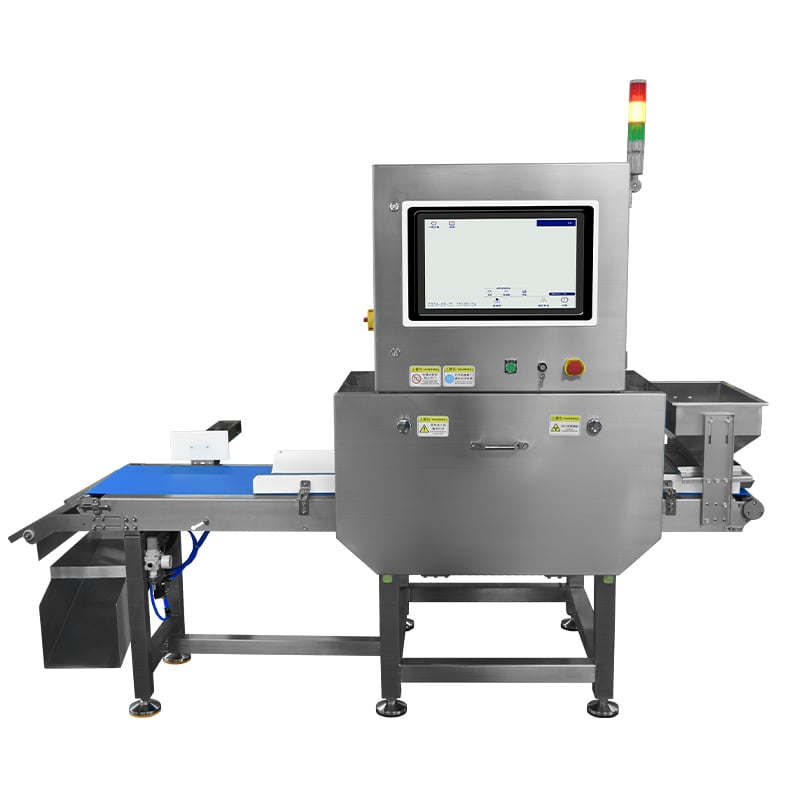
This line is two units, not three machines. The metal detector and the checkweigher share one frame, one drive and one pair of reject outlets; the X-ray stands alone with its own reject section. Three questions, two speed settings, three bins to empty.
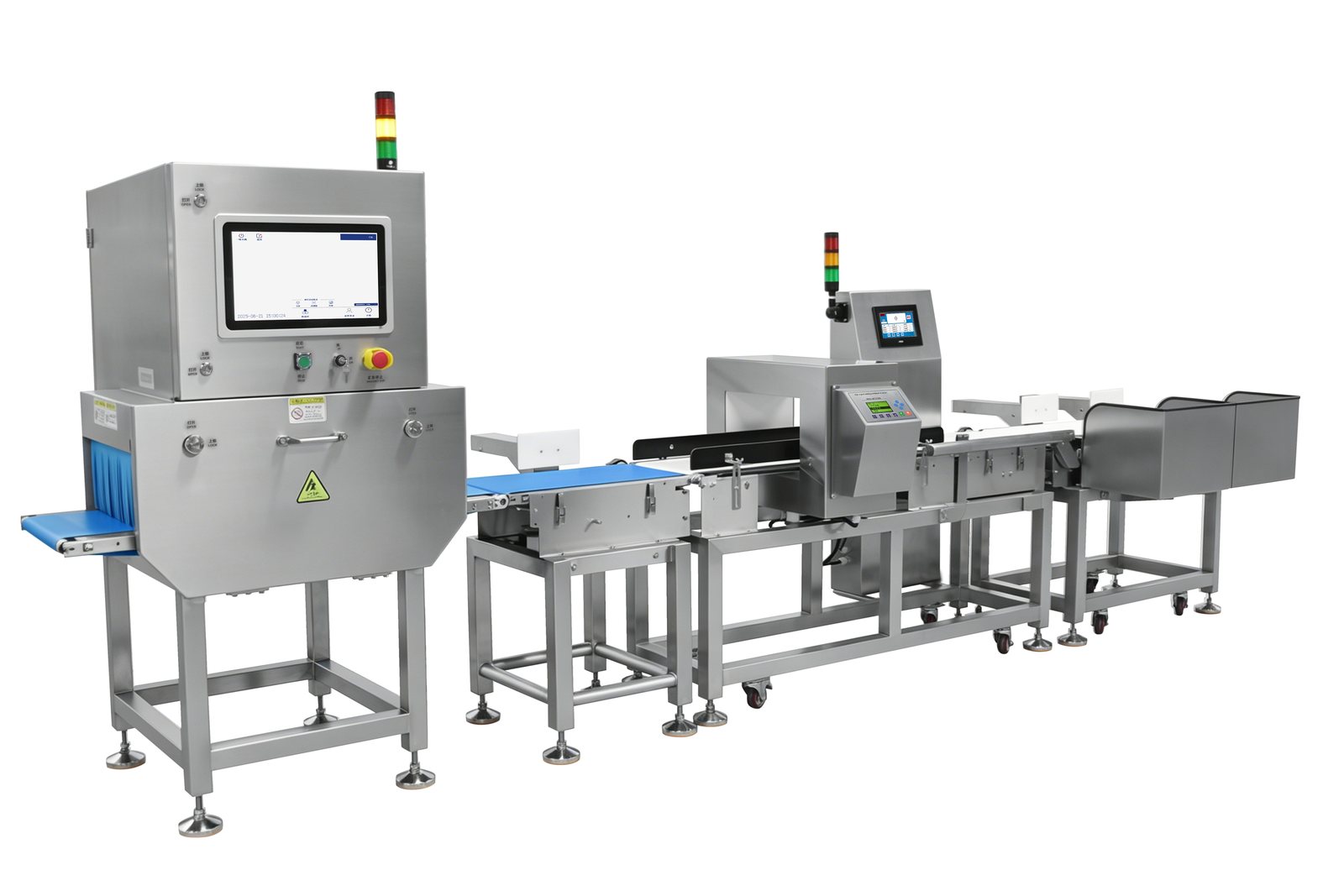
Three questions, two units
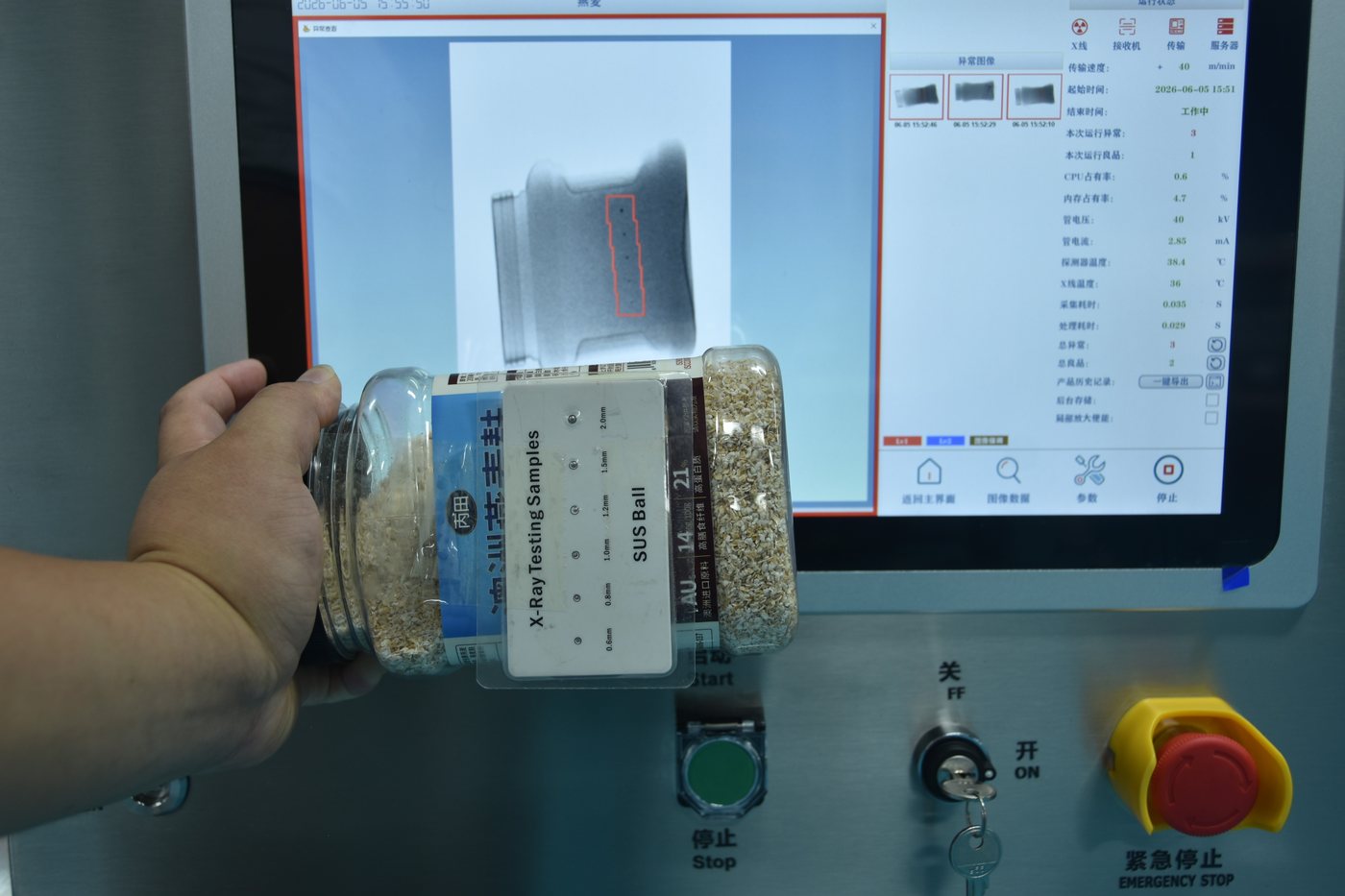
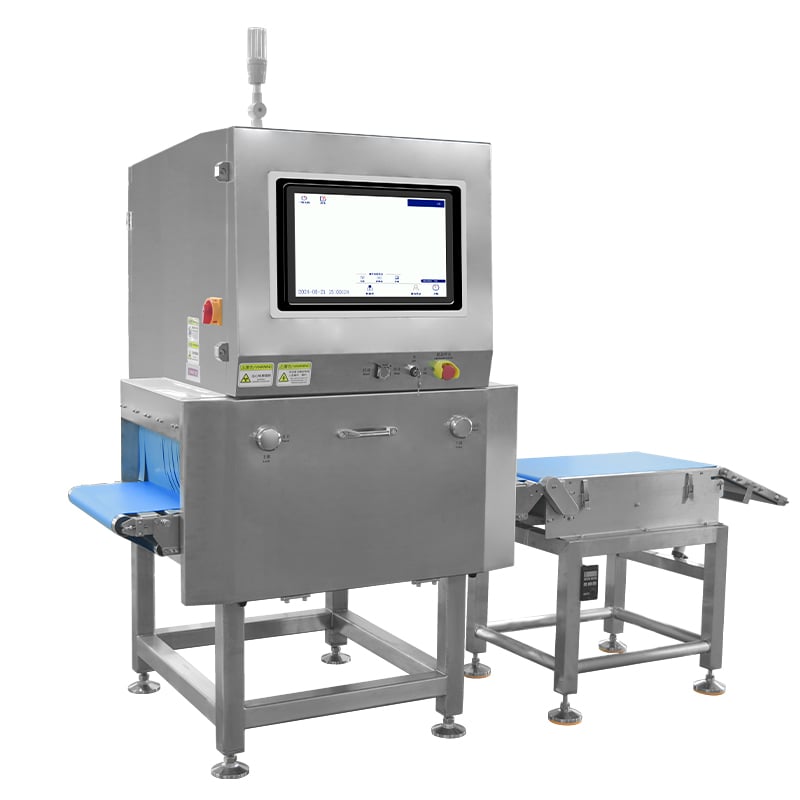
The X-ray asks what is inside the pack. It is the only one of the three that can see glass, bone, stone and high-density plastic, through foil and through the sealed pack. A metal detector sees metal; it will never see a piece of glass. On the CQ-YW800 the empty-belt floor is 0.4 mm stainless, 1.0 mm ceramic and 2.0 mm glass, and the 3015 build passes a 300 x 150 mm tunnel.
The metal detector asks whether the pack disturbs an electromagnetic field. That catches ferrous, non-ferrous and 304 stainless, including shapes the X-ray may pass. On the CQ-YW818 the answer depends on the aperture: Fe 0.8 mm at the smallest, rising to 3.0 mm at the largest.
The checkweigher asks how much the pack weighs: up to 3000 g, a 0.1 g scale, and ±0.5 to ±1 g on a pack crossing the weighing section at a steady speed.
The metal detector and the checkweigher are one machine: one infeed, one frame, one drive, and two reject outlets. That last part changes how you run the line.
The X-ray does not have to come first
Most line drawings put the X-ray at the head. It does not have to be there. Its job is narrower than "first stage": it covers the contaminants a metal detector cannot see — glass, bone, stone, dense plastic — and in a foil-sealed pack it is the only one of the two that reads anything at all. Nothing about that job fixes a position.
Four things do decide it:
- What form you inspect. A sealed pack has to be inspected after the sealer; bulk product on a belt does not.
- Where the bin can stand. At the head it sits at the infeed end; at the tail it stands beside the combined unit's two bins, three collection points in one corner.
- Retrofit. Adding an X-ray to a running line is cheapest at the tail.
- Speed. Wherever the two units meet, both belts run at one setting.
What does not move with it is the tunnel. 300 x 150 mm wherever the machine stands, and it is the gate on pack size for the line no matter how far it sits from the metal detector.
Two speed settings that have to meet
- The X-ray runs 10 to 70 m/min.
- The combined unit has one drive for both heads, set to one value.
Putting the metal detector and the checkweigher on one frame removes a variable: the pack cannot run at one speed at the detector and another at the weigh cell. On two separate machines it can, and you find out when the weights drift.
That leaves the transfer point between the units. If the X-ray outfeed runs faster than the metal detector end of the combined unit, packs arrive faster than they leave and close up at the transfer. If it runs slower, gaps open and throughput drops while neither machine is at its limit.
One number goes in the commissioning sheet: both units on the same belt speed, chosen from the pack rate you need and the steady speed the weighing accuracy is quoted at. Change one without the other and you have moved the accuracy, not the throughput.
Three reject outlets, three records
Count them: one on the X-ray, two on the combined unit — one from the metal detector, one from the checkweigher. They are not interchangeable.
The X-ray's reject section takes the pack off wherever the machine stands. That bin collects packs holding glass, bone, stone or dense plastic.
The two outlets inside the combined unit are split by cause. That split is the whole value of having two. A metal detector reject sends someone to the upstream equipment — a worn screen, a broken blade, a bolt. A weight reject sends someone to the filler. One shared bin turns both into "rejected", and the operator guesses which line to walk to.
Three things to check before the machine ships:
- The screen records which outlet fired, not just that a reject happened.
- The bins are physically separate, so the shift count matches the record.
The gap between the units
The distance between the two units — from the X-ray's reject box to the other unit's infeed — is set by the reject, not by the floor plan.
The pack has to be off the belt and into the bin before the next pack reaches the same point. A short gap and a fast belt mean the pusher meets the following pack, or two packs land in one bin and the count drifts.
So the gap is a function of belt speed and reject actuation time, and it has to be settled before the frames are welded. Ask for a drawing with the transfer point dimensioned.
Power, air, and what you buy twice
The X-ray needs its own supply circuit. The combined unit carries a 120 W metal detector and a 400 W checkweigher on one frame, and its pneumatic rejects run on 0.6 to 1 MPa external air.
So: two power drops, and two air drops if both units reject pneumatically. Two sets of belts, two manuals, two service intervals.
Integration did not remove the second reject decision — that still lives inside the machine, at two outlets.
| Unit | Question it answers | What to specify |
|---|---|---|
| X-ray | glass, bone, stone, dense plastic | tunnel 300 x 150 mm, fixed |
| Metal detector, in the combined unit | ferrous, non-ferrous, 304 stainless | smallest aperture that clears the tallest pack |
| Checkweigher, in the combined unit | weight, fill, missing item | pack ≤300 x 290 mm, ≤3000 g |
What to specify, in one pass
For the X-ray: the tunnel against your tallest pack. The 3015 tunnel is 300 x 150 mm, and a taller pack needs a different tunnel, not a faster belt.
For the metal detector: the aperture. Sensitivity moves from 0.8 mm to 3.0 mm across the 818's range, so a taller tunnel than you need gives away sensitivity for nothing.
For the checkweigher, downstream of the metal detector in the same frame: pack footprint first. A 300 x 290 mm pack on a 450 x 300 mm belt is the ceiling.
The range
X-ray: CQ-YW800. Metal detector: CQ-YW818. Checkweigher: CQ-YWXP300. Category pages: X Ray Machine, Metal Detector, Check Weigher.
Frequently asked questions
Do I need all three, and which comes first?
There are only two units on this line: the metal detector and the checkweigher are already one machine. The real question is whether you need the X-ray. If weight and metal are your control points today, start with the combined unit and add the X-ray when a customer asks about glass or bone, or when you move into foil.
Does the X-ray have to go first?
No. It fills the gap the metal detector leaves, so its position is a layout choice. Put it where the bin can be reached and where the pack is in the form you want inspected.
Do both units have to run at the same speed?
At the transfer point, yes. Pick one value, and pick it from the weighing accuracy you need and the pack rate you want.
Can the metal detector and the checkweigher share one reject bin?
Yes, and you lose the ability to tell a metal fault from a filling fault. Two outlets, two bins, two counts.
What is the biggest pack the line can take?
The X-ray tunnel is the fixed gate at 300 x 150 mm. The metal detector's aperture can be sized to suit; the tunnel cannot.
Two units in a row is not two purchases. It is one layout decision, one speed decision and one reject decision — and the reject decision is the one you make three times.

 Hot News


 ONLINE