 EN
EN



Checkweigher Accuracy vs Capacity: Pick the Right Model
Most enquiries open the same way: a 500 g pack.
The weight is the easy half. The half that matters is how much that 500 g is allowed to vary. A tolerance of 3 g and a tolerance of 20 g are two different inline checkweighers, and both fit on the same frame. One of them holds an accuracy band of ±0.2 to 0.5 g; the other holds ±1 to 3 g.

What an Inline Checkweigher Actually Measures
While the product crosses the weigh deck, an inline checkweigher records how much the load-cell signal changes, and compares that change against the tolerance you set. Belt speed, infeed spacing and how steadily the product sits are all there to make that comparison repeat.
The same machine sells as a dynamic checkweigher, and plenty of buyers come to us asking for a weight checker. On a packing line it is one instrument with one accuracy band.
The small model cannot carry a 30 kg carton, and a load cell built for 30 kg will not resolve 0.05 g either. The big model cannot see small deviations: on a 500 g pack missing 2 g, those 2 g sit under the noise floor of that capacity band. An inline checkweigher is therefore picked from the deviation backwards, never from the maximum weight forwards.
The Six-Model Accuracy Ladder
As capacity climbs, the accuracy band widens and the belt slows down. The three figures move together, and no supplier can sell you all three at once.
The accuracy column covers a range. The tight end needs a steady product paired with the right belt speed; a product that is light, tall or irregular lands nearer the wide end.
One thing the table does not show: of the six inline checkweighers, only the smallest uses air-blow rejection, and only that one is built to IP54. Light products need a faster, gentler reject than a pusher, and the lines that get washed down tend to be running exactly those products.
Capacity on an inline checkweigher is a ceiling per item rather than a throughput figure. The 40 kg and 60 kg models are both rated 30 pcs/min, and the belt sets that ceiling, not the load cell.
| Model | Max weight | Accuracy | Min scale | Max speed | Material size |
|---|---|---|---|---|---|
| CQ-YWXP1010 | 200 g | ±0.05–0.1 g | 0.05 g | 100 pcs/min | 100 × 100 mm |
| CQ-YWXP210 | 1,500 g | ±0.2–0.5 g | 0.1 g | 160 pcs/min | 280 × 200 mm |
| CQ-YWXP300 | 3 kg | ±1–3 g | 1 g | 80 pcs/min | 300 × 290 mm |
| CQ-YWXP400 | 15 kg | ±2–10 g | 1 g | 60 pcs/min | 450 × 390 mm |
| CQ-YWXP500 | 40 kg | ±5–30 g | 1 g | 30 pcs/min | 650 × 490 mm |
| CQ-YWXP600 | 60 kg | ±30–100 g | 1 g | 30 pcs/min | 650 × 490 mm |
Which Model for Which Line
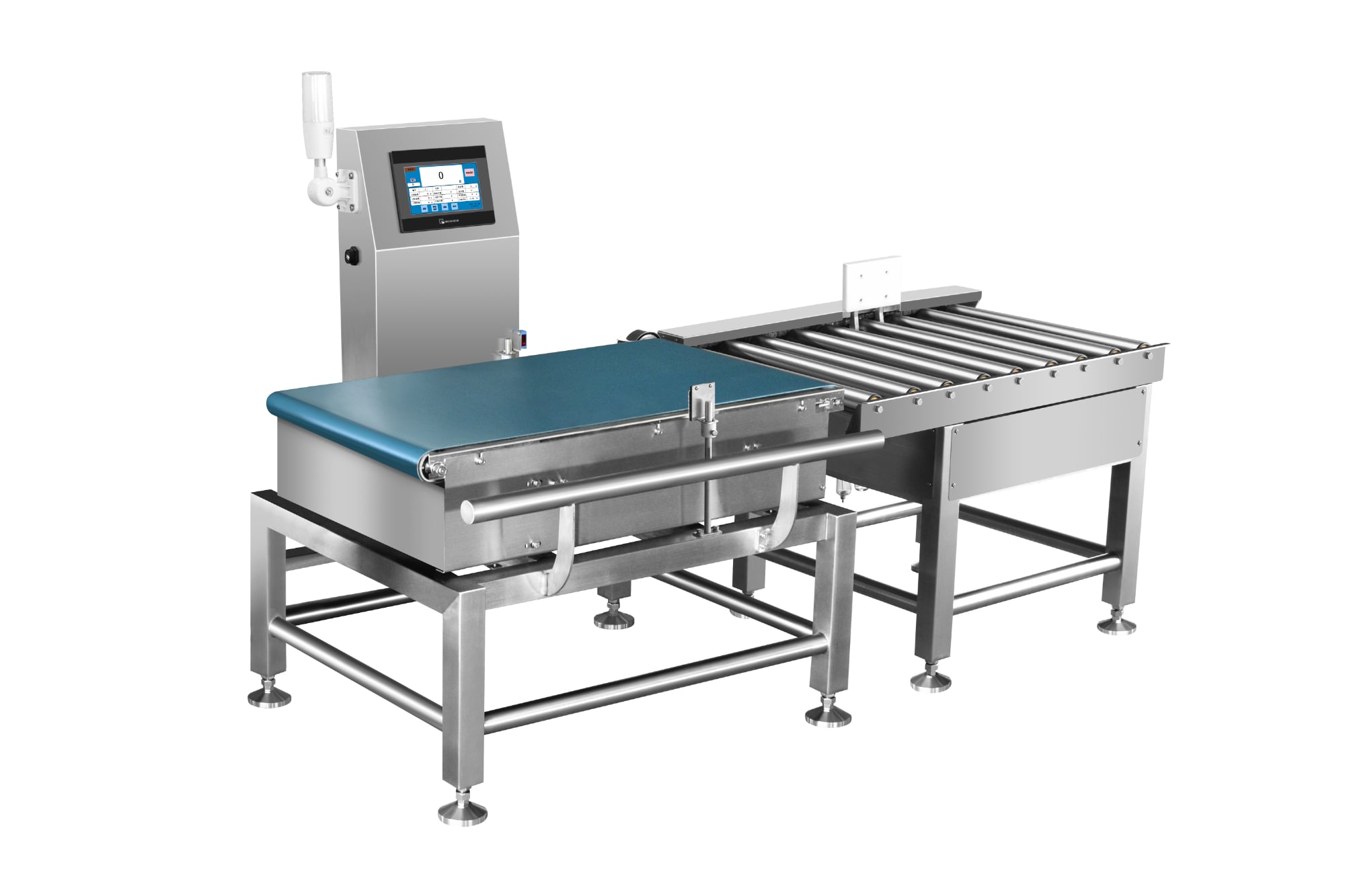
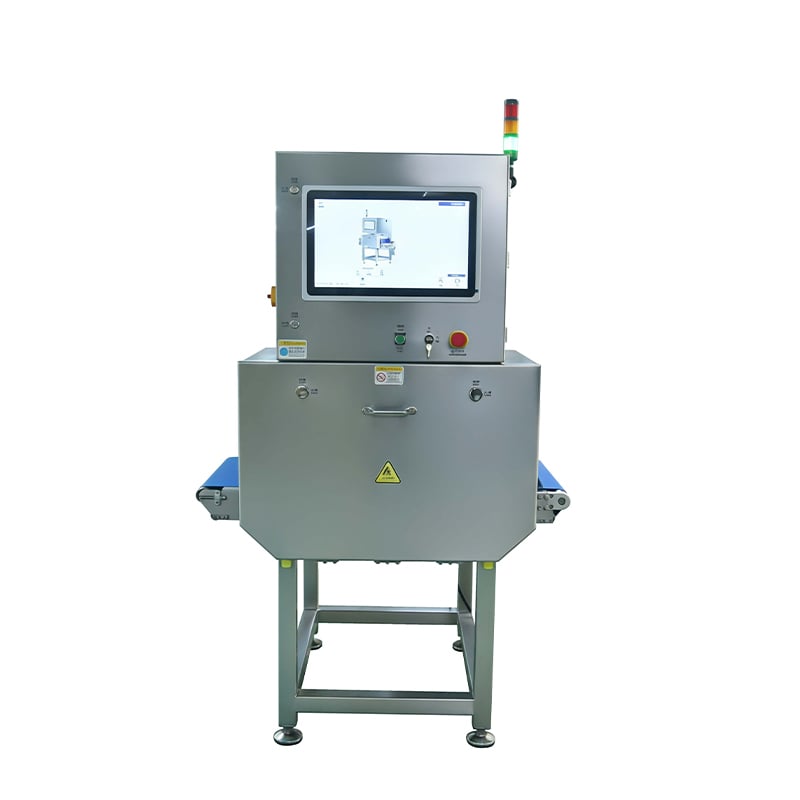
The inline checkweigher at the top of this page is the CQ-YWXP400, the workhorse of the middle range and the one most lines end up with. The other five are below, smallest first.



Accuracy Is Settled Before the Weigh Deck
We have two inline checkweighers with the same frame, the same belt and the same load cell, and their accuracy bands differ by a factor of three. The difference is what the belt does between the infeed and the weigh deck.
*Belt speed.* The signal is sampled while the product is on the deck. Run the belt fast and fewer samples fall inside that window; run below the ceiling and you get the tight end of the accuracy band. Matching belt speed is always the first step at commissioning, and it is why we wrote a separate note on it.
*Infeed spacing.* An inline checkweigher weighs one item at a time. Close the gap and two products share the deck, so the reading belongs to neither. The false rejects we hear about usually trace back to infeed spacing rather than to the rejector.
*Product stability.* A bag that shifts on the belt changes its own inertia. Guides, a short flight on the infeed and a settling run before the deck all take floor space, and they usually move the reading more than a change of model does.
*Leveling.* Every inline checkweigher we build sits on adjustable feet rather than castors. A frame that is not levelled takes the reading with it, and "it weighs wrong" often turns out to be a foot that was never adjusted.
Where an Inline Checkweigher Specification Goes Wrong
- Quoting an inline checkweigher's accuracy without its capacity band. "±0.1 g" on its own means nothing, because ±0.1 g at 200 g and ±0.1 g at 60 kg are not the same instrument.
- Leaving capacity headroom for later. The extra kilograms cost accuracy today, on every pack, for a product you may never run. If that product does arrive, split the line instead.
- Assuming the rejector keeps up. At 160 pcs/min there are 375 ms between items, and the reject has to fire and reset inside that window.
- Sizing the belt for the largest pack. Material size sets belt width, and belt width sets floor space and price. A line that mostly runs 100 mm sachets should not be sized around an occasional 650 mm case.
Frequently Asked Questions
How accurate is an inline checkweigher?
From ±0.05 g at the 200 g band to ±100 g at 60 kg. The capacity band decides it, not the brand: our smallest model resolves 0.05 g, and the 60 kg model will not do better than 30 g.
Can one inline checkweigher handle both sachets and cartons?
We would not advise it. Pick by the product you run most. A 15 kg model cannot resolve a 0.1 g deviation on a sachet, and the 200 g model cannot carry a 15 kg box.
How fast will an inline checkweigher run?
160 pcs/min on the CQ-YWXP210, and 30 pcs/min on the 40 kg and 60 kg models. The belt sets that ceiling, and you have to run below it to reach the tight end of the accuracy band.
Does an inline checkweigher need compressed air?
Yes. Every rejector needs clean, dry air at 0.6–1 MPa. The smallest model uses an air blow, and the other five use a pusher.
What do you need to quote an inline checkweigher?
Pack weight and tolerance, line speed, the belt width you already have, where the reject goes, and whether the area gets washed down. That last answer fixes the protection level.
What you are really choosing with an inline checkweigher is how small a deviation it will catch, and the capacity band fixes that.
Send us the pack weight, the tolerance and the line speed, and we will tell you which model holds that figure, or that you need two inline checkweighers. All six are compared on our check weigher page.

 Hot News

 ONLINE